


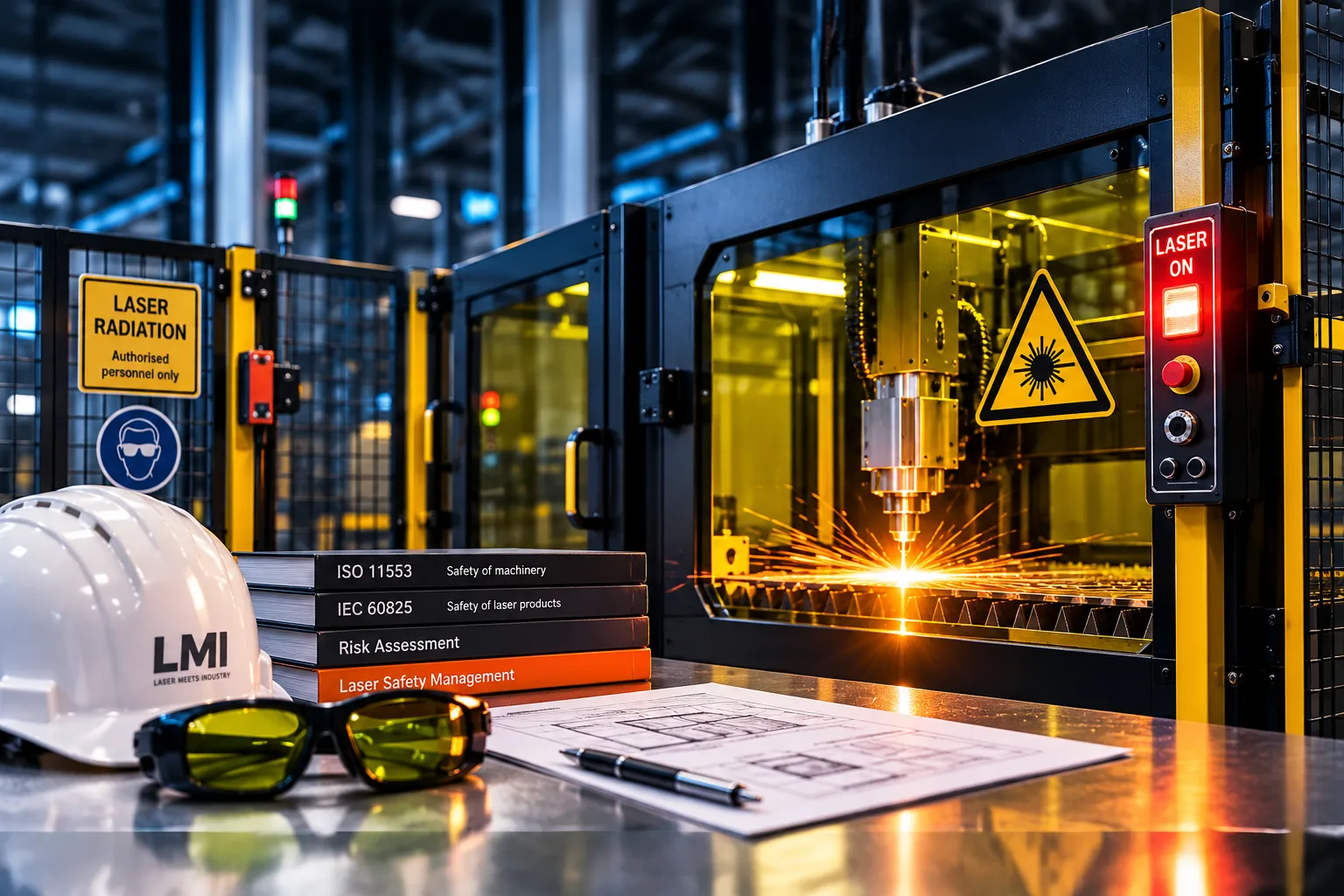
Laser Safety for Industrial Laser Systems
Laser safety is an essential part of every industrial laser installation. An effective safety solution needs to take into account the characteristics of the laser, the process, the design of the machine and how people work in and around the equipment.
LMI AB helps companies analyse, plan and improve laser safety in both new and existing laser installations. Our work can include everything from risk assessment and safety concepts to the selection and integration of technical safeguards, training and follow-up.
The objective is a safety solution where technology, working procedures and personnel competence work together.
Risk Assessment and Analysis of Laser Installations
An effective safety solution starts with understanding the risks associated with the specific installation.
An assessment may take into account factors such as:
- laser type, wavelength and power
- laser class and possible access to laser radiation
- direct, reflected and scattered radiation
- the laser process
- the design of the machine or laser installation
- access to hazardous areas
- service and maintenance situations
- operator tasks and working procedures
- existing safety functions and protective measures.
The assessment provides a basis for determining which technical and organisational measures should be considered.
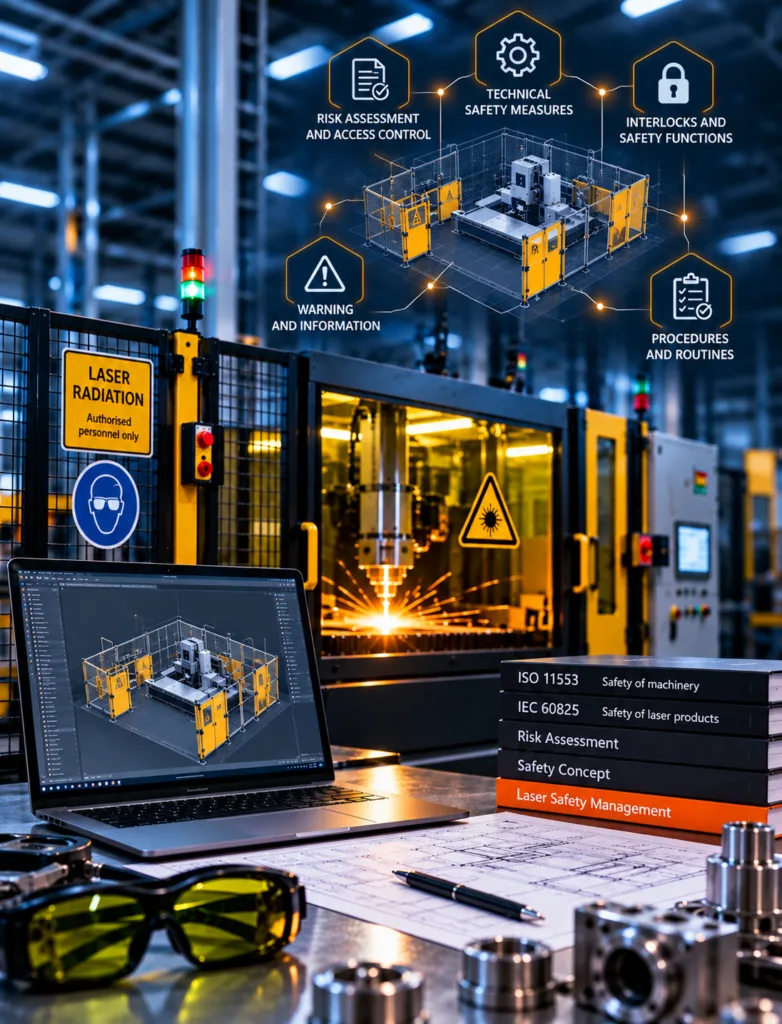
Safety Concepts for New and Existing Laser Systems
Laser safety should be an integral part of a laser installation rather than something added afterwards.
For new installations, LMI AB can help develop the safety concept during the planning stage. For existing installations, we can analyse the current solution and identify areas where safety measures may need to be supplemented or modified.
A safety concept may include:
Hazardous areas and access
How should the area surrounding the laser process be restricted, and who needs access?
Technical safeguards
Which barriers, enclosures and safety functions are required for the specific installation?
Interlocks and safety functions
How should doors, service panels, emergency stops and other functions interact with the laser system?
Warnings and information
How should the status of the installation and potential hazards be communicated to operators and other personnel?
Working procedures
Which procedures are required during normal operation, servicing, maintenance and other situations where operating conditions may change?
Technical Laser Safety Solutions
Technical safeguards are a central part of laser safety and should, wherever possible, prevent people from being exposed to hazardous laser radiation.
LMI AB works with complete solutions and components for industrial laser safety, including:
- laser safety enclosures and cells
- laser safety curtains and barriers
- laser safety windows
- interlock systems
- safety switches and access control
- active and passive warning systems
- laser safety roller blinds
- warning signs and labels
- personal protective equipment.
The appropriate safeguards depend on the laser, the process and the design of the installation. Warning systems and personal protective equipment do not replace technical safeguards but form part of the overall safety solution.
Upgrading Existing Laser Installations
Laser safety should also be reviewed whenever an existing installation is modified.
This may be necessary when:
- a new or more powerful laser source is installed
- a different wavelength is introduced
- the laser process changes
- the machine is modified
- automation or robotics are added
- material handling changes
- new openings or access points are introduced
- working procedures or applications change.
LMI AB can review the existing installation and assess which parts of the safety solution may need to be adapted.a delar av säkerhetslösningen som behöver anpassas. Det här tycker jag är ett viktigt avsnitt eftersom det tydliggör att tjänsten inte bara är relevant när någon köper en ny maskin.
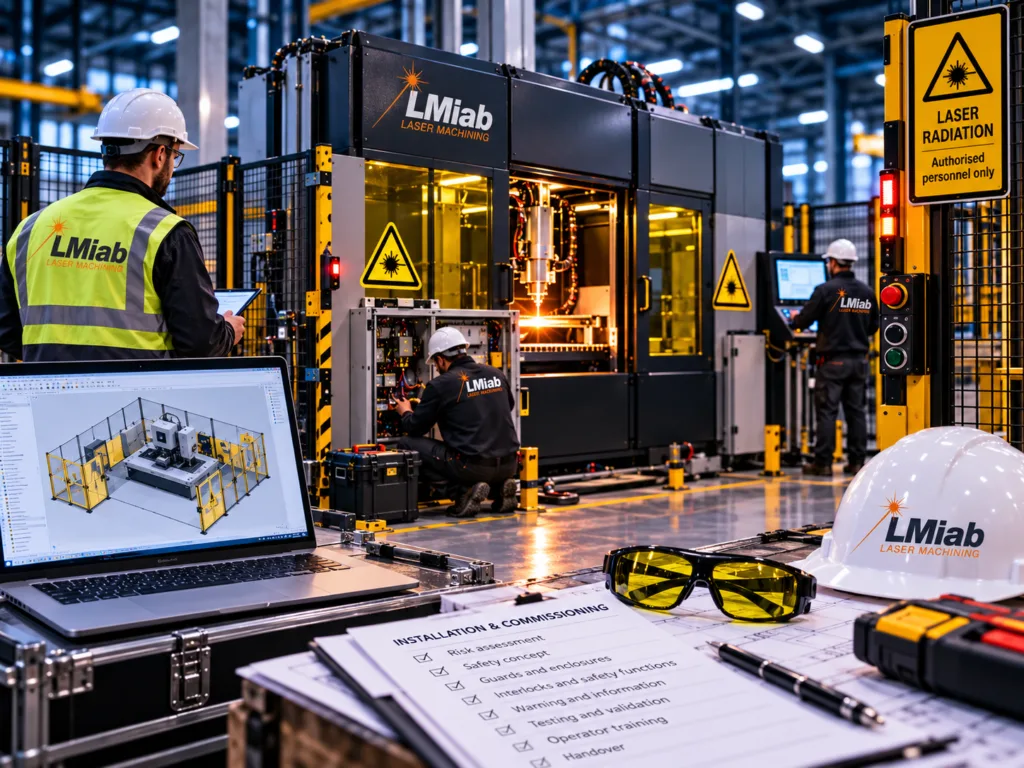
Laser Safety During Installation and Commissioning
When a new laser system is installed, its safety functions need to work together with the machine and the environment in which the equipment will operate.
LMI AB can integrate laser safety as part of the installation and commissioning process.
This may include checks of enclosures and access points, interlock functions, warning systems, labelling and other safety functions included in the specific solution.
In this way, laser safety becomes a natural part of the transition from installation to production.
Training as Part of Laser Safety
Technical safeguards work best when they are combined with personnel who understand the hazards and know how the equipment should be used.
LMI AB therefore provides laser training with a particular focus on laser safety, including training for operators and personnel with specific responsibility for laser safety, such as a Laser Safety Officer (LSO).
Training can be adapted to the equipment, organisation and roles of the participants.
Learn more about our Laser Training →
From Risk Assessment to an Effective Safety Solution
Analysis → Risk Assessment → Safety Concept → Protective Measures → Implementation → Training
A laser safety solution needs to reflect the actual installation. LMI AB therefore considers the laser and process as well as how the machine is used, who may come into contact with the equipment and which situations may occur during operation and servicing.
The result is an integrated solution where technical safeguards, safety functions, procedures and training complement each other.
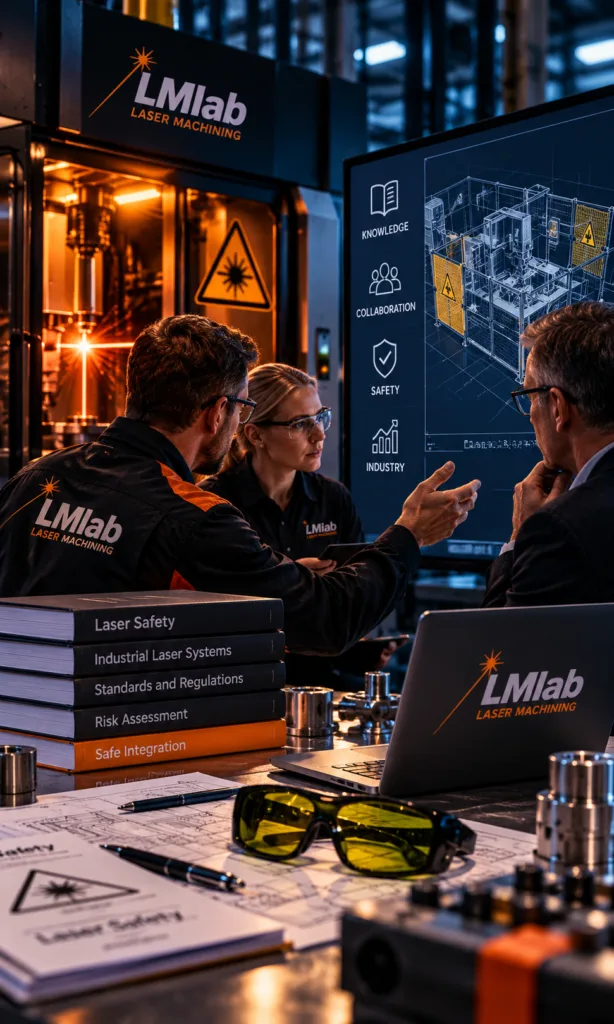
Knowledge and Experience in Industrial Laser Safety
LMI AB has extensive experience of laser safety as an integral part of industrial laser systems and works with Lasermet Ltd., a specialist in laser safety solutions. LMI AB is a distributor for Lasermet in Sweden and Norway.
LMI AB also participates actively in Swedish industry initiatives relating to laser safety. In 2026, LMI AB hosted the Lasergruppen laser safety meeting, where industry representatives continued their work on areas including training guidelines, daily inspections, incident analysis and common recommendations for laser safety in Swedish industry.
This combination of practical experience with laser installations, safety systems, training and industry-wide safety initiatives provides a broad foundation for helping customers create effective laser safety solutions.
Learn More About Laser Safety
For those who want to learn more about laser classes, hazards, safety principles and different protective measures, we have collected more detailed technical information in our Knowledge Centre.
This allows this service page to focus on how LMI AB can help, while our Knowledge Centre provides the underlying technical information.

Do You Need to Review Your Laser Safety?
Do you have an existing laser installation that needs to be reviewed, are you planning a new installation, or do you need help developing a laser safety solution?
Contact LMI AB and we can review your laser equipment, application and working environment together and discuss suitable measures for your installation.
Tim Smith
Contakt person for Laser safety
Please briefly describe your laser installation and what you would like us to help you with. If possible, include the laser type, wavelength, power, laser process and whether it is a new or existing installation. We will contact you to discuss the next step.
Services – Laser training
"*" indicates required fields