


Laser Safety Enclosures
Laser safety enclosures are a central part of laser safety in industrial laser systems. By enclosing all or part of the laser process, hazardous direct, reflected and scattered laser radiation can be contained within a controlled area. An enclosure can range from a small standalone workstation to a complete safety cell surrounding a robotic laser process.
When correctly designed, a laser safety enclosure combined with safety systems, interlocks, laser safety windows and other protective measures can provide a safe working environment even around high-power laser processes.
What is a laser safety enclosure?
A laser safety enclosure is a physical barrier between the laser process and its surroundings. Its purpose is to prevent laser radiation that could pose a risk to the eyes or skin from reaching people outside the designated laser area.
The enclosure may surround only the laser process itself or a larger area containing robots, fixtures, material handling equipment and other production machinery.
The design therefore depends both on the characteristics of the laser and on the process itself. A compact laser marking station has very different requirements compared with, for example, a robotic high-power laser welding system.
Why enclose a laser process?
For industrial systems using high-power lasers, relying solely on personal protective equipment is generally not sufficient. An important principle of laser safety is to minimise the possibility of people being exposed to hazardous laser radiation in the first place.
Physical containment can define the hazardous area and control access to it. A properly designed enclosure can:
- prevent direct laser radiation from leaving the process area
- protect against hazardous reflections and scattered laser radiation
- restrict access to the hazardous area
- integrate with doors, gates and interlock systems
- allow safe observation through laser safety windows
- be adapted to machinery, robots and material flows.
The objective is to create a safety solution that allows the laser process to operate without exposing people outside the enclosure to hazardous laser radiation.
From compact enclosures to complete laser safety cells
Laser safety enclosures are available in many different configurations.
For smaller laser systems, a compact enclosure surrounding the working area may be sufficient. These solutions can be suitable for laser marking, smaller processing systems or laboratory applications.
Larger industrial installations may instead require a complete laser safety cell incorporating walls, a roof, doors, observation windows and safety monitoring. Modular enclosure systems allow the solution to be configured around the specific process. They can also make it easier to modify or expand the installation as production requirements change.
Passive and active laser protection
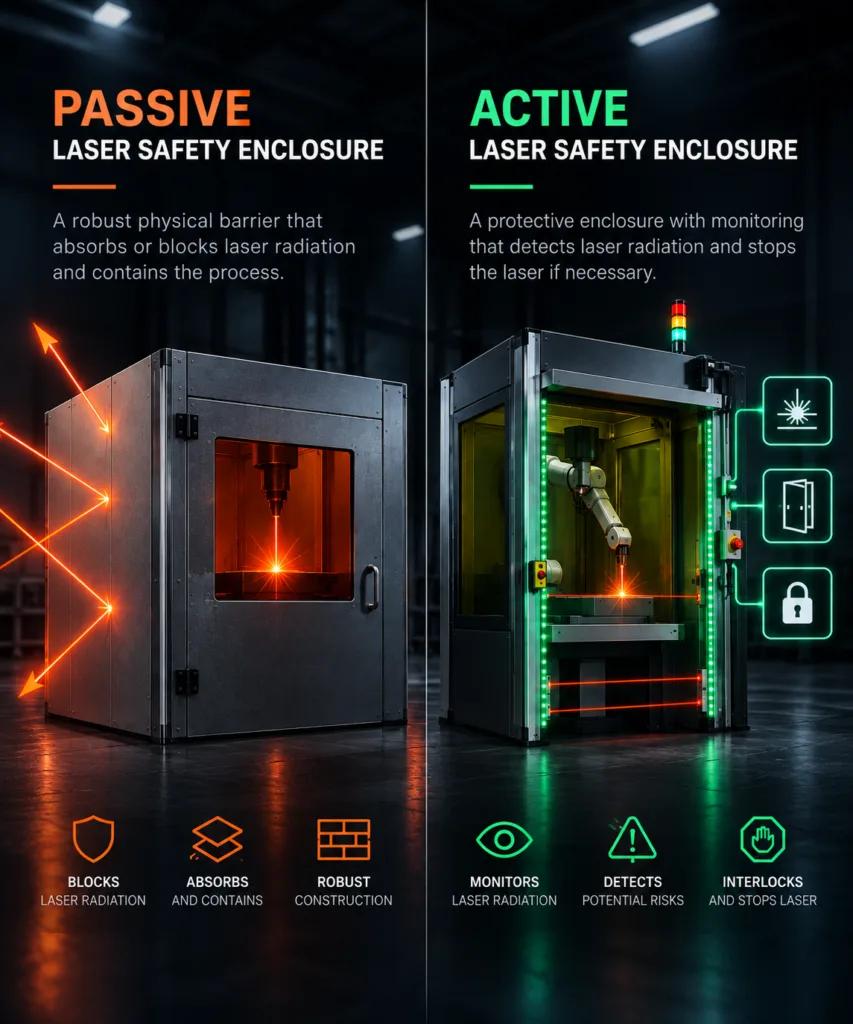
Laser safety enclosures can use passive or active laser protection.
Passive laser protection
Passive protection relies on the enclosure material being capable of absorbing or blocking laser radiation under the conditions for which the system has been designed.
Factors such as laser wavelength, power, potential exposure time and power density must be considered when specifying the protective barrier.
Active laser protection
Active laser protection adds monitoring to the physical barrier. The system can detect when laser radiation strikes the protective surface in a way that could damage or penetrate the barrier.
The active protection system can then be connected to the safety circuit of the laser installation so that laser emission is interrupted.
This can be particularly relevant for high-power laser systems, where a focused or partially focused laser beam can transfer a large amount of energy to the enclosure material within a short period of time.
Doors and interlock systems
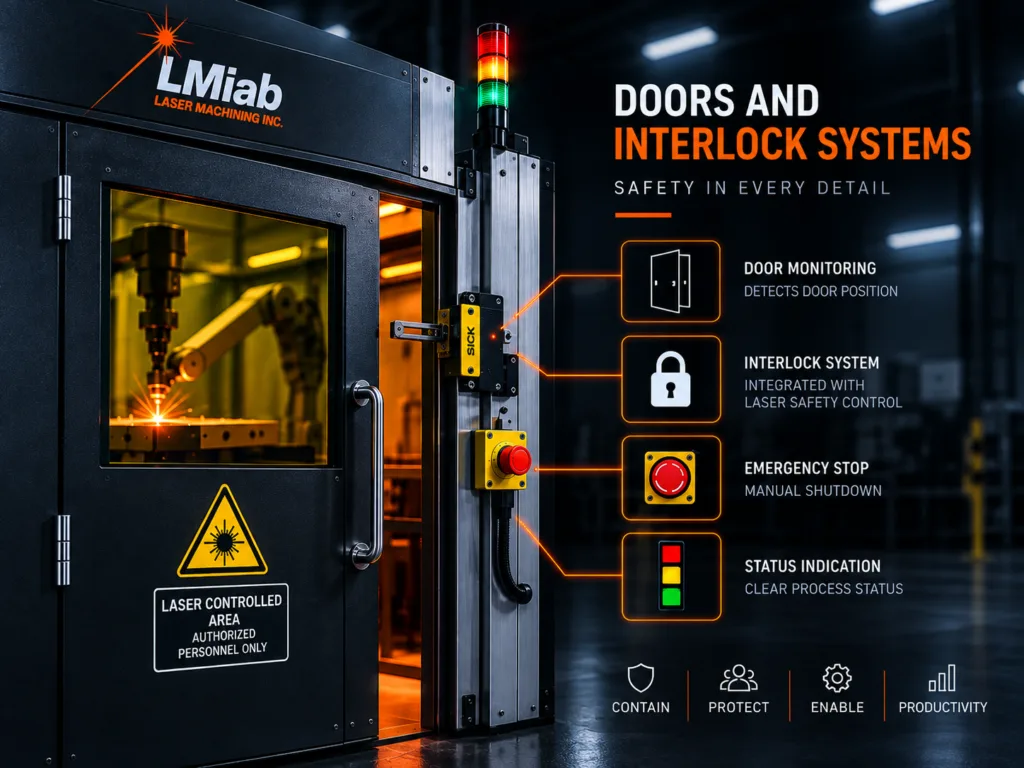
As soon as an enclosure includes doors, gates or other access points, access to the laser area must be managed safely.
Interlock systems can monitor the position of doors and other access points and interface with the safety functions of the laser equipment. If a door is opened when hazardous exposure could occur, the system can prevent or interrupt laser emission.
The enclosure and interlock system should therefore be considered parts of the same overall safety concept.
Laser safety windows
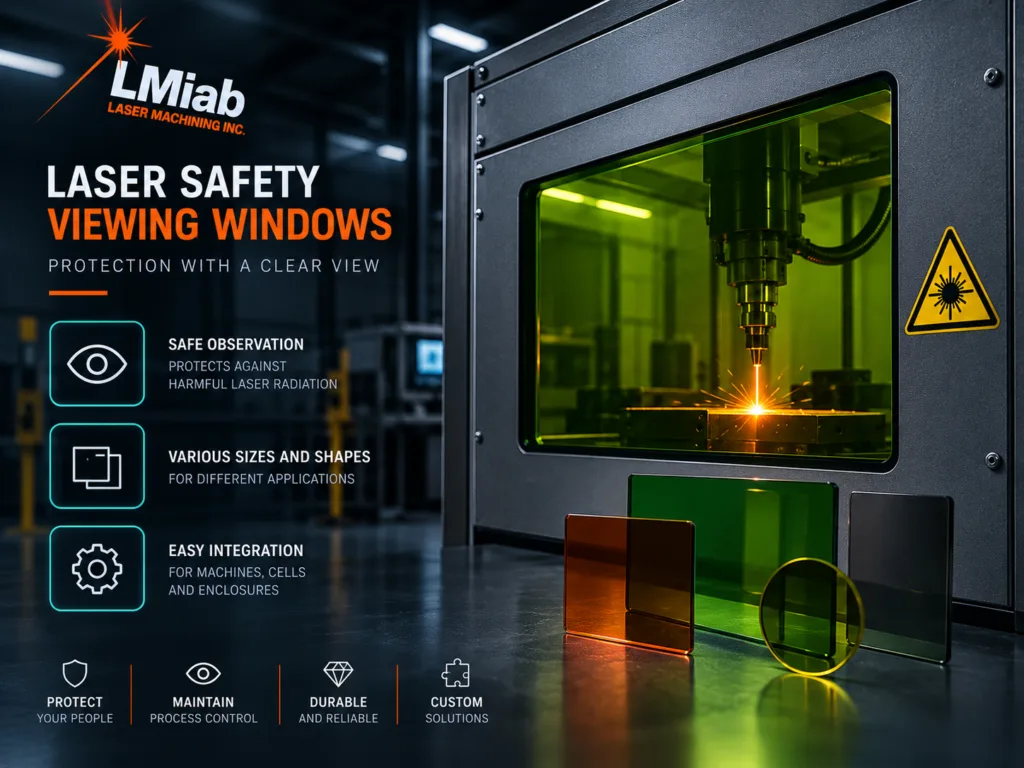
In many installations, operators need to observe the process without opening the enclosure. Special laser safety windows can therefore be integrated into enclosure walls or doors.
The window must be suitable for the wavelength of the laser and the potential exposure conditions. At the same time, sufficient visible light transmission is needed to allow the operator to observe the process effectively.
Ordinary glass or transparent plastic should not be considered laser protection simply because it appears to block or attenuate the laser light.
What determines which enclosure is required?
The selection and specification of a laser safety enclosure should be based on a risk assessment of the complete laser installation.
Factors to consider include:
- laser wavelength
- laser class and output power
- continuous-wave or pulsed operation
- potential power density at the enclosure surfaces
- possible beam directions and reflections
- distance between the process and protective barrier
- level of process automation
- access requirements for operators and service personnel
- material loading and unloading
- requirements for doors, gates and observation windows
- ventilation and process extraction.
This means that an enclosure should not be selected solely on the basis of the laser’s nominal output power. The complete application and potential exposure conditions determine which protective measures are required..
Laser safety enclosures for different processes
Protective enclosures are used in many industrial laser processes, including laser welding, laser cutting, laser marking, laser cleaning and other forms of laser processing.
In automated applications, the enclosure may also need to integrate with robots, conveyors, fixtures and other components of the production system.
Laser safety should therefore be considered as an integral part of the machine or production cell design rather than as a separate component added afterwards.
Standards and risk assessment
Laser safety is governed by standards and requirements covering both laser products and the design and use of laser installations.
The EN/IEC 60825 series is among the key standards relating to laser safety. Which standards and requirements apply depends on the design and intended use of the installation. A proper risk assessment therefore provides the basis for selecting the enclosure and any additional safety functions required.


Laser safety enclosures from LMI AB
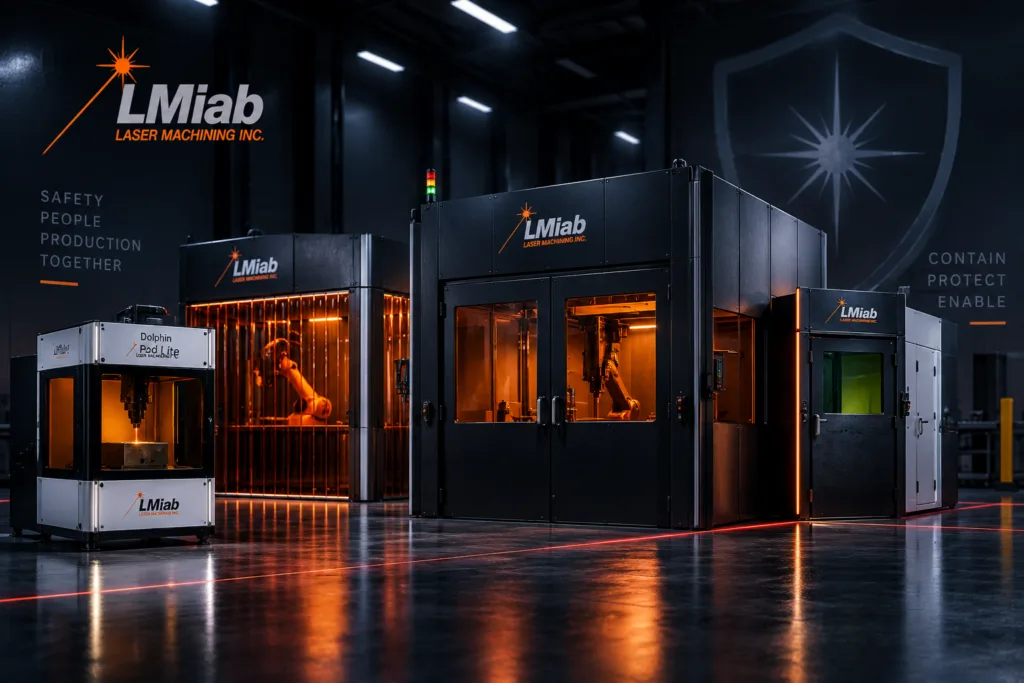
LMI AB offers solutions for enclosing and shielding industrial laser processes, ranging from compact and flexible enclosures to large modular laser safety cells.
The range includes Dolphin Pod Lite, Dolphin Laser Safety Curtain Pod, XXXL Dolphin Laser Safety Cell, Laser Castle and Laser Castle Lite.
The enclosures can be combined with other components of a complete laser safety system, including interlock systems, laser safety windows, protective curtains, warning signs and personal laser protective equipment.
Need help choosing the right laser safety enclosure?
The appropriate solution depends on both the laser and the process. Contact LMI AB and we will help you assess your requirements and find a suitable solution for your laser installation.
Urban Gärds
Contact person for laser safety enslosures