

Laser Safety Windows
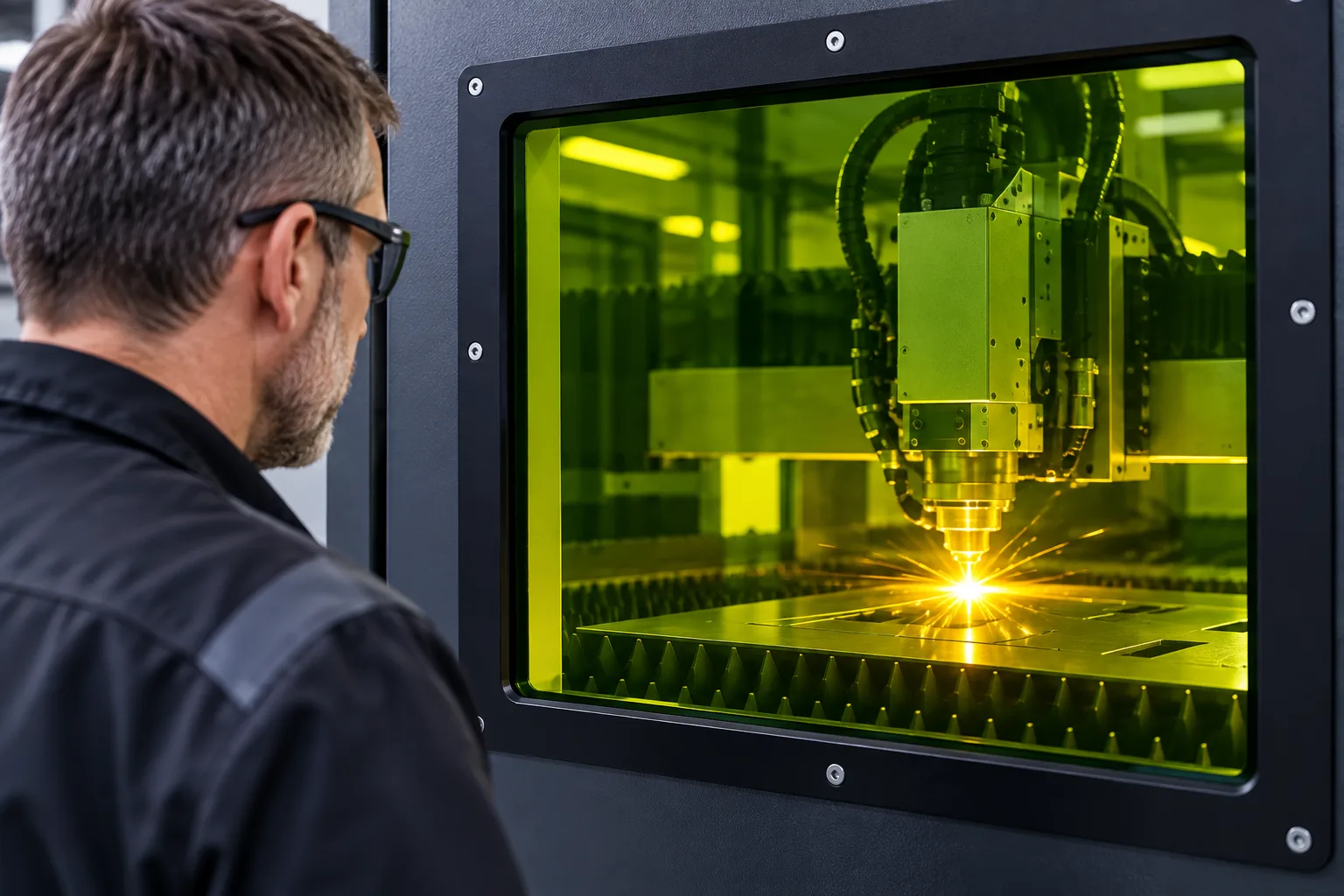
Laser safety windows allow operators to monitor a laser process without opening the protective enclosure or entering the laser-controlled area. The window forms part of the protective barrier and filters laser radiation within specified wavelength ranges while allowing the operator to observe the process and equipment inside.
The correct laser safety window must be selected according to the specific laser and installation. Wavelength, laser power, potential exposure, filter material and window position are some of the factors that determine the required level of protection.
What is a laser safety window?
A laser safety window is an optical filter installed in a laser cell, protective enclosure, door or wall to provide visual access to the laser process without opening the protective barrier.
The filter is designed to significantly reduce laser radiation within specified wavelength ranges while allowing part of the visible light to pass through.
This allows the operator to monitor, for example:
- the laser process
- the workpiece
- robot or machine movements
- fixtures and positioning
- process conditions
without entering the protected area.ådet.ydd bestäms utifrån det aktuella lasersystemet och applikationen.
Wavelength determines the required filter
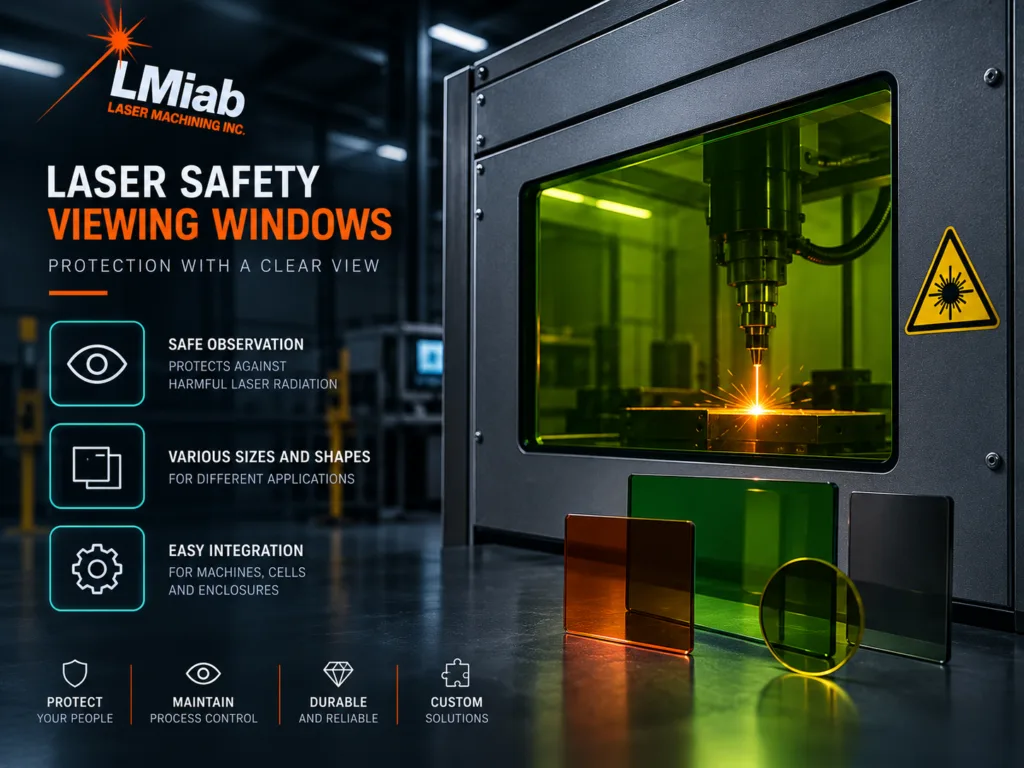
Just like laser safety eyewear, a laser safety window must be matched to the wavelength of the laser.
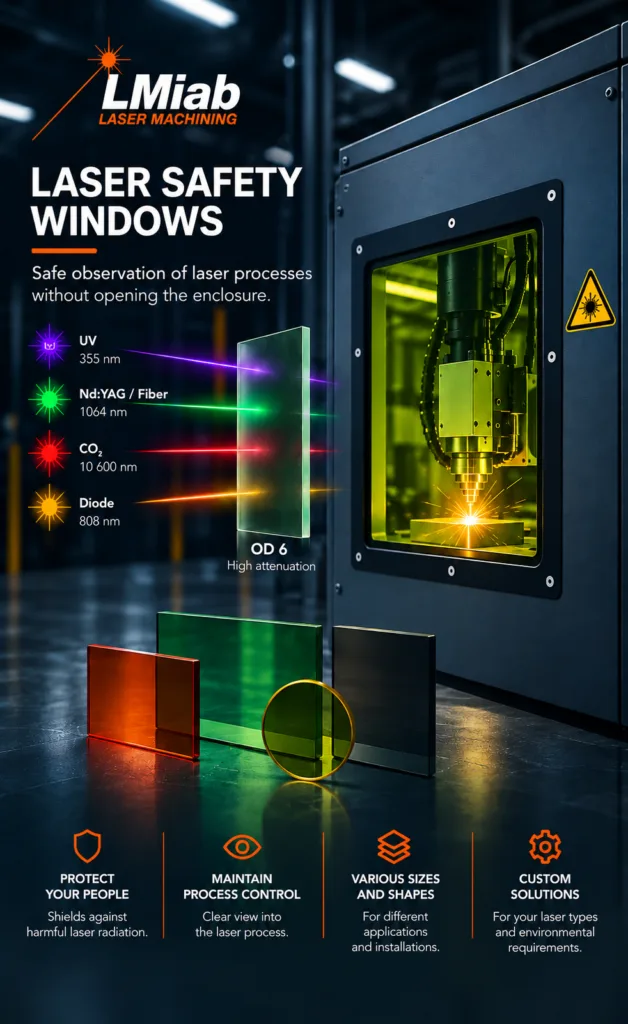
Different laser technologies operate at different wavelengths. Fibre and Nd:YAG lasers, for example, commonly operate around 1 µm, while CO₂ lasers operate at 10.6 µm.
A filter providing a high level of protection within one wavelength range does not necessarily provide equivalent protection at another wavelength.
The selection of a laser safety window must therefore always be based on the laser or lasers that may be present in the installation.
Optical Density – OD
Optical Density (OD) describes how strongly a filter attenuates laser radiation at a specified wavelength.
The higher the OD value, the greater the attenuation.
For example, OD 6 corresponds to an attenuation factor of one million at the specified wavelength.
The basic principle is the same as for laser safety eyewear.
However, particularly in high-power industrial laser installations, there is another very important factor to consider.
OD is not the whole story
A material can provide very high optical density and still be damaged if it is exposed to sufficiently intense laser radiation.
It is therefore also necessary to consider the ability of the material to withstand the potential laser exposure.
This is particularly important in industrial high-power laser applications. A filter may provide sufficient optical attenuation at a particular wavelength but still be damaged or penetrated if exposed to a concentrated high-power laser beam.
Both optical attenuation and the resistance of the material to laser exposure must therefore be considered when selecting a laser safety window.
Visible Light Transmission – VLT
A laser safety window must not only provide protection – it should also allow the operator to see what is happening inside the enclosure.
VLT – Visible Light Transmission indicates how much visible light passes through the filter.
Higher VLT generally provides better visibility through the window, while filters designed to provide strong attenuation within certain wavelength ranges may affect both light transmission and colour perception. Selecting a laser safety window therefore involves finding the appropriate balance between laser protection and good visibility of the process.över man därför hitta rätt balans mellan skyddsnivå och god sikt in i processen.
Glass or plastic?
Laser safety windows can be manufactured from different filter materials.
Common solutions include:
Glass filters – can provide high optical quality, good visible light transmission and high levels of laser protection.
Polycarbonate or acrylic filters – can provide lightweight solutions and make it possible to manufacture larger windows at a lower cost. The appropriate material depends on factors such as wavelength, required protection level, window size, mechanical requirements and the potential laser exposure within the installation.
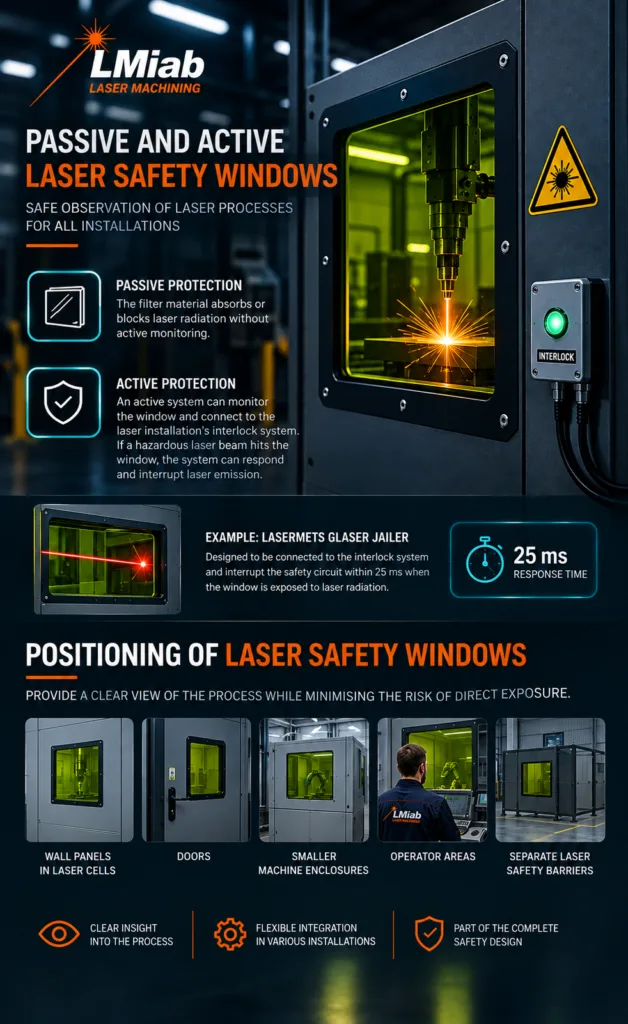
Passive and active laser safety windows
Most laser safety windows operate as passive protective barriers. The filter material absorbs or blocks laser radiation without active monitoring.
For particularly demanding installations, active laser safety windows are also available.
An active system can monitor the window and interface with the laser installation’s interlock system. If hazardous laser radiation strikes the window, the safety system can respond and interrupt laser emission.
Active protection can therefore be particularly useful in high-power installations where prolonged direct exposure of a window could compromise the protective barrier.
Positioning laser safety windows
The window should provide a good view of the process while minimising the possibility of direct laser exposure.
Laser safety windows can be installed in, for example:
- laser cell wall panels
- access doors
- compact machine enclosures
- operator viewing areas
- separate laser safety barriers.
The position and dimensions of the window should therefore form part of the safety design of the complete installation rather than being considered in isolation.se processen från utsidan. Placering och dimensionering bör därför vara en del av säkerhetskonstruktionen för hela installationen – inte något som bestäms isolerat.
The window is part of the protective barrier
A laser safety window should be regarded as part of the complete protective enclosure.
This means that having the correct filter properties alone is not sufficient. The mounting system, frame, joints and interface between the window and enclosure must also be designed so that the intended level of protection is maintained.
Doors, penetrations, ventilation openings and other parts of the enclosure must likewise be considered as part of the overall safety solution.
Standards and risk assessment
For laser safety windows used as part of a protective laser barrier, IEC 60825-4 – Safety of laser products – Part 4: Laser guards is an important standard. It addresses laser guards and the ability of protective barriers to withstand laser radiation.
Depending on the product and application, other standards and classifications may also be relevant. The important principle is that the laser safety window should be selected according to the actual laser installation and its risk assessment, rather than solely on the basis of a single parameter such as OD.


Laser safety windows from LMI AB
LMI AB offers laser safety windows for different laser technologies, wavelengths and industrial installations.
The windows can be used in laser cells, protective enclosures and access doors where the process needs to be monitored without opening the protective barrier.
Based on the laser parameters and the design of the installation, the appropriate combination of wavelength range, protection level, material, dimensions and visible light transmission can be selected.
Need help selecting the right laser safety window?
The correct window depends on the laser wavelength and power, the characteristics of the process and how the window is positioned within the installation.Contact LMI AB and we will help you identify a laser safety window suited to your laser and safety solution.
Urban Gärds
Contact person for safety windows