

Vision Systems for Laser Processing
Vision systems enable a laser machine to see and identify the workpiece before the laser process is performed. By combining camera technology, image processing and scanner control, the system can locate components, compensate for variations in position and guide the laser process to the correct location on the workpiece.
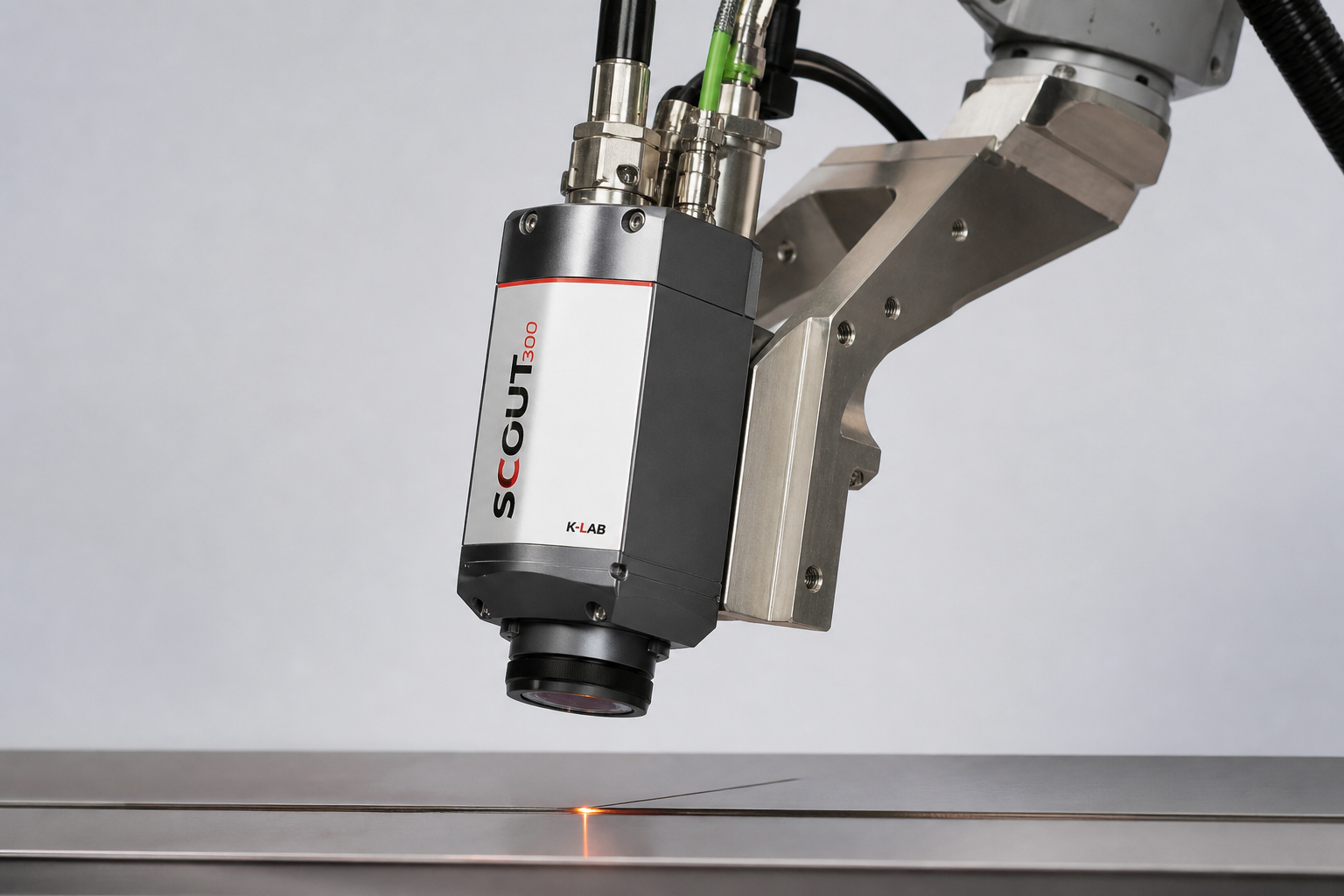
LMI offers vision systems for industrial laser processing, with a particular focus on laser welding and automated laser processes. An important solution in our portfolio is K-Lab SCOUT, which combines advanced vision technology with scanner-based laser processing.
Contact us about vision systems for laser processing
Why use vision in a laser process?
In an automated laser process, the laser beam must hit the workpiece at the correct position with high precision. Traditionally, this is achieved through precise fixturing and by programming or teaching the machine based on a predetermined component position.
In real production environments, however, variations can occur. Workpieces may be slightly displaced or rotated, and their geometry may vary within permitted tolerances.
A vision system can identify the actual position of the workpiece and allow the system to adapt the laser process accordingly.
This can provide several advantages:
- reduced sensitivity to variations in component position
- reduced need for extremely precise fixturing
- shorter teaching and setup times
- greater flexibility when handling product variants
- improved repeatability
- easier programming of complex laser paths
- automatic correction of process positions
Vision thus becomes an integrated part of the laser process control.
K-Lab SCOUT – vision and laser processing in one system
K-Lab SCOUT is designed to combine scanner-based laser processing with advanced vision technology.
Unlike a conventional camera system that only displays a limited area, SCOUT can use the galvo scanner to acquire images across the entire working field. Image processing then stitches these images together to create a complete view of the working area.
The laser process can subsequently be positioned relative to the processed image.
K-Lab describes the workflow in three main stages:
- Image acquisition – the working field is captured.
- Process geometry creation – the operator defines, for example, welding paths on the image.
- Laser processing – the laser beam follows the defined geometry on the workpiece.
The system can also identify components that are not located exactly in their expected positions and compensate the process according to the actual component position.
The entire working field as one continuous image
A conventional coaxial camera normally sees only a limited section of the scanner field at any given position.
SCOUT addresses this by using the scanner optics to acquire images from different areas of the working field. K-Lab’s image-processing technology then stitches a large number of images together to create one continuous image.
This allows the operator to work with a visual representation of the entire scanner field, rather than only a small area around the current laser position.
This is particularly useful for complex components and applications involving multiple separate welds or processing areas.
Automatic positioning and compensation
One of the major advantages of vision-guided laser processing is the ability to compensate for variations in workpiece position.
Once a component has been identified, the system can adjust the scanner field or individual process contours according to the component’s actual position. K-Lab’s SCOUT technology provides automatic component recognition and adjustment of process contours within the scanner field.
This can reduce dependence on extremely precise mechanical positioning.
Vision does not, however, automatically eliminate the need for good fixturing. Requirements for component position, joint fit-up and process tolerances still depend on the specific application.
Vision systems for laser welding
Laser welding is a particularly interesting application for vision technology because the laser beam often needs to be positioned very accurately in relation to the joint.
SCOUT has been developed with scanner-based laser welding as one of its key applications.
Vision can be used for applications including:
- spot welding
- complex weld contours
- multiple weld positions on the same component
- remote welding
- precision welding
- components with varying positions
- automated series production
- production involving multiple product variants
The combination of vision and scanner technology is particularly powerful because the same system can first locate the component and then rapidly direct the laser beam to the required welding positions.
Less teaching and faster changeovers
Traditional programming of a complex laser process can require a large number of positions to be taught individually.
With a vision system, the operator can instead work directly with an image of the actual component.
K-Lab’s SCOUT software allows process geometries to be created on the acquired image using predefined geometric shapes and other tools. For suitable applications, this can significantly reduce setup and programming time.
For production involving many variants or complex welding geometries, this can make changeovers considerably easier.
SCOUT-200 and SCOUT-300
K-Lab’s product range includes solutions such as SCOUT-200 and SCOUT-300, developed for different requirements regarding aperture, working field and laser power.
| Parameter | SCOUT-200 | SCOUT-300 |
| Wavelength | 1070 nm | 1070 nm |
| Laser connection | QBH | QBH |
| Aperture | 20 mm | 30 mm |
| Maximum laser power* | 2 kW | 5 kW |
| Cooling | Air / water | Air / water |
| Interface | XY2-100 | XY2-100 |
*Maximum laser power depends on the specific version, cooling and system configuration. Specifications should always be verified for the actual system and application.
SCOUT-300 for larger and more demanding applications
SCOUT-300 is designed for applications requiring a larger scanner aperture and higher laser power. Depending on the configuration, the system can be used with laser powers of up to 5 kW at approximately 1070 nm.
The SCOUT-300 family is also available in different configurations for varying working-field and vision requirements.
This makes the system particularly interesting for automated laser welding applications where the combination of a larger working area, high laser power, scanner speed and vision guidance can provide significant productivity benefits.
Vision and scanner systems – two technologies working together
A vision system and a scanner system perform different functions.
The scanner system controls the laser beam.
The vision system identifies where the laser process should be performed.
When the two technologies are combined, the actual component position can first be identified and the laser beam can then be directed to the corrected process position.
With SCOUT, this integration is particularly close because the galvo scanner is also used during image acquisition.
Learn more about scanner systems and galvo mirrors
K-DRAW – programming directly on the component image
K-Lab’s K-DRAW software is used with SCOUT to create and manage process geometries.
The operator can work with the acquired image of the workpiece and define the laser processing operations directly on the image.
This provides a more visual approach to programming and can reduce the need to manually define a large number of coordinates.
For laser processes involving many individual welds or complex geometries, this can make both programming and product changeovers considerably easier.
Vision in automated production
Vision technology becomes particularly valuable when the laser system is integrated into an automated production cell.
The system can then form part of a process in which components are:
- automatically loaded
- positioned in a fixture
- identified using vision
- checked for position
- compensated by adjusting the process path
- laser processed
- transferred to the next production stage
This reduces dependence on every component being located at exactly the same coordinates during every production cycle.
Vision can therefore be an important part of both flexible automation and high-volume production.
When is a vision system the right solution?
Vision is particularly useful when:
| Production condition | Potential benefit of vision |
| Component position varies | Automatic position compensation |
| Many process positions are required | Easier programming |
| Geometry is complex | Visual definition of process paths |
| Multiple product variants are produced | Faster changeovers |
| High positioning accuracy is required | Process adapted to actual component position |
| A scanner is used for processing | Vision and beam control can be integrated |
| Production is automated | Reduced sensitivity to loading and fixturing variations |
The actual application must always determine whether vision provides a technical and economic advantage.
Vision does not replace a stable process
An advanced vision system can compensate for many variations, but it cannot correct every problem in a laser process.
In laser welding, for example, factors such as:
- joint fit-up
- gap width
- component tolerances
- material
- surface quality
- laser parameters
- focusing
- shielding gas
remain critical to the welding result.
Vision should therefore be regarded as a tool for identification, positioning and process control, rather than a substitute for a correctly designed and stable laser process.
Integration with laser systems and automation
A vision system must be integrated with the rest of the machine.
Depending on the application, the system may need to communicate with:
- laser source
- scanner system
- PLC
- robot
- linear and rotary axes
- fixtures
- safety systems
- process monitoring
- higher-level production systems
LMI’s role therefore extends beyond the vision system itself. We can integrate vision, scanner, laser, control systems and automation into a complete solution for the specific laser process.
Vision systems from LMI
LMI offers vision systems and scanner-based solutions for industrial laser processing.
With K-Lab SCOUT, vision, image processing and laser processing can be combined in an integrated system that identifies the actual position of the workpiece and adapts the laser process accordingly.
Combined with our experience in lasers, scanner systems, optics, control systems and automation, we can develop complete solutions for both new production systems and upgrades of existing machines.
Contact LMI for vision systems and vision-guided laser processing
Frequently asked questions about vision systems for laser processing
What is vision used for in a laser machine?
Vision is used to identify workpieces, determine their actual position and provide the control system with information about where the laser process should be performed.
What is K-Lab SCOUT?
SCOUT is a scanner-based laser system that combines vision, image processing and laser processing. The system can image the working field, identify component positions and adapt the laser process to the processed image.
Can vision compensate for incorrectly positioned components?
Yes, within the tolerances of the system and process. SCOUT is designed to identify components that deviate from their expected position and compensate the position of the laser process accordingly.
Are fixtures still required when using vision?
Normally, yes. Vision can reduce the requirement for highly repeatable positioning, but the component must still be held sufficiently securely and within the positional and process tolerances allowed by the application.
Can SCOUT be used for laser welding?
Yes. Laser welding is one of the primary applications for SCOUT, which is designed for scanner-based laser processing and welding.
Can LMI integrate vision into a complete laser system?
Yes. LMI develops complete laser systems in which vision can be integrated with scanners, lasers, optics, machine control and automation.