


Scanner Systems
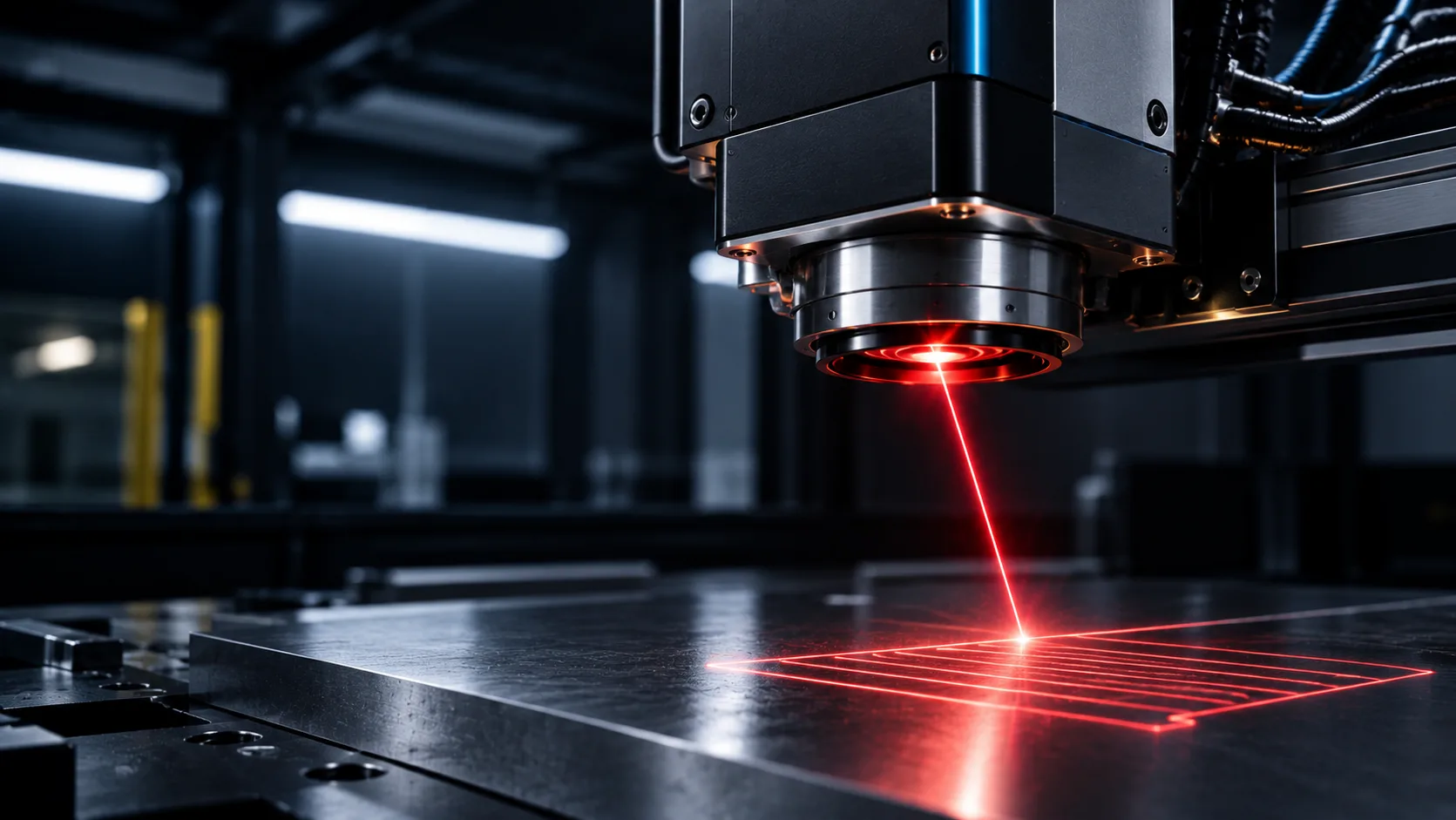
Scanner systems are used for fast and precise control of the laser beam and are a key component in many industrial laser systems. By using galvanometer-driven mirrors, the laser beam can be positioned across the working field at very high speed without mechanically moving the laser head or the workpiece.
LMI AB works with scanner systems for applications including laser marking and laser welding and has extensive experience in integrating scanner technology into both standard and customised laser systems.
What is a laser scanner system?
A galvanometer-based scanner system, often referred to as a galvo scanner or scan head, is used to control the laser beam across a defined working field.
In a conventional two-axis scanner system, the laser beam is directed by two lightweight, fast-moving mirrors. Each mirror is driven by a galvanometer and controls the beam along one axis. By coordinating the movement of the mirrors, the laser beam can be positioned very quickly and precisely.
Compared with a mechanical XY system, significantly less mass needs to be accelerated and decelerated. This enables very high positioning speeds and rapid changes in direction.
Scanner technology is therefore particularly suitable for laser processes where the beam needs to move rapidly between multiple positions or follow complex geometries.
Scanner systems for laser marking
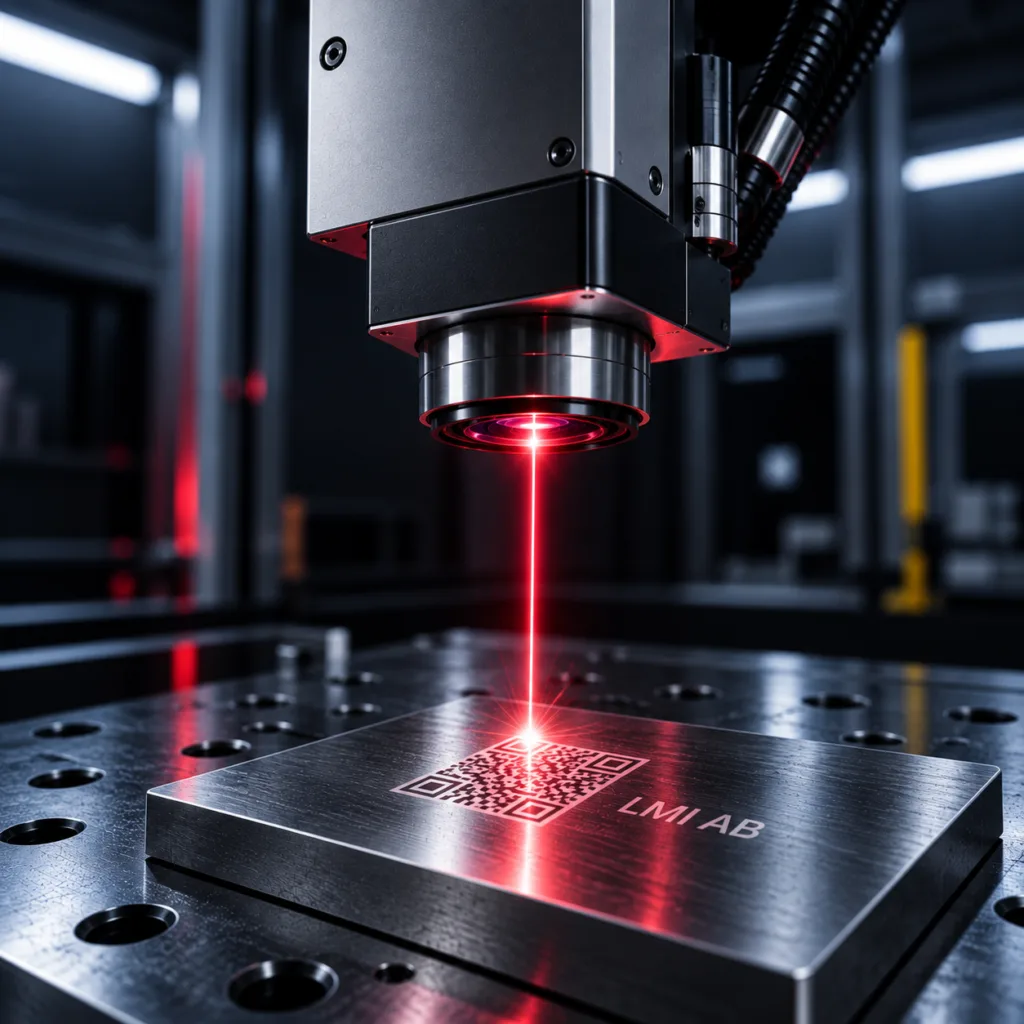
Laser marking is one of the most common applications for galvanometer scanners. The scanner controls the laser beam across the workpiece and can, for example, create:
- text and numbers
- logos and graphics
- serial numbers
- barcodes
- Data Matrix and QR codes
- contours and geometric patterns
- traceability markings
The high dynamics of the scanner make it possible to combine high marking speeds with excellent positioning accuracy.
At the same time, the scanner, laser source, control system and focusing optics must operate as a complete optical system to achieve the required working field, spot size and process result.tstorlek och processresultat ska uppnås.edelhöga effekter till huvuden för högeffektslaserskärning.
Scanner systems for laser welding
Scanner technology is also widely used in industrial laser welding. Instead of relying solely on mechanical movement of the entire laser head, the laser beam can be rapidly positioned across the workpiece using galvo mirrors.
This enables both fast positioning between welds and advanced beam movements during the welding process. Scanner-based laser welding can be used for applications such as:
- spot welding
- short and complex weld geometries
- high-productivity automated welding
- fine and precision welding
- wobbling and other controlled beam movements
- remote welding
The requirements placed on the scanner system can differ considerably between applications such as laser marking, precision welding and remote welding. The scanner must therefore be selected according to the specific application, laser power and beam characteristics – not simply according to the required working field.ationen, lasereffekten och strålens egenskaper – inte enbart efter önskat arbetsfält.

Galvo mirrors – a central part of the scanner system
Galvo mirrors are the optical components that enable rapid beam steering. Because the mirrors must accelerate and change direction extremely quickly, they require low mass, high mechanical rigidity and excellent optical quality.
At the same time, the mirror surface must be suitable for the wavelength, power and other optical characteristics of the laser.
When dimensioning or replacing galvo mirrors, several factors need to be considered:
- laser wavelength
- laser power and power density
- scanner aperture
- beam diameter
- mirror substrate
- optical coating
- thermal load
- scanner configuration
Galvo mirrors are available with optical coatings for different laser wavelengths and applications, including fiber and YAG lasers, green lasers, UV and CO₂ lasers, as well as more specialised requirements involving multiple wavelengths, short laser pulses and different states of polarisation.
A galvo mirror should therefore not be regarded as a generic spare part that can be selected solely by its physical dimensions. The optical and mechanical configuration must match both the scanner system and the laser process.
F-theta optics, working field and spot size
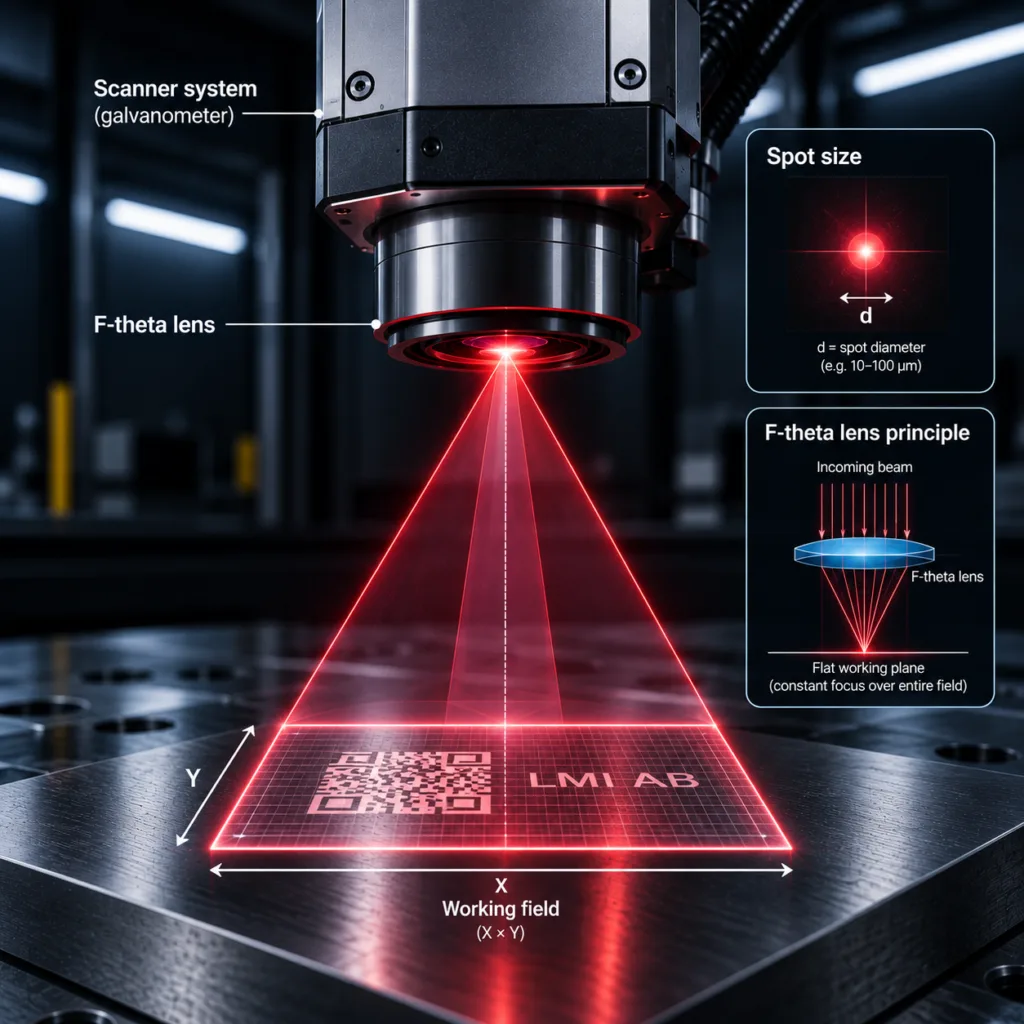
After being directed by the galvo mirrors, the laser beam normally passes through focusing optics. In many two-dimensional scanner systems, an F-theta lens is used to focus the laser beam across a defined working field.
The choice of focal length affects factors including:
- working field size
- focused spot size
- working distance
- power density
- process result
A larger working field is therefore not automatically better. Increasing the focal length and working field also affects spot size and other process characteristics and must be balanced against requirements such as precision and power density.
The scanner and focusing optics should therefore be dimensioned as a complete optical system.imensioneras som ett sammanhängande optiskt system..
2D and 3D scanning
A conventional two-axis scanner system controls the laser beam in the X and Y directions across a working field.
For applications where the focal position also needs to be adjusted in the Z direction, the scanner system can be combined with dynamic focusing or other 3D technology.
This enables processing of:
- larger working fields
- components with variations in height
- three-dimensional geometries
- applications requiring dynamic adjustment of the focal position during processing
3D scanning therefore provides additional possibilities when the workpiece is not flat or when a larger three-dimensional working area needs to be processed.
Control and system integration
A scanner system does not operate in isolation. To create a complete laser process, the scanner, laser source, control system and any machine automation need to communicate with each other.
Depending on the system and application, integration may include:
- scanner control
- laser triggering and power control
- digital I/O
- encoder signals
- processing-on-the-fly
- vision systems
- robots or other automation
- safety systems
- process monitoring
For LMI AB, the scanner system is therefore not simply a stand-alone component, but part of the complete laser and automation solution.
Choosing the right scanner system
Selecting the right scanner system involves considerably more than choosing the size of the scan head or the required working field. The complete combination of laser, scanner, optics, control system and process needs to be dimensioned together.
| Parameter | Influences |
| Laser wavelength | Mirrors, coatings and optics |
| Laser power | Mirrors, thermal load and cooling |
| Aperture | Permitted beam diameter |
| Working field | Optics and focal length |
| Spot size | Precision and process result |
| Scanner speed | Cycle time and productivity |
| Accuracy and drift | Repeatability and process quality |
| Application | Marking, welding, micromachining and more |
| Control system | Communication and machine integration |
It is the combination of these parameters that determines which scanner solution is suitable for the application.
Service, spare parts and replacement scanners
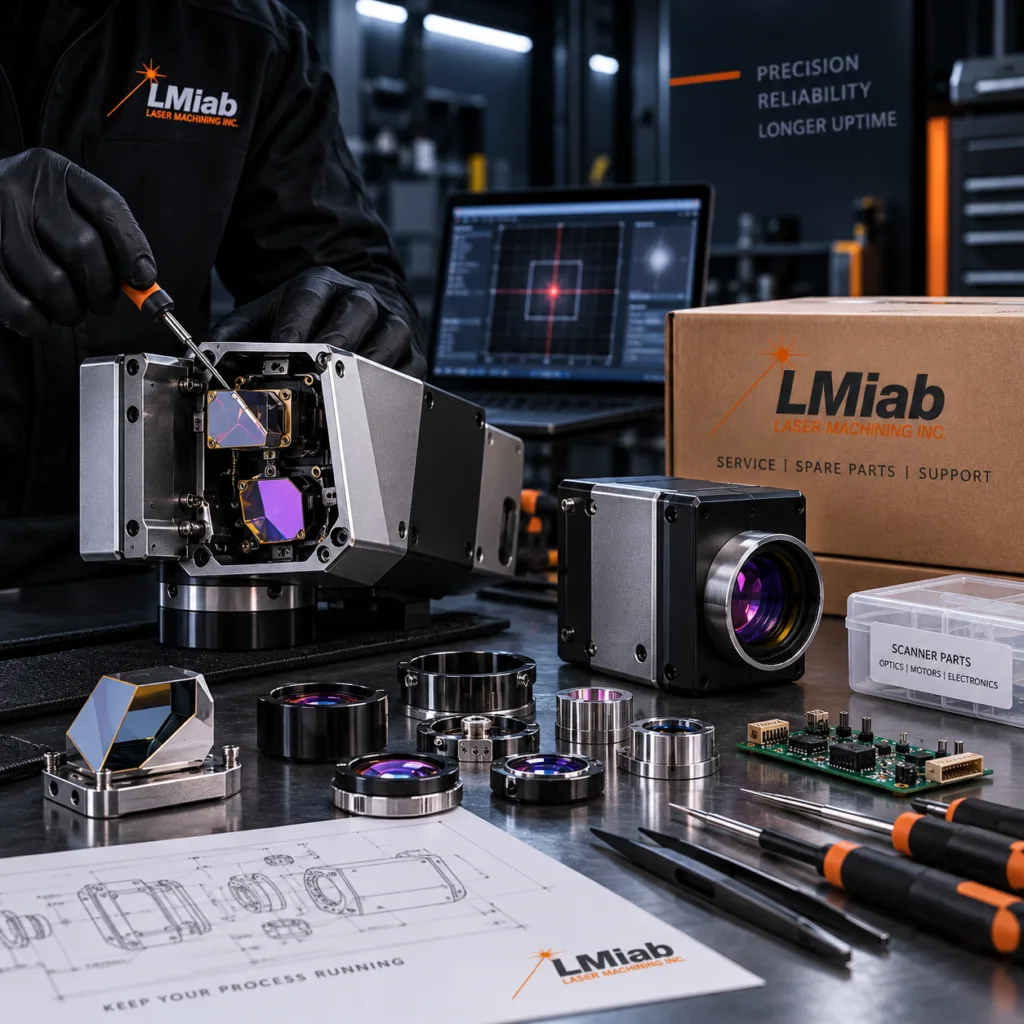
When an existing scanner system needs to be repaired or replaced, it is important to identify the exact version and configuration.
Two scanners with similar model designations may differ in areas such as:
- mechanical configuration
- connector position
- galvo mirrors
- mirror substrate
- optical coating
- interface
- cooling
- tuning
- optical configuration
Knowing only the scanner family and aperture is therefore not always sufficient. Part numbers, serial numbers, documentation and information about the existing configuration can be essential when identifying the correct replacement product.
LMI AB can assist with the identification and specification of scanner systems, galvo mirrors and associated optical components for both new and existing laser systems.ldelar och slitkomponenter för sina skär- och svethuvuden.
Scanner systems from LMI AB
LMI AB supplies and integrates scanner systems for industrial laser applications, with particular expertise in applications including laser marking and laser welding.
The choice of scanner is always application-dependent. With experience in scanner technology, lasers, optics, control systems and complete machine solutions, LMI AB can help select and integrate a scanner solution tailored to the specific process.
See our scanner systems below for more information about individual models and their technical specifications.
Frequently asked questions about scanner systems
A galvo scanner uses high-speed controlled galvanometers and mirrors to direct a laser beam across a working field. This enables considerably faster beam positioning than mechanically moving the entire laser head.
The same basic scanner principle is used for both processes, but the requirements can differ considerably. Laser power, beam diameter, mirrors, coatings, cooling, dynamics and optics must be dimensioned for the specific application.
A galvo mirror is the optical mirror mounted on the moving shaft of the galvanometer and used to direct the laser beam. A conventional two-axis scanner system uses two mirrors to control the beam in the X and Y directions respectively.
No. The mirror substrate, coating, mass and optical properties must be suitable for the scanner, laser wavelength and application.Nej. Spegelsubstrat, coating, massa och optiska egenskaper måste vara anpassade till den aktuella skannern, laservåglängden och applikationen.
The working field is determined by a combination of factors including the scanner’s maximum scan angle and the focal length of the focusing optics. These choices also affect spot size and other process characteristics.
Yes. To identify the correct replacement scanner, information about the existing model and configuration is normally required. Part numbers, serial numbers, photographs, documentation and information about the laser source and application can help identify the correct solution.

Contact LMI AB about scanner systems
Do you need a scanner system for a new laser installation, or are you looking for a replacement scanner, galvo mirrors or associated optics for an existing system?
Contact LMI AB with information about the laser, application and existing equipment and we will help you identify and specify a suitable solution.
Contact Tim Smith för advice about scanner systems.
Tim Smith
Contakt person for scanner system