


High-Power Lasers – Cleanliness, Optics and Maintenance
The development of fiber laser technology has progressed rapidly, and today’s laser cutting machines can be equipped with laser sources delivering extremely high power levels. This enables higher cutting speeds, increased productivity and the processing of increasingly thick materials.
At the same time, the requirements placed on the laser system change as power increases. The cutting head, optical components, cleanliness and preventive maintenance become increasingly important. Contamination that may not cause immediate problems at lower power levels can lead to significant local heating and optical damage in a high-power system.
This is particularly important in modern laser cutting systems operating at 20 kW and above, where even minor disturbances in the optical path can have costly consequences.
What Happens as Laser Power Increases?
As the laser beam passes through the optical system of the cutting head, as much of the energy as possible must be transmitted through the optics and delivered to the cutting process.
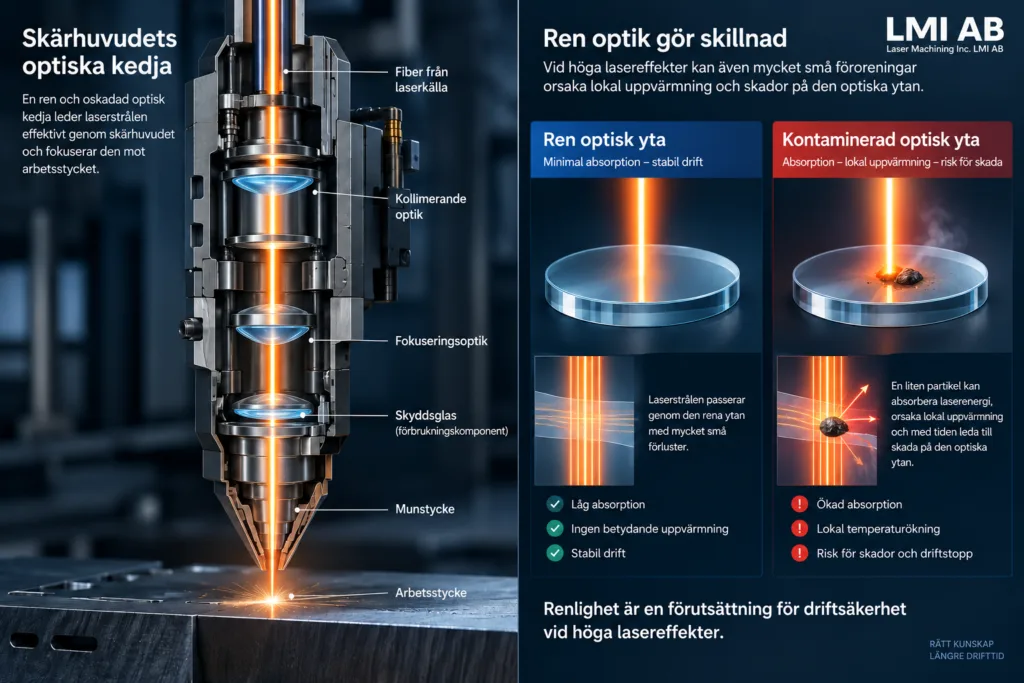
A clean and undamaged optical surface is designed to handle the laser radiation with very low optical losses. However, if dust, particles, process residues or other contaminants are present on an optical surface, some of the laser energy may be absorbed by the contamination.
This can create a local increase in temperature.
The higher the laser power passing through the system, the greater the consequences of such absorption can become. Even very small amounts of contamination can therefore develop from a minor issue into damage to an optical component.
Once an optical surface begins to deteriorate, absorption may increase further. This can result in additional heating and rapidly progressing damage.
Why Is Cleanliness So Important at High Laser Powers?
A laser cutting system contains several sensitive optical components that work together to guide and focus the laser beam onto the workpiece.
At the same time, the cutting process generates smoke, particles, metal vapours and spatter. The cutting head is therefore designed to protect the sensitive internal optics from the process environment as effectively as possible.
An important part of this protection is the protective window, which acts as a barrier between the cutting process and the more sensitive optics inside the cutting head. Protective windows are consumable components and are designed to be inspected and replaced before contamination or damage can affect other optical components.
However, cleanliness is not only important during the cutting process itself.
During inspection, servicing or component replacement, particles can be introduced into the system if the work is carried out in an unsuitable environment or using incorrect procedures. The higher the laser power, the more important correct and clean handling becomes.
Small Contaminants Can Have Major Consequences
Optical damage does not necessarily occur immediately or become visible from the outset.
A contaminant may initially cause only a limited local increase in temperature. Over time, this can affect coatings or optical surfaces and create an area that absorbs even more laser energy. The process can therefore become self-reinforcing.
In the worst case, local damage can progress to other components within the cutting head. If contamination or damage spreads further back through the optical path, more expensive components may also be affected.
It is therefore important to respond to changes in cutting quality, temperature, process stability or recurring problems with protective windows. Such changes may indicate that the cutting head or its optics require inspection.
Preventive Maintenance of High-Power Laser Systems
As laser power increases, preventive maintenance becomes an increasingly important factor in ensuring reliable machine operation.
To reduce the risk of optical damage, it is important to:
- follow the machine and component manufacturers’ procedures for inspection and maintenance
- keep the machine environment and service areas clean
- regularly inspect protective windows and other components in accordance with the manufacturer’s recommendations
- avoid opening sensitive parts of the optical path in an unsuitable environment
- use the correct methods and equipment when inspecting, replacing and cleaning optical components
- respond to changes in cutting quality, temperature warnings or other abnormalities
- ensure that contaminated or damaged high-power optics are handled by qualified personnel.
Preventive maintenance is therefore not simply a matter of replacing wear parts at predetermined intervals. It is also about detecting changes before they develop into major damage and costly downtime.
Servicing High-Power Optics Requires the Right Environment and Expertise
A cutting head designed for high laser powers cannot be treated like ordinary mechanical equipment.
If contaminants have penetrated beyond the components that normally protect the internal optics, inspection, disassembly and cleaning may require a controlled clean environment, specialised equipment and personnel with experience of high-power optics.
Incorrect handling can introduce new particles, damage sensitive optical surfaces or otherwise make the problem worse.
It is therefore important to distinguish between normal operator maintenance – such as inspecting and replacing components specifically designed for this purpose – and servicing the internal optical system of the cutting head.
If contamination or damage to internal optics is suspected, the work should be carried out in accordance with the manufacturer’s instructions and by personnel with the appropriate expertise and equipment.
The Highest Possible Laser Power Is Not Always the Best Solution
Higher laser power can provide major productivity benefits. In the right application, increased power can mean higher cutting speeds, the ability to process thicker materials and greater overall machine capacity.
However, higher power also places greater demands on the machine’s other components, process control, cooling, optics, cleanliness and maintenance.
The choice of laser power should therefore be based on the actual production requirements.
Materials, material thicknesses, product mix, required cutting speeds, machine utilisation and production volumes are all factors that should be considered. Service requirements, maintenance and operational reliability should also form part of the assessment.
The highest possible laser power is therefore not automatically the best solution. The right laser power is the power level that provides the best productivity and economy for the specific production requirements – taking the entire lifecycle of the laser system into account.
The Right Machine Is About More Than Kilowatts
When comparing high-power laser systems, it is easy to focus primarily on the maximum output of the laser source. However, the actual performance of a laser cutting machine is determined by many more factors.
The cutting head, optics, motion system, control system, process monitoring, cooling, gas supply and mechanical design of the machine must all work together to utilise the available laser power in a stable and productive way.
A laser cutting machine should therefore be evaluated as a complete system rather than simply by comparing the power rating of the laser source.
LMI Helps You Get the Most from High-Power Laser Technology
LMI works with modern fiber laser systems for industrial laser cutting and has experience in the installation, servicing and maintenance of high-power laser systems.
We can assist with:
- selecting and specifying the right laser power for your production
- advice on cutting heads, optics and other system components
- preventive maintenance
- troubleshooting and service
- advice on the correct handling of cutting heads and optical components
- evaluation of existing laser systems and production requirements.
The objective is not to select the highest possible laser power, but to create a solution in which power, productivity, operational reliability and maintenance work together.
Contact LMI to discuss the laser power and system configuration best suited to your production.