


Laser Interlock Systems
Laser interlock systems are a central part of the safety infrastructure surrounding industrial laser installations. The system monitors doors, access panels, emergency stops and other safety functions and can prevent or interrupt laser emission if a safety circuit is broken.
By connecting the laser equipment with access points, warning systems and other safety components, the interlock system creates a controlled safety chain around the laser process.
What is a laser interlock system?
A laser interlock system is a safety system that monitors different parts of a laser installation and ensures that defined safety conditions are met before the laser can be operated.
The system can, for example, monitor:
- doors and access panels
- magnetic or mechanical safety switches
- emergency stops
- beam stops or beam shutters
- active warning signs
- other safety circuits and external signals.
If a door is opened or another monitored safety function is activated, the interlock system can send a signal that prevents or interrupts laser emission.
Safe access to the laser area
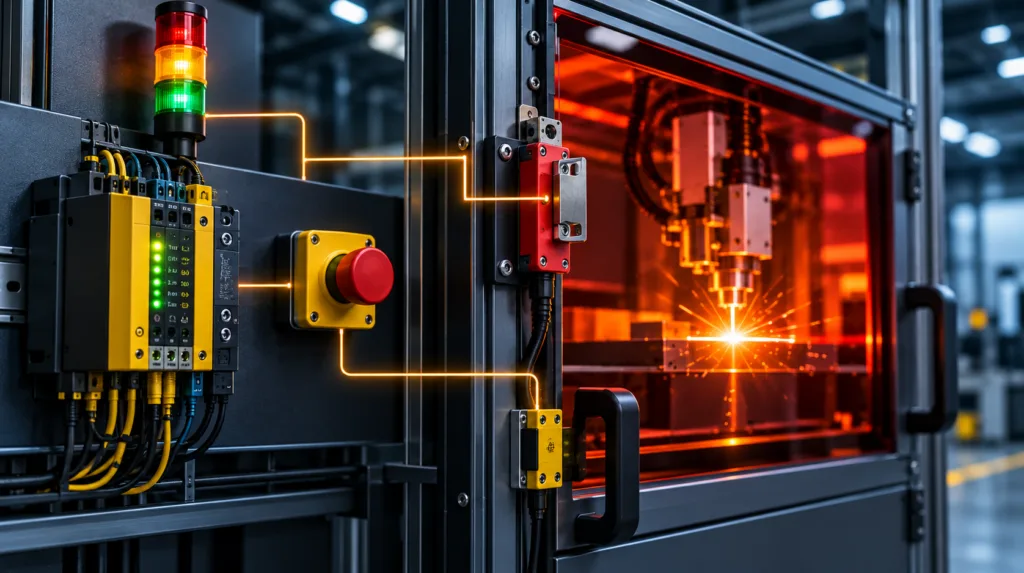
One of the most important functions of an interlock system is to control access to areas where hazardous laser radiation may be present.
In a laser safety cell, for example, a safety switch can monitor the position of the door. When the door is closed and the other defined safety conditions are met, the system can permit laser operation.
If the door is opened, the safety circuit is interrupted and the laser system is brought into a safe state according to the design of the installation. This makes access control an active part of the laser safety system rather than relying solely on instructions and warning signs.
Connecting the safety functions
A laser interlock system often acts as the central hub of the technical safety solution.
The same system can be connected to components such as:
- door interlocks
- emergency stops
- magnetic locks
- key switches
- active warning signs
- status indicators
- beam shutters
- external safety signals
- the safety input of the laser equipment.
By allowing these functions to work together, the status of the laser installation can be automatically monitored, controlled and communicated.
Active warning signs and status indication
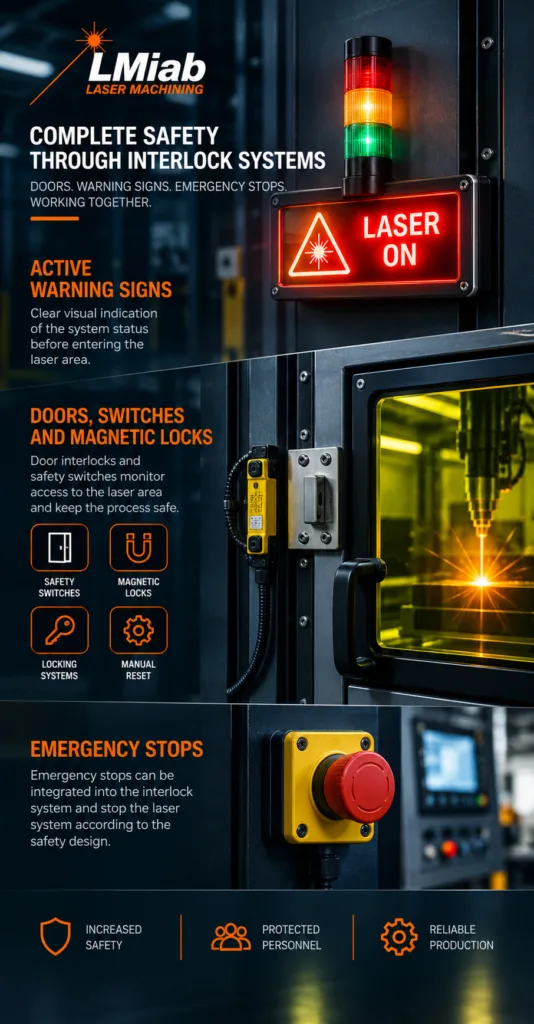
Interlock systems can also control active warning signs and other visual status indicators.
A warning sign at the entrance to a laser-controlled area can, for example, indicate whether the system is in a safe state or whether the laser is enabled.
This provides people outside the area with clear information before they open a door or enter the laser-controlled area.
This is an important difference compared with a passive warning sign, which displays the same information regardless of the current status of the laser installation.
Doors, switches and magnetic locks
Access doors are often among the most important points monitored by a laser interlock system.
Depending on the installation, a door can be equipped with:
- safety switches
- magnetic sensors
- locking systems
- electromagnetic locks
- manual reset functions.
The appropriate solution depends on how the laser-controlled area is used and the potential risk if someone opens a door during operation.
For some installations, interrupting laser emission when the door is opened may be sufficient. In other installations, it may also be appropriate to keep the door locked during certain operating modes.
Emergency stops
A laser interlock system can also be integrated with emergency stops positioned at suitable locations around the laser installation.
When an emergency stop is activated, the connected safety function should respond according to the safety design defined for the installation. An emergency stop does not replace other protective measures. Instead, it forms another part of the overall safety system.
Manual reset and controlled restart
After a safety circuit has been interrupted, it is important in many installations that the laser system cannot automatically return to operation simply because the door is closed again.
A controlled reset can therefore be required before the system can be re-enabled.
This reduces the risk of an unexpected restart and allows the operator to verify that the area is safe before laser operation resumes.
Interlock systems for different laser installations
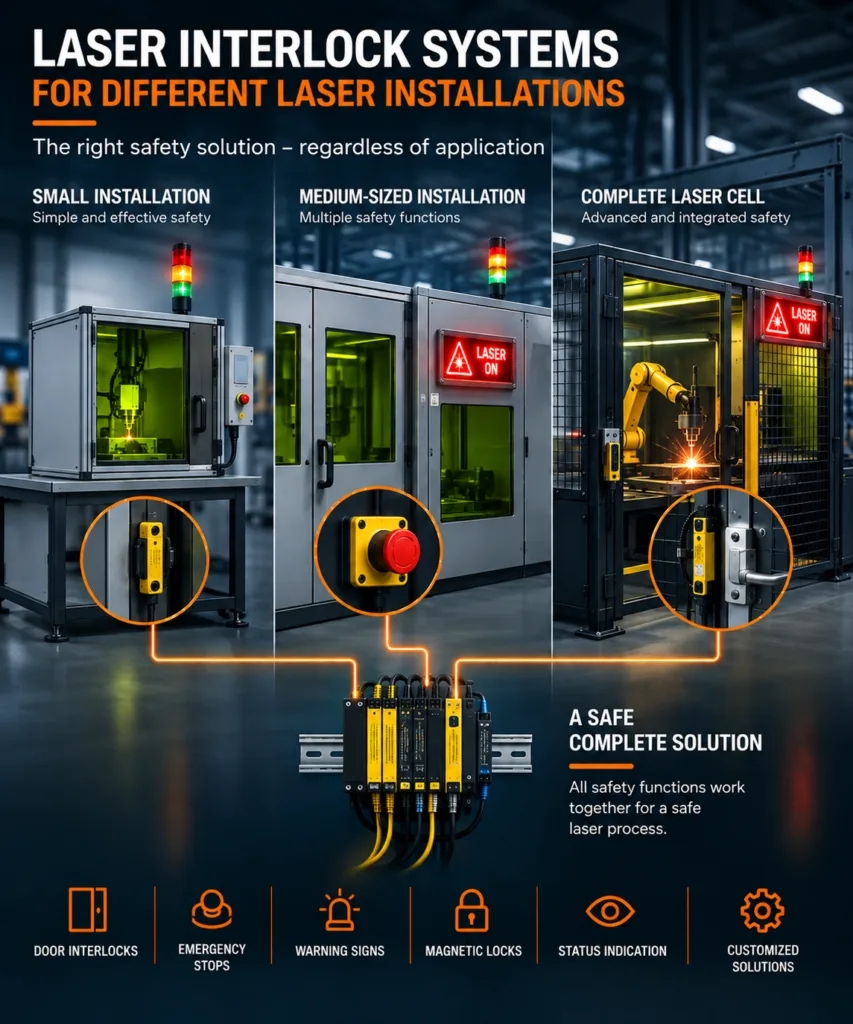
Interlock requirements can range from very simple to advanced systems.
A smaller installation may only need to monitor a single door and an emergency stop.
A larger laser safety cell may instead include:
- multiple doors
- several emergency stops
- active warning signs
- magnetic locks
- status indication
- multiple safety circuits
- different operating modes.
The interlock system therefore needs to be designed according to the complete installation, not just the laser equipment itself.
Interlock systems are part of the complete safety solution
A laser interlock system should not be considered a standalone safety product.
It works together with other protective measures such as:
- protective enclosures and laser safety cells
- laser safety curtains
- laser safety windows
- warning signs and status indicators
- personal protective equipment
- procedures and training.
The objective is to create multiple, coordinated protective barriers that help prevent people from being exposed to hazardous laser radiation.
Risk assessment and safety design
The design of an interlock system depends on the laser installation, the process and how the area is used.
The risk assessment should consider factors including:
- laser class and power
- possible beam paths
- access to the laser-controlled area
- number of doors and openings
- service and maintenance
- operating modes
- locking requirements
- reset functions
- other safety systems.
The interlock solution should therefore be designed as an integral part of the complete machine and laser safety system.n.

Laser interlock systems from LMI AB
LMI AB offers laser interlock systems and associated safety components for industrial laser installations.
Solutions are available for different levels of complexity, ranging from smaller installations to complete laser safety cells incorporating multiple safety functions.
Depending on the application, the system can be combined with components such as door switches, magnetic locks, emergency stops, active warning signs and other safety components.
Need help selecting the right interlock system?
The appropriate solution depends on the laser installation, access requirements and which safety functions need to be monitored and controlled.
Contact LMI AB and we will help you identify the right interlock system and safety components for your laser installation.
Urban Gärds
Contact person for laser interlock systems
Urban helps you select the right interlock system and safety components for your laser installation.