

Laser Safety Curtains
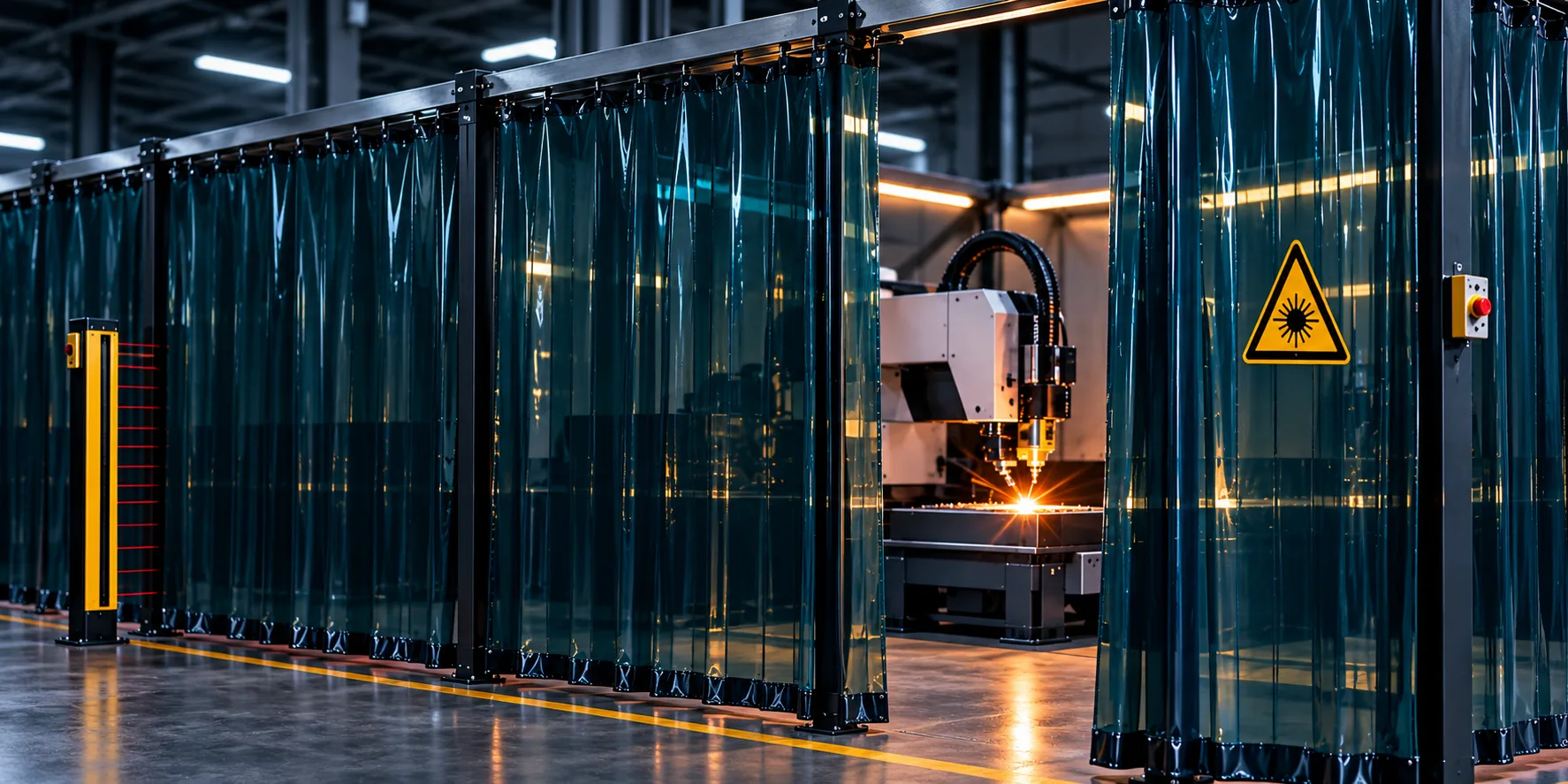
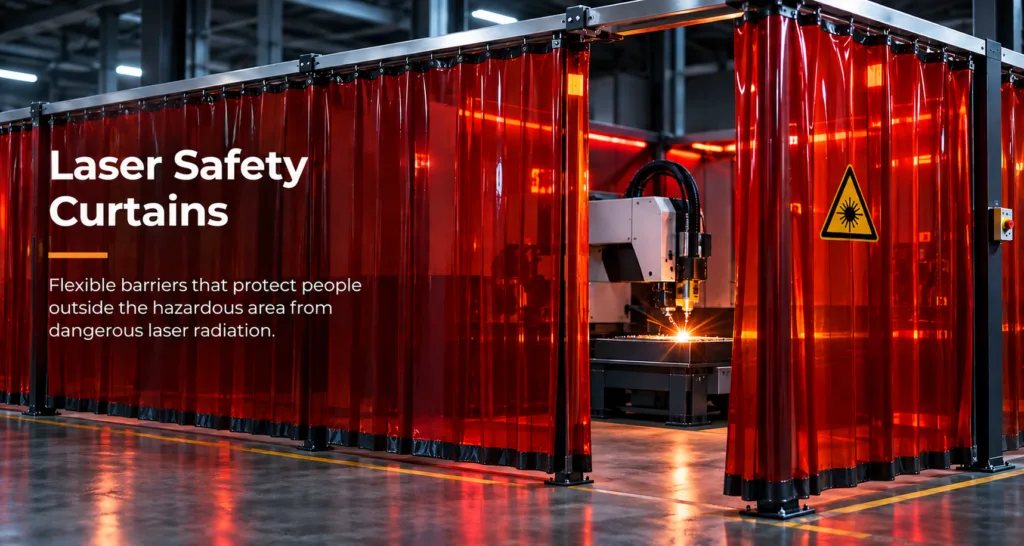
Laser safety curtains are flexible protective barriers used to define laser-controlled areas and protect people outside the hazardous area from direct, reflected or scattered laser radiation. They can be used to create anything from smaller protective screens to complete enclosed laser areas and are particularly useful where a fixed enclosure is impractical or where accessibility and flexibility are important.
When correctly selected and installed, a laser safety curtain can form an important part of the overall safety system surrounding an industrial laser process.
What is a laser safety curtain?
A laser safety curtain is a flexible protective barrier made from material designed to absorb and block laser radiation within specified wavelength and exposure ranges.
Unlike ordinary industrial or welding curtains, laser safety curtains are specifically designed for use around lasers, and their protective properties must be suitable for the laser source and process involved. The curtains can, for example, be installed on ceiling-mounted tracks, fixed frames or freestanding systems. They can also be configured so that sections of the barrier can easily be opened when access to the working area is required.
When are laser safety curtains used?
Laser safety curtains are useful when a safe barrier is required without constructing a complete fixed enclosure.
Typical applications include:
- industrial laser installations
- laser processing and laser welding
- service and maintenance areas
- laboratories and development environments
- temporary laser installations
- separation of laser equipment from other working areas.
They can also form part of a larger laser safety solution together with fixed walls, protective enclosures and other barriers.
Laser safety curtain or ordinary welding curtain?
It is important to distinguish between a laser safety curtain and a conventional welding curtain.
A conventional welding curtain is primarily intended to protect the surrounding area from hazards such as UV radiation, visible light and sparks generated by conventional welding. This does not automatically mean that it provides defined protection against laser radiation. A laser safety curtain, on the other hand, is specifically designed and rated for laser applications. Its protective capability must be assessed according to factors including the laser wavelength, power and potential exposure.
Passive and active laser protection
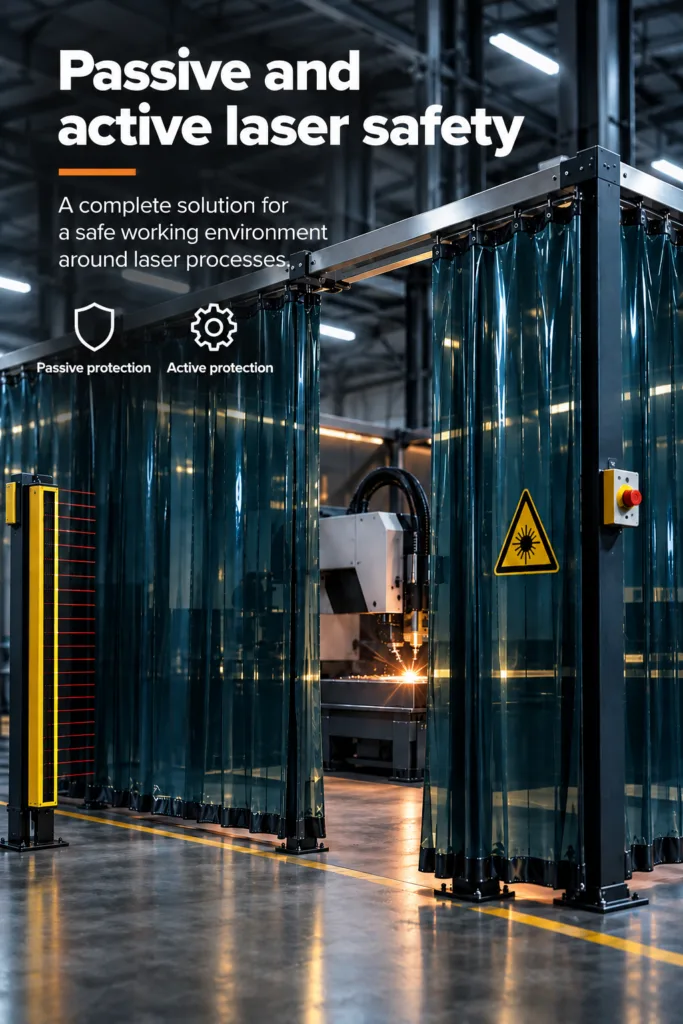
As with fixed protective enclosures, flexible laser barriers can use different protection principles.
Passive protection
Passive laser protection relies on the curtain material absorbing or blocking laser radiation under the conditions for which the protection has been specified.
The ability of the material to withstand laser radiation is affected by factors including:
- laser wavelength
- output power
- beam diameter
- power density
- exposure time
- distance between the laser process and the curtain.
Knowing only the nominal output power of the laser is therefore not sufficient when specifying a protective solution.
Active protection
For applications involving higher risks, active protection systems can be used. These combine the physical barrier with a system capable of detecting when laser radiation strikes the protective surface in a way that could compromise the barrier.
The system can then interface with the safety circuit of the laser installation to interrupt laser emission.tt sätt som kan äventyra barriärens funktion. Systemet kan då kopplas till laserinstallationens säkerhetskrets för att stoppa laseremissionen.
Flexible separation of the laser area
One of the main advantages of laser safety curtains is their flexibility.
A curtain system can be adapted to existing premises and production equipment and generally requires less space than a complete fixed wall structure.
Tracks or overlapping curtain sections can also be used to create openings for materials, equipment and service personnel. This makes laser safety curtains particularly useful where the laser-controlled area needs to be reconfigured or where regular access to the process is required.
What determines which laser safety curtain is required?
The selection of a laser safety curtain should be based on a risk assessment of the specific laser installation.
Important factors include:
- laser wavelength
- laser class and output power
- continuous-wave or pulsed operation
- beam diameter and divergence
- potential power density at the curtain
- distance between the laser process and protective barrier
- possible direct and reflected beam paths
- exposure time
- how the area is used and who may have access.
The position of the curtain is also important. Increasing the distance between the process and the curtain may, in many situations, reduce the power density of the laser radiation reaching the barrier, but this must be assessed for the specific installation.ellan process och gardin kan i många situationer innebära att laserstrålens effekttäthet vid barriären blir lägre, men detta måste bedömas för den aktuella installationen.
Installation and access
A laser safety curtain is only one part of the overall safety solution. Openings, access points and possible lines of sight into the laser-controlled area must also be considered.
Curtains can, for example, be installed with overlapping sections to reduce the possibility of a direct line of sight towards the process. If an opening is used as a regular access point, it may also need to be combined with an interlock system or other safety functions.
The objective is for the entire enclosed area to function as one integrated safety system.
Standards and risk assessment
Protection against laser radiation must be specified according to the particular laser installation and applicable requirements and standards.
The EN/IEC 60825 series is central to laser safety, while additional standards may be relevant depending on the design and intended use of the protective barrier. The risk assessment should consider the complete installation – not only the curtain itself.
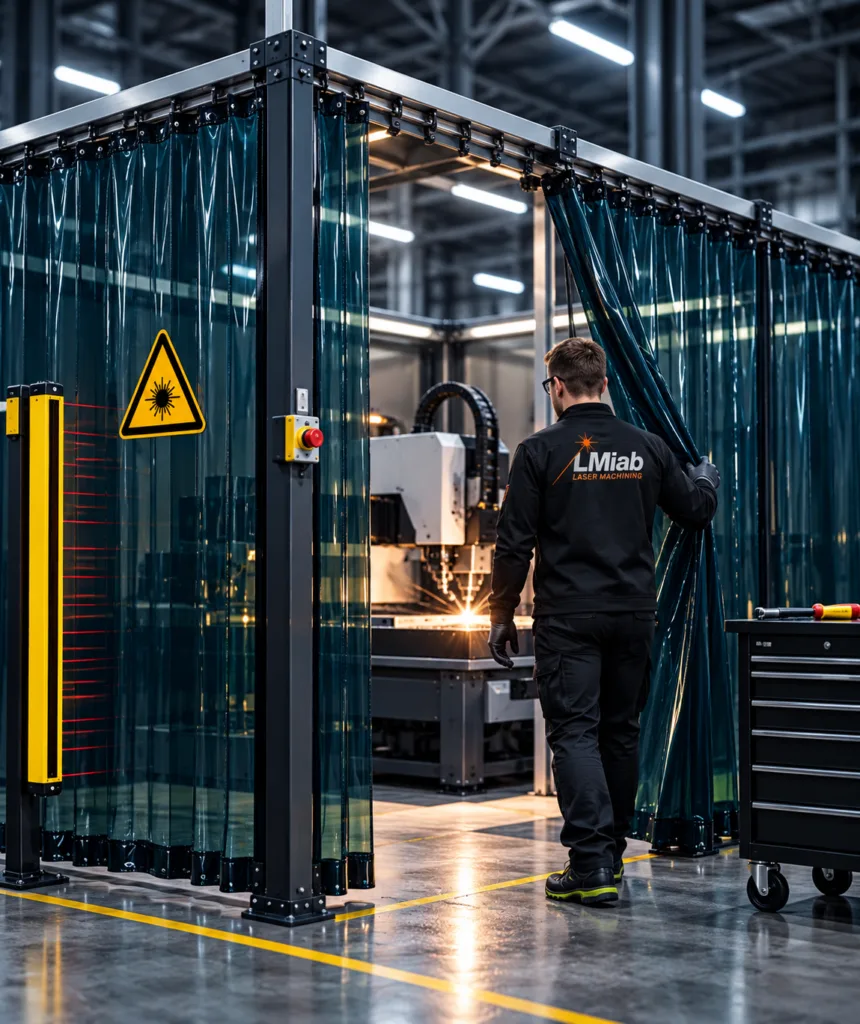

Laser safety curtains from LMI AB
LMI AB offers laser safety curtains and flexible screening solutions for industrial laser installations.
The solutions can be used independently or combined with laser safety enclosures, interlock systems, laser safety windows, warning systems and personal laser protective equipment to create a comprehensive safety concept around the laser process.
Need help choosing the right laser safety curtain?
The appropriate protective solution depends on the laser, the process and the layout of the working area. Contact LMI AB and we will help you assess the application and find a suitable solution for your laser installation.
Urban Gärds
Contact person for laser safety curtains
Urban helps you finding the right laser safety curtain for your needs.