


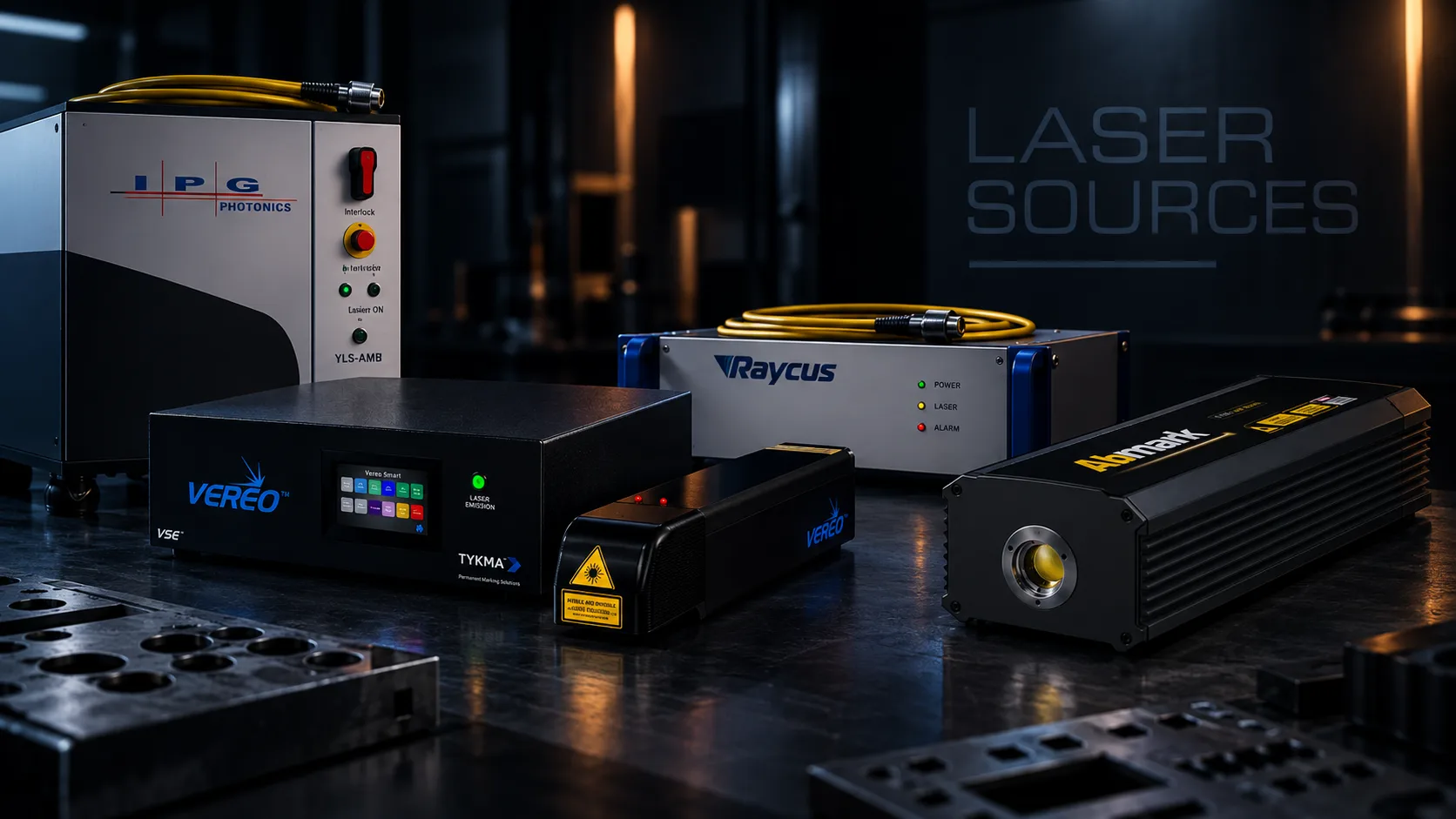
Laser Sources
The laser source is the heart of an industrial laser system and generates the laser radiation used in the actual processing operation. The choice of laser source affects factors such as available power, wavelength, beam quality, pulse characteristics, processing speed, energy efficiency and which materials and applications can be processed.
LMI AB works with several types of industrial laser sources and laser technologies from different manufacturers. Depending on the application, this may include high-power fiber lasers for cutting and welding, pulsed lasers for marking, cleaning and ablation, or specialised laser sources with advanced beam and pulse control.
What is a laser source?
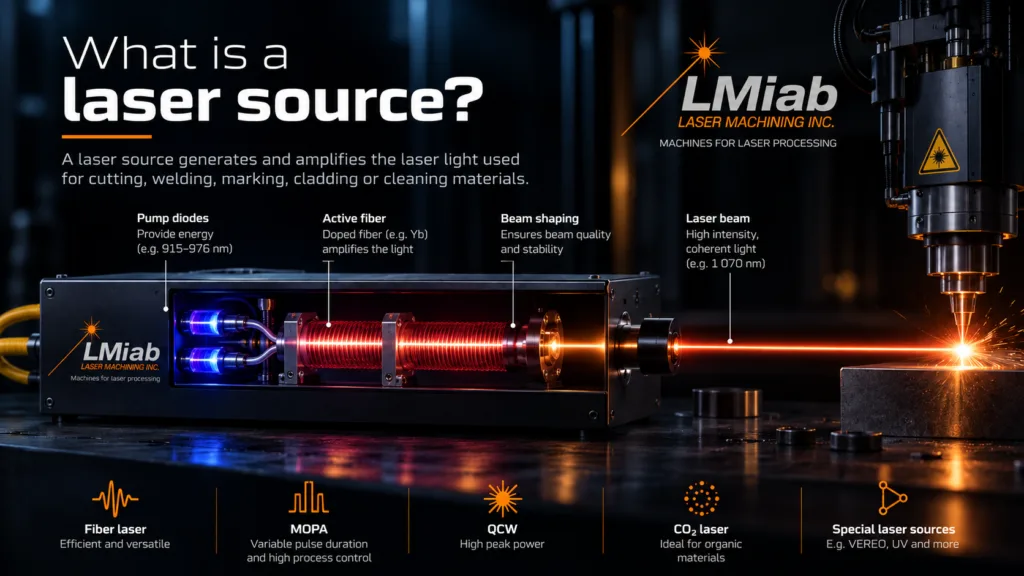
The purpose of the laser source is to generate a controlled laser beam with characteristics suited to the specific process. The laser beam is then delivered to, for example, a laser processing head or scanner system where it is shaped, focused and directed onto the workpiece.
Laser sources can differ significantly in terms of:
- laser power
- wavelength
- beam quality
- pulse energy and pulse duration
- repetition rate
- power control
- single-mode or multi-mode operation
- fiber diameter
- cooling and efficiency
The correct laser source must therefore always be selected based on the complete laser process rather than maximum output power alone.
Fiber lasers
Fiber lasers have become one of the most important laser technologies for industrial materials processing. In a fiber laser, the laser light is generated and amplified in an active optical fiber. The laser beam can then be delivered through a process fiber to the processing head.
The technology offers several characteristics that are attractive for industrial production:
- high electrical efficiency
- high available laser power
- good beam quality
- compact design
- high reliability
- low maintenance requirements
- flexible fiber-based beam delivery
- fast laser power control
Industrial ytterbium fiber lasers typically operate in the near-infrared region around 1 µm and are used for processes including laser cutting, laser welding, cleaning, surface treatment, cladding and additive manufacturing.
CW – Continuous Wave Lasers
CW stands for Continuous Wave and means that the laser source can deliver continuous laser energy. CW fiber lasers are primarily used in processes where high average power and continuous energy transfer are important.
Typical applications include:
- laser cutting
- laser welding
- laser brazing
- laser cladding
- heat treatment
- other processes requiring continuous high energy input
Pulsed Laser Sources
In pulsed laser systems, laser energy is delivered in short, controlled pulses rather than as continuous radiation. This makes it possible to achieve high peak power while keeping the average heat input significantly lower than with continuous operation.
Pulsed fiber lasers are widely used for applications such as:
- laser marking
- laser engraving
- laser ablation
- laser cleaning
- micromachining
- drilling
- surface structuring and modification
Nanosecond lasers are commonly used for marking, cleaning, ablation and precision processing, while even shorter picosecond and femtosecond pulses are used where very high precision and minimal heat input are required.
Ultrashort Pulses – Picosecond and Femtosecond Lasers
Ultrashort Pulses – Picosecond and Femtosecond Lasers
For particularly demanding precision processing applications, laser sources with extremely short laser pulses are used. Picosecond lasers operate with pulse durations in the order of 10−12 seconds, while femtosecond lasers reach pulse durations in the order of 10−15 seconds.
When laser energy is delivered over such a short period of time, very high peak powers can be achieved while limiting the spread of heat into the surrounding material. This enables materials to be processed with very high precision and a very small heat-affected zone.
Ultrashort-pulse lasers are used for applications including:
- micromachining and microstructuring
- precision drilling and cutting
- ablation and selective material removal
- processing of thin and heat-sensitive materials
- structuring of optical and electronic components
- processes where minimal heat input is critical
Picosecond and femtosecond lasers can also operate at different wavelengths. In addition to infrared lasers, green and ultraviolet wavelengths are used for materials that absorb these wavelengths more efficiently or where specific processing results are required.
Specialised wavelengths
The most common wavelength for industrial ytterbium fiber lasers is around 1 µm, but industrial laser technology covers a considerably wider spectrum. Frequency conversion and other laser technologies can, for example, be used to generate green and ultraviolet laser radiation.
Shorter wavelengths can provide very different absorption characteristics and enable the processing of materials that are difficult to machine using a conventional infrared fiber laser. This is particularly relevant in electronics, microproduction, polymer processing and other precision applications.
Selecting a laser source is therefore not simply a question of power. The combination of wavelength, pulse duration, pulse energy, repetition rate, peak power and beam quality determines how the laser energy interacts with the material.
MOPA – flexible control of the laser pulse
MOPA stands for Master Oscillator Power Amplifier. In a MOPA architecture, the laser signal is first generated in a master oscillator and is then amplified in one or more amplifier stages.
This architecture separates the generation of the laser pulse from power amplification and provides considerable flexibility in controlling the laser parameters.
In industrial pulsed fiber lasers, MOPA technology can be used to vary parameters including:
- pulse duration
- repetition rate
- pulse energy
- peak power
- energy delivery during processing
This is particularly valuable in laser marking and surface processing, where different materials can require very different pulse parameters to achieve the desired result.
MOPA technology can, for example, be used to optimise contrast, reduce heat input, improve black marking on certain metals and adapt the process to heat-sensitive materials.n exempelvis användas för att optimera kontrast, minska värmepåverkan, förbättra svartmärkning av vissa metaller och anpassa processen till känsliga material.
Laser power
Laser power is normally specified in watts or kilowatts and is a key specification of an industrial laser source. Higher power can enable higher processing speeds or the processing of thicker materials, but the highest possible laser power is not automatically the best solution for every application.
Laser power must be considered together with factors such as beam quality, focal spot size, material, processing speed and the required process result.
Beam quality and BPP
Beam quality describes how effectively the laser beam can be focused. An important parameter is BPP – Beam Parameter Product.
A low BPP generally means that the laser beam can be focused to a smaller spot or maintain a small beam diameter over a longer working distance.
Beam quality can therefore be just as important as laser power in many applications. Two laser sources with the same output power can produce very different process results depending on their beam characteristics.
Single-mode and multi-mode
Fiber lasers can be designed with different beam profiles and beam quality.
Single-mode lasers provide very high beam quality and can be focused to very small spot sizes. This is valuable for precision processing and applications requiring very high power density.
Multi-mode lasers can deliver very high powers and are widely used for industrial cutting, welding and other high-power processes.
The choice between single-mode and multi-mode is therefore determined by the process rather than laser power alone.
AMB – Adjustable Mode Beam
A further development of conventional fiber laser technology is AMB – Adjustable Mode Beam.
AMB lasers use a central core beam together with a separate ring-shaped beam. The power in the core and ring can be controlled to change how the laser energy is distributed in the material.
In laser welding, for example, this can be used to stabilise the melt pool, reduce spatter and influence welding speed, penetration and the available process window.
The technology is particularly interesting for advanced welding applications and material combinations where a conventional beam profile does not provide the optimum result.
Wavelength
The laser wavelength affects how laser energy is absorbed by different materials and which optical components can be used in the system.
Industrial ytterbium fiber lasers commonly operate around 1,070 nm. Other wavelengths, including green and UV, are also used for marking and micromachining when material absorption or process requirements make them more suitable.
The choice of wavelength therefore affects both the interaction with the material and the design of the optics, scanner system and processing head.
Fiber diameter and beam delivery
In many industrial fiber laser systems, laser energy is transported from the laser source to the processing head through an optical process fiber.
Together with the beam quality of the laser source, the fiber diameter affects how the beam can be collimated and focused. Selecting the correct fiber is therefore an important part of designing the complete optical system.
Different applications can require very different fiber diameters depending on the required spot size, power density and process characteristics.
Power control and modulation
Modern laser sources can regulate their output power very rapidly. This allows laser power to be synchronised with machine movement and the energy input to be adapted during the process.
In laser cutting and welding, for example, power control can be used during acceleration, deceleration, cornering, entry and exit from the material, or in other parts of the process where energy requirements change.
In pulsed systems, pulse duration, repetition rate and pulse energy can also be used as process parameters.
Laser sources for laser cutting
High-power fiber lasers are widely used for industrial laser cutting. The combination of high power, good beam quality and high efficiency enables very high cutting speeds across a wide range of material thicknesses.
At high power levels, however, significant demands are also placed on the processing head, optics, cooling, process gas and the overall machine design.
Laser sources for laser welding
Laser welding can be performed using a wide range of laser powers and beam characteristics. The appropriate laser source depends on factors including material, thickness, joint geometry, welding speed and required penetration.
Both conventional CW fiber lasers and advanced beam concepts such as AMB can be used for automated laser welding.
Laser sources for laser marking
Laser marking can be performed using several different types of laser source depending on the material and the required marking result.
Pulsed fiber lasers are widely used for marking metals and many plastics. MOPA-based fiber lasers provide additional possibilities for adapting pulse parameters to the material and application.
For certain plastics, electronic components and sensitive materials, green or UV lasers may be more suitable.
LMI AB works with marking systems from manufacturers including TYKMA Electrox, where different laser sources are used depending on the marking application and material.
Laser sources for laser cleaning and ablation
Pulsed laser sources are often used for laser cleaning and laser ablation when materials or coatings need to be selectively removed with limited impact on the underlying substrate.
The process can be used for removing oxides, coatings, contaminants and process residues, as well as for surface structuring and preparation before welding or bonding.
The choice of laser source and pulse parameters is critical in determining how much material is removed and how much heat is transferred to the substrate.

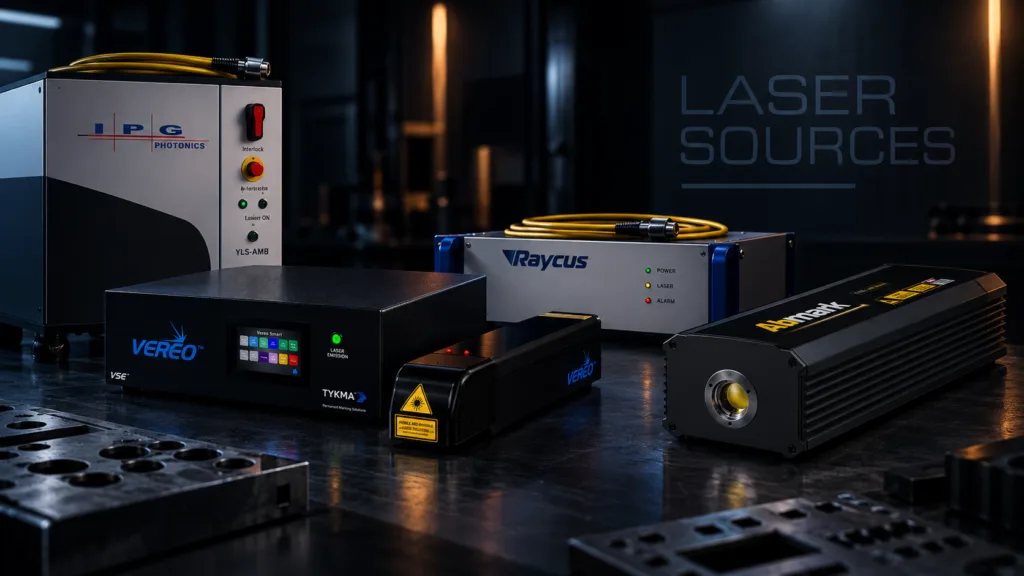
Laser sources from different manufacturers
LMI AB works with laser sources and laser systems from several different manufacturers. The choice of laser source depends on the application, machine concept, required power, beam quality, pulse characteristics and other system requirements.
Examples of manufacturers and laser platforms used in solutions supplied by LMI AB include:
other laser sources selected according to the specific application and machine solution
IPG Photonics – including YLS, YLR and AMB series for industrial laser cutting, laser welding and other materials processing applications
Raycus – fiber laser sources used in various industrial laser systems and machine platforms, including certain HSG machines
TYKMA Electrox – laser sources and complete marking systems for industrial laser marking and engraving
MOPA-based fiber lasers – for applications where flexible control of pulse parameters is important, including marking and surface processing
Standalone laser source or integrated machine component?
A laser source can either be supplied as a standalone component or be integrated as part of a complete laser system.
High-power lasers for special-purpose machines and customised systems can be specified as separate products, while the laser source in a laser cutting machine or laser marking system is often an integral part of the complete solution.
This means that in some applications the laser source is selected directly by LMI AB together with the customer, while in others it forms part of the selected machine platform.
Cooling and energy efficiency
A laser source converts electrical energy into laser light, but some of the energy is converted into heat and must be dissipated.
Depending on the type and power of the laser, cooling may be provided by air or by a separate water-based cooling system.
High electrical efficiency reduces both energy consumption and waste heat, which can reduce cooling requirements and the overall energy consumption of the production system.
Integration into the laser system
The laser source must operate correctly together with the rest of the laser system. When selecting and integrating a laser source, the complete chain should therefore be considered:
- laser source
- process fiber and fiber connection
- laser processing head or scanner system
- collimating and focusing optics
- cooling system
- control system and communication
- process monitoring
- machine automation
- laser safety
A correctly specified laser source is therefore part of a complete process solution and should not be selected independently of the rest of the system.
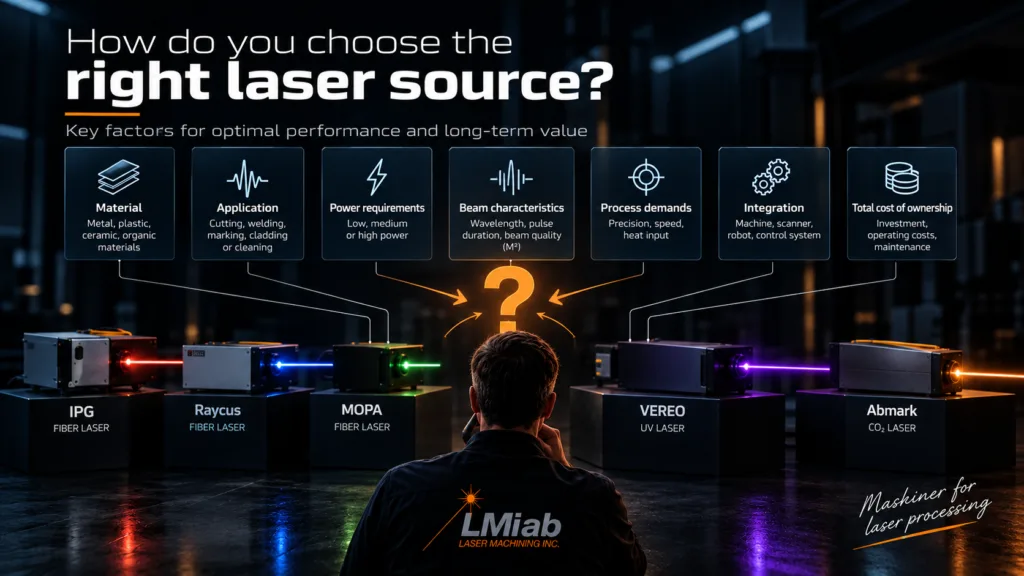
How do you select the right laser source?
The choice of laser source should always be based on the actual application.
Important factors include:
- laser process
- material and material thickness
- required processing speed
- laser power and peak power
- beam quality and BPP
- single-mode or multi-mode
- fiber diameter
- wavelength
- CW, modulated or pulsed operation
- pulse duration and repetition rate
- power control requirements
- cooling
- integration with the processing head or scanner system
It is the combination of these characteristics that determines which laser source will provide the best process result.
Laser sources and product families from LMI AB
Within the Laser Sources product area, LMI AB presents a selection of the laser sources and product families used in our laser systems and customised solutions.
The range includes both standalone laser sources and laser sources integrated into complete machines and systems.
Product families and technologies include:
- IPG YLS series – high-power fiber lasers for industrial materials processing
- IPG YLR series – compact and flexible fiber lasers for a wide range of industrial applications
- IPG AMB series – fiber lasers with adjustable core and ring beams
- pulsed and MOPA-based laser sources for marking, cleaning, ablation and surface processing
- integrated laser sources from Raycus and other manufacturers in complete machine solutions
Frequently asked questions about laser sources
They use different laser media and operate at different wavelengths. Fiber lasers for industrial metal processing typically operate around 1 µm, while conventional CO₂ lasers commonly operate around 10.6 µm. This affects material absorption, optics, beam delivery and overall system design.
No. The correct power depends on the material, process, beam quality, spot size and required processing speed. Excessive power can be unnecessary or unsuitable for some applications.
MOPA stands for Master Oscillator Power Amplifier. The architecture separates generation of the laser signal from power amplification and provides considerable flexibility when pulse parameters need to be adapted to different materials and processes.
Single-mode lasers produce a beam with very high beam quality that can be focused to a small spot, providing high power density.
BPP stands for Beam Parameter Product and is used to describe the quality and focusability of a laser beam. A lower BPP generally indicates better focusability.BPP står för Beam Parameter Product och används för att beskriva laserstrålens kvalitet och fokuserbarhet. Ett lägre BPP innebär generellt bättre fokuserbarhet.
AMB stands for Adjustable Mode Beam and allows laser energy to be distributed between a central core beam and an outer ring beam. By controlling them separately, the energy distribution can be adapted to the process.
In some cases, but the complete laser system must be evaluated. The process fiber, laser head, optics, cooling, control system and laser safety must all be suitable for the new laser source and its beam characteristics.

Contact LMI AB about laser sources
Do you need a laser source for a new laser system, are you planning to upgrade an existing installation, or do you need help selecting the correct power, wavelength and beam characteristics?
Contact LMI AB with information about your process, materials and system requirements, and we can help specify a suitable laser source and configuration.
Contact Tim Smith for consultancy on laser sources.
Tim Smith
Kontaktperson för laserkällor
Tim helps you assess your process and production requirements to identify the right laser source for the application.