


Laser cutting
Laser cutting is a fast, precise and flexible method for industrial processing, particularly of sheet metal, tubes and profiles. Modern fiber laser technology enables everything from thin components to thick plate to be processed with high productivity and repeatability. Here, we explain how laser cutting works, which materials and cutting processes are used, and what is important when selecting a laser cutting machine.
What is laser cutting?
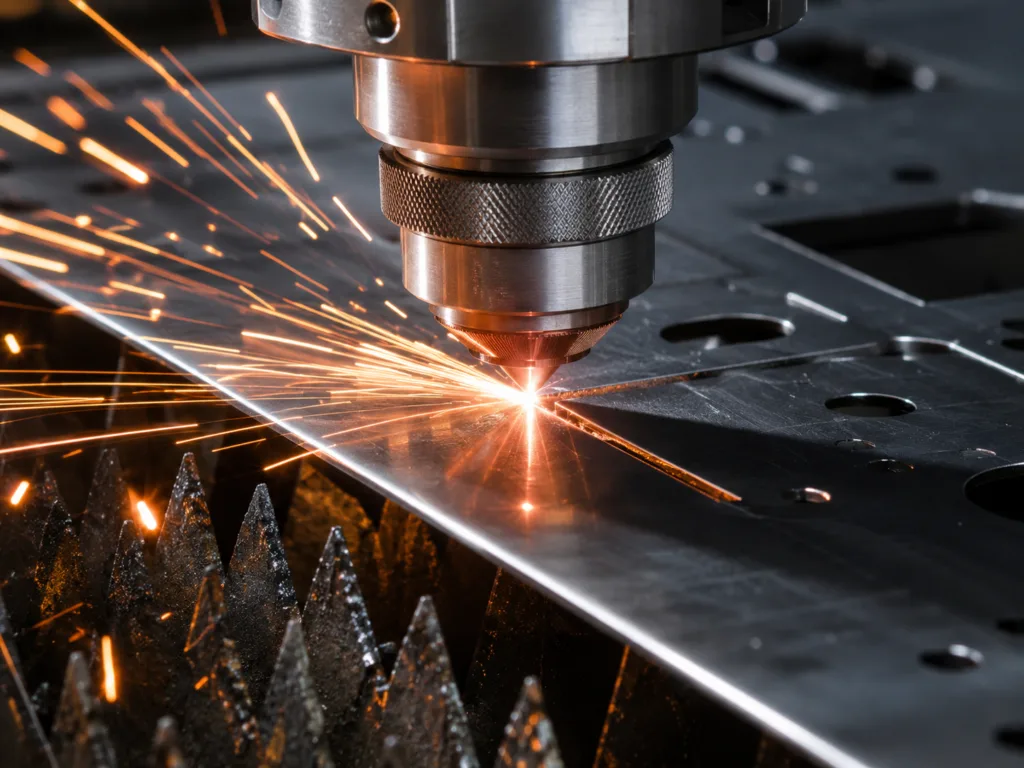
Laser cutting is a thermal processing method in which a concentrated laser beam is used to separate material along a programmed cutting path. The laser beam is focused to a very small spot, creating a high energy density that enables narrow and precise cuts.
Since the process is contact-free, cutting takes place without a mechanical cutting tool. This provides great geometric freedom and makes it possible to switch quickly between different parts simply by changing the cutting program.
In modern industrial metalworking, fiber lasers are the predominant technology. They combine high cutting speeds with good energy efficiency and are suitable for a wide range of metallic materials and material thicknesses.
How does laser cutting work?
The laser beam is directed to a cutting head, where it is focused onto the surface of the material. The high energy density heats the material very locally, causing it to melt, oxidise or vaporise depending on the cutting process.
At the same time, a cutting gas is supplied through the cutting nozzle. The gas helps remove material from the kerf and has a significant influence on both the cutting process and the properties of the finished cut edge.
The movement of the cutting head is digitally controlled according to the programmed geometry. The result is influenced by the interaction of several factors, including:
- laser power
- material and material thickness
- cutting speed
- focal position
- nozzle
- cutting gas and gas pressure
- surface condition of the material
- condition of the machine and optics
When correctly optimised, the process provides high repeatability, good cutting quality and a significantly reduced need for secondary processing.

Benefits of laser cutting in industrial production
Laser cutting has become a key processing method in modern manufacturing because it combines high productivity with great flexibility.
High precision
The focused laser beam enables narrow kerfs and complex contours with high repeatability.
High productivity
Modern fiber laser systems offer high cutting speeds. Higher laser power can also provide significant productivity gains when processing thicker materials.
Great flexibility
Because the geometry is controlled digitally, completely different parts can be produced on the same machine without the need for part-specific cutting tools.
Efficient material utilisation
Nesting software allows parts to be positioned efficiently on the sheet to reduce scrap and improve material utilisation.
Excellent automation potential
Laser cutting machines can be combined with automatic loading and unloading, material storage systems and other solutions for automated production.
Reduced need for secondary processing
With the correct process parameters, laser cutting can provide high edge quality and minimal dross formation, reducing the need for subsequent processing.
Laser cutting of sheet metal
Sheet metal cutting is one of the largest application areas for industrial fiber lasers. The technology is used for everything from thin sheet metal components to the processing of thick plate. Machines are available in many different working formats and power classes and can be configured for both flexible subcontract manufacturing and automated series production.
Common materials include:
- carbon steel
- stainless steel
- aluminium
- galvanised and coated sheet metal
- copper
- brass
- other suitable metal alloys
The thicknesses that can be processed depend on the material, laser power, cutting process, cutting gas and the requirements for the finished part.
High laser power enables both increased productivity and the processing of thicker materials, but the highest available power is not automatically the best choice. The machine should be dimensioned according to the actual material mix and production requirements.
Laser cutting of tubes and profiles
Tube laser cutting enables tubes and structural profiles to be processed directly in an automated process.
Depending on the machine, round, square and rectangular tubes as well as various types of open and closed profiles can be processed.
In addition to conventional cut-off operations, the laser can create:
- holes
- slots
- cut-ons
- connection geometries
- angled cuts
- complex contours
This allows several traditional machining operations to be combined in a single machine. Sawing, drilling and other mechanical machining operations can in many applications be reduced or eliminated entirely.
It can also simplify subsequent assembly and welding by creating connections, positioning features and other functions during the laser cutting process itself.
Fiber laser and CO₂-laser
Fiber laser is currently the most important laser technology for industrial metal cutting. The laser light is generated in a fiber laser source and delivered through an optical fiber to the cutting head.
The technology provides high efficiency, high cutting speeds and relatively low maintenance requirements for the beam delivery system.
CO₂ lasers operate at a different wavelength and are still used in applications where their properties are advantageous, particularly for processing many non-metallic materials such as acrylic, wood, textiles and certain plastics.
| Property | Fiber laser | CO₂-laser: |
| Common applications | Metal, sheet metal, tubes and profiles | Many non-metallic materials and certain metal applications |
| Energy efficiency | High | Lower |
| Beam delivery | Optical fiber | Optical beam path, normally using mirrors |
| Key strength | High productivity in metal processing | Highly suitable for many organic and non-metallic materials |
For industrial metalworking, fiber laser is normally the first choice, but the appropriate laser technology should always be selected according to the material and application.
Cutting gases – an important part of the process
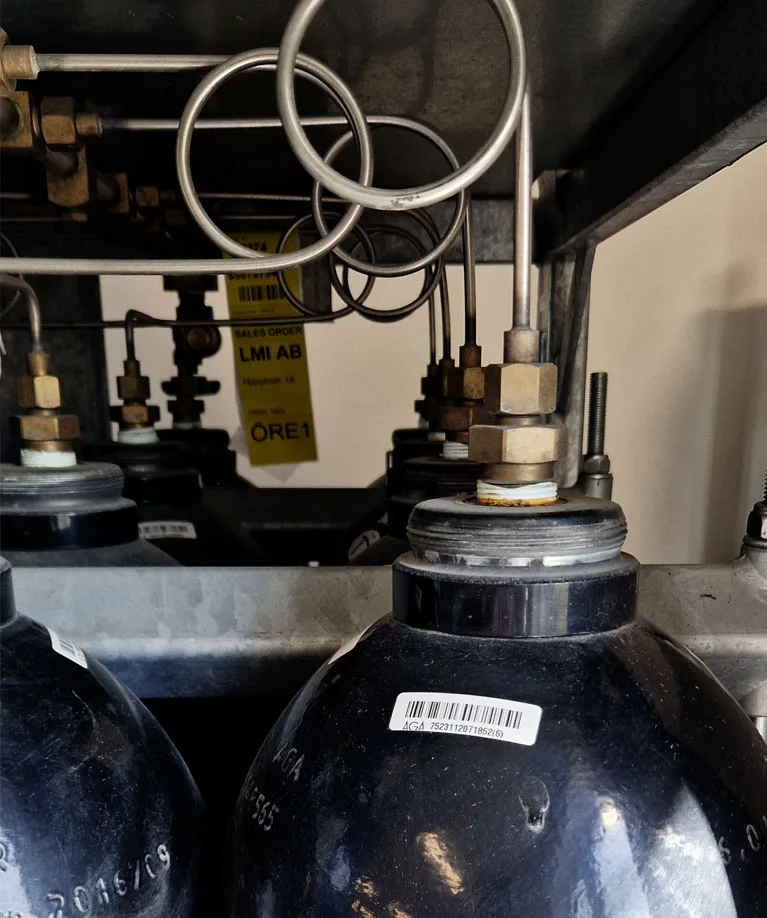
The cutting gas has a major influence on cutting speed, quality, oxidation and production cost. Nitrogen, oxygen and compressed air are the most commonly used gases for laser cutting of metals.
Nitrogen
Nitrogen is often used when a clean and essentially oxide-free cut edge is important, for example when processing stainless steel and aluminium. The gas helps remove molten material without actively contributing to combustion.
Oxygen
Oxygen is primarily used for cutting carbon steel. The oxygen reacts with the material and contributes additional energy to the cutting process. At the same time, an oxide layer is formed on the cut edge.
Compressed air
Compressed air can be a cost-effective alternative for certain applications. The achievable result depends on the material, material thickness, machine, laser power and quality requirements.
The choice of cutting gas is therefore an important part of overall process optimisation and can have a significant impact on the cost per finished part.

What determines cutting quality?
A good cut edge is the result of several interacting factors. High laser power is only one of many parameters that influence the result.
To achieve a stable cutting process, laser power, focal position, cutting speed, nozzle, cutting gas and gas pressure must all be correctly matched to the material.
Material quality, flatness and surface condition also influence the result, as do the condition of the cutting head and optics.
Signs that the process may require optimisation include:
- excessive dross formation
- uneven cutting striations
- incomplete penetration
- discolouration or unwanted oxidation
- excessive heat input
Modern laser cutting machines contain extensive process data and functions that simplify setup, but regular maintenance and process knowledge remain important for stable production.
Laser cutting compared with plasma, oxy-fuel and waterjet cutting
Laser is not the only technology available for industrial cutting. Plasma, oxy-fuel and waterjet cutting all have their strengths and continue to be used in many types of production. The best method depends on factors such as material, thickness, quality requirements, production volume and the need for secondary processing.
At the same time, the development of high-power fiber lasers has made laser cutting competitive across an increasingly wide range of applications. For companies currently using older plasma or oxy-fuel cutting equipment, a modern fiber laser can therefore represent a significant step forward in both productivity and part quality.
Laser cutting compared with plasma cutting
Plasma cutting is an established and robust method for cutting electrically conductive materials and can be a cost-effective alternative, particularly when requirements for precision and cut-edge quality are less demanding.
Fiber laser normally provides higher precision, a narrower kerf and higher cutting speeds in thinner and medium-thickness materials. The improved precision and edge quality can also reduce the need for grinding and other secondary processing.
Laser also offers greater capability for cutting small holes, fine details and complex geometries. Combined with modern automation, this can provide significant productivity benefits.
For companies operating older plasma cutting equipment, it is therefore relevant to compare the total production cost, not just the cutting speed itself. Material utilisation, secondary processing, staffing, energy consumption, consumables and the potential for automated production all influence the actual cost per finished part.
Laser cutting compared with oxy-fuel cutting
Oxy-fuel cutting, also known as flame cutting, is a well-established method used primarily for thicker unalloyed and low-alloy steels. The equipment is relatively simple, and the technology retains clear advantages for very large material thicknesses.
Compared with oxy-fuel cutting, laser offers higher precision, a smaller heat-affected zone and significantly greater geometric flexibility within the thickness range where laser cutting is suitable. Laser cutting also normally requires less secondary processing and is better suited to automated production of complex parts.
Oxy-fuel cutting is, however, more limited in terms of materials. Stainless steel and aluminium, for example, cannot be cut using conventional oxy-fuel cutting in the same way as carbon steel, whereas fiber laser can process a considerably wider range of metallic materials.
Laser cutting compared with waterjet cutting
Waterjet cutting differs from the other methods because the material is cut without a thermal process. This means that no heat-affected zone is created, which is an important advantage for heat-sensitive materials and applications where the material properties must not be affected by heat.
Waterjet cutting can also be used on a very wide range of materials and at large material thicknesses.
For conventional industrial sheet metal processing, however, fiber laser is often considerably faster and is very well suited to automated series production. Abrasive waterjet cutting also requires the handling, consumption and disposal of water and abrasive media.
The technologies therefore compete in some applications, while waterjet cutting also has areas where its cold cutting process makes it a better choice than laser.
Which cutting method is right?
| Property | Fiber laser | Plasma: | Oxy-fuel cutting | Waterjet cutting |
| Precision | Very High | Medium -high | Lower | High |
| Cutting speed in thin/medium-thickness sheet | Very High | High | Lower | Lower |
| Complex geometries | Very good | Good | Limited | Very good |
| Heat-affected zone | Small | Larger | High | None |
| Range of materials | Many metals | Electrically conductive materials | Primarily carbon steel | Very broad |
| Very thick materials | Application-dependent | Good | Very good | Very good |
| Need for secondary processing | Often low | Often higher | Often higher | Often low |
| Automation | Very good | Good | Possible | Good |
There is therefore no cutting technology that is best in every situation. However, developments in fiber laser technology mean that it now covers a considerably wider application range than in the past.
For companies using plasma or oxy-fuel cutting, it can therefore be worthwhile to evaluate which parts could instead be produced using fiber laser. The benefits may include higher cutting speeds and precision, but also reduced secondary processing, better material utilisation and a more efficient automated production flow.
LMI can help compare your existing cutting process with modern fiber laser cutting based on your own materials, parts and production volumes.
Automation and material handling
A fast laser cutting machine does not automatically create an efficient production process. As cutting times become shorter, material handling becomes an increasingly important part of overall productivity.
Depending on production requirements, laser cutting systems can be combined with:
- shuttle tables
- automatic loading and unloading
- sheet storage systems
- automatic material handling
- automated handling of tubes and profiles
- sorting
- production planning and nesting
The appropriate level of automation depends on product mix, batch sizes, staffing and how material should flow through production.
For some operations, a flexible stand-alone machine is the right solution. For others, automated material handling can be essential to fully utilise the machine’s capacity.
How to choose the right laser cutting machine

Choosing a laser cutting machine involves much more than simply comparing maximum laser power.
The starting point should always be the company’s actual production requirements.
Materials and thicknesses
Which materials are processed and what thicknesses are normally used? A machine optimised for high-volume thin sheet production may have very different requirements from a machine primarily intended for thick plate.
Sheet metal, tubes or profiles
Processing flat sheet and processing tubes and profiles place different demands on machine design and material handling. Combination machines are also available for operations that require both capabilities.
Format
Which sheet sizes, tube lengths and profile dimensions need to be handled? The working area must be dimensioned according to actual production requirements.
Production volume
At high machine utilisation, cutting speed, acceleration and material handling have a major influence on productivity. For smaller batches, flexibility and fast changeovers may be more important.
Quality requirements
Requirements for tolerances, edge quality, oxidation and secondary processing influence the choice of both machine and cutting process.
Automation
Automatic loading, unloading and material storage can provide significant productivity gains but should be dimensioned according to the actual material flow.
Service and support
A laser cutting machine is a long-term production investment. Access to service, spare parts, training and technical support is therefore an important part of the overall solution.
LMI helps analyse these factors and dimension a solution based on both current production and future requirements.
High Laser Powers Place Greater Demands

Modern high-power fiber lasers can provide extremely high productivity, faster cutting speeds and the ability to process thicker materials. At the same time, they place greater demands on the cutting head, optics, cleanliness and preventive maintenance.
At high laser powers, even very small amounts of dust or other contamination on optical surfaces can absorb laser energy and cause local heating. This can result in optical damage and, in the worst case, costly downtime.
Proper maintenance procedures, clean handling and access to qualified service therefore become increasingly important as laser power increases. The choice of power should also be based on actual production requirements – the highest possible laser power is not automatically the best solution.

Safety in laser cutting
Industrial high-power lasers can cause serious injury to the eyes and skin. The laser cutting process can also generate fumes, particles, hot material and fire hazards, as well as risks associated with process gases and material handling.
The machine enclosure, safety functions, extraction system and installation must therefore be designed for the specific process.
Many modern laser cutting machines are designed as enclosed Class 1 systems during normal operation, even though the integrated laser source and the open laser process itself involve Class 4 laser radiation.
LMI also provides advice and training in laser safety.
Laser cutting machines and solutions from LMI
LMI offers laser cutting machines for different types of industrial production – from flexible sheet metal processing to high-power cutting, large working formats and advanced processing of tubes and profiles.
Within fiber laser cutting, we offer machines from HSG Laser for:
- sheet metal cutting
- tube and profile cutting
- combined sheet and tube processing
- large sheet formats
- high-power cutting
- automated material handling
We support our customers throughout the process, from needs analysis and machine selection to installation, training, service and support.
Machine models, power ranges and available functions are continuously evolving. Current technical specifications and machine configurations should therefore always be confirmed with LMI before quotation and investment.
Frequently asked questions about laser cutting
Fiber lasers are used for materials including carbon steel, stainless steel, aluminium, copper and brass. CO₂ lasers are also used for many non-metallic materials. The appropriate laser and process must always be selected according to the material.
This depends on the material, laser power, cutting gas, machine configuration and the requirements for cutting quality and productivity. Capacity should therefore be assessed for the specific application rather than based on a general maximum value.
The appropriate power depends primarily on the material mix, thicknesses and required production rate. Higher power can provide major productivity advantages but does not automatically provide the best overall economy for every production environment.
Nitrogen, oxygen and compressed air are common alternatives in metal processing. The choice affects cutting speed, edge quality, oxidation and process cost.
Yes. Combination machines are available that can process both sheet metal and tubes. For high production volumes, separate specialised sheet and tube laser machines may provide higher productivity.
Materials, thicknesses, formats, production volumes, quality requirements, material flow, automation and access to service should all be evaluated together. Comparing machines solely on the basis of laser power does not provide a complete picture of which machine is best suited to the production requirements.

Contact LMI about laser cutting
Are you planning to invest in a laser cutting machine, or would you like to evaluate how a new laser could improve the efficiency of your production?
LMI can help you analyse materials, part geometries, production volumes, capacity requirements and automation needs to identify a technically and economically suitable solution.
Contact us for advice on laser cutting and laser cutting machines.
Niklas Johansson
Vice VD & Teknisk säljare
Niklas har hand om försäljningen och produktgruppen gällande laserskärning. Är mycket på resande fot för kundbesök.