


Laser Marking
Laser marking is a fast, non-contact method for creating permanent, high-detail markings on components and products. The technology is used for serial numbers, part numbers, Data Matrix codes, QR codes, logos and other traceability information.
Here we explain how laser marking works, which materials can be marked, the differences between various laser technologies and what companies should consider when choosing a laser marking system.
What is laser marking?
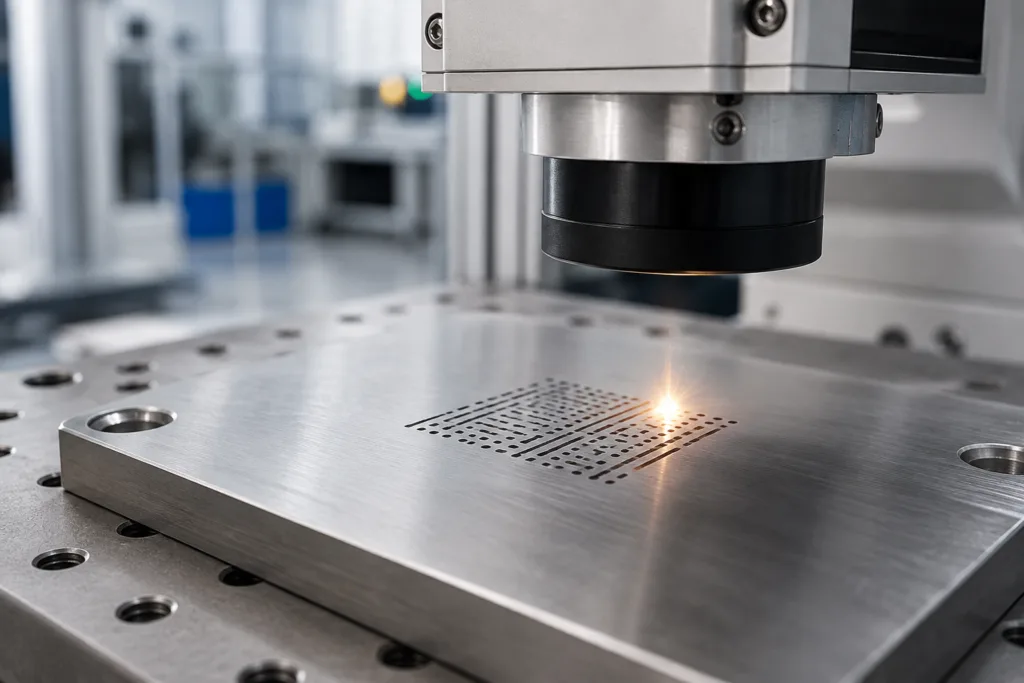
Laser marking is a non-contact process in which a focused laser beam interacts with the surface of a material to create a permanent and clearly defined mark. Depending on the material, laser type and selected process parameters, the laser can, for example, change the colour or structure of the surface, remove a surface layer or coating, or create shallow or deep engraving.
The technology is used throughout industry to mark components and products with serial numbers, part numbers, batch numbers, dates, text, logos, barcodes, QR codes and Data Matrix codes.
Since the marking information is generated digitally, its content can be varied from one component to the next and linked to production, quality and traceability systems.
Achieving the correct marking result requires the laser wavelength, power, pulse characteristics, optics and process parameters to be matched to the material, its surface and the desired result.
How does laser marking work?
The process can be simplified into five steps:
- The marking information is created or retrieved by the system software.
- The product is positioned manually, in a fixture or automatically within a production line.
- The laser source generates laser light with characteristics suited to the material and application.
- Optics and high-speed galvanometer mirrors focus and direct the laser beam across the marking field.
- The laser energy interacts with the material surface to create the programmed text, code or graphics.
Marking can be performed in a standalone workstation, using a mobile system directly on a large component, or as an automated part of a production line.
Cameras, sensors, fixtures and system interfaces can be used for positioning, quality control, code verification and the handling of variable data.
Benefits of industrial laser marking
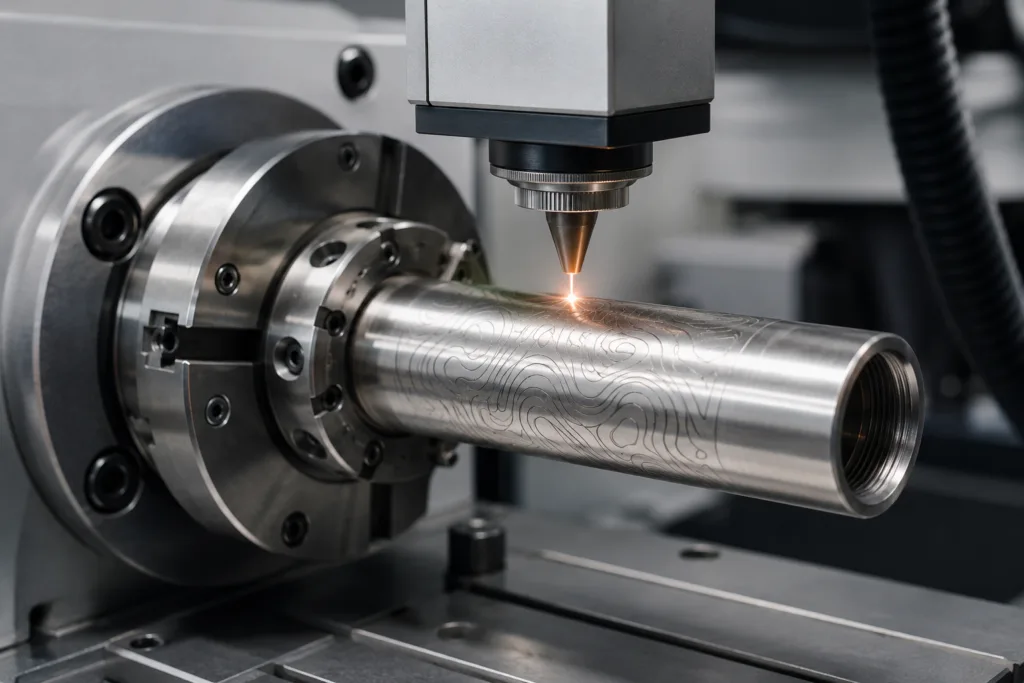
Laser marking is used when markings need to be clear, repeatable and durable while the process must operate efficiently in production.
Permanent marking
The mark is created directly in or on the material surface and can be made highly resistant to wear, chemicals and environmental exposure. The actual durability depends on the material and marking process used.
High level of detail
Lasers can create very small text, detailed graphics and machine-readable codes with high precision.
Non-contact process
No tool needs to make physical contact with the component. This means there is no mechanical tool wear and no mechanical load is applied to the component during marking.
Variable information
Serial numbers, dates, batch data, codes and other information can be changed automatically between individual components.
High repeatability
With suitable fixturing, stable positioning and controlled process parameters, the same marking result can be reproduced with high accuracy throughout production.
Wide range of applications
With the appropriate laser source and wavelength, the process can be used on many metals, plastics, coatings, organic materials and other substrates.
What is laser marking used for?
Laser marking can serve technical, regulatory and visual purposes. Common applications include:
- serial numbers and unique identifiers
- part and component numbers
- batch numbers and manufacturing dates
- Data Matrix codes, QR codes and barcodes
- logos and graphical symbols
- scales, graduations and functional markings
- warning symbols and product information
- markings for assembly and quality control
- traceability data throughout the product lifecycle
- decorative and brand-related markings
The appropriate marking method depends partly on whether the information needs to be human-readable, machine-readable or both.
For a reliable traceability solution, the entire chain must work together: correct data content, sufficient contrast, appropriate code size, stable positioning and reliable reading and, where required, verification of code quality.
Which materials can be laser marked?
Laser marking can be used on a very wide range of materials, but the result is affected by the material composition, surface treatment and how efficiently the material absorbs the laser wavelength.
Common materials include:
- stainless steel and carbon steel
- aluminium and anodised aluminium
- titanium
- brass and copper
- carbide
- engineering plastics
- painted and coated components
- glass and ceramics
- wood, paper, cardboard and other organic materials
Fiber lasers and MOPA fiber lasers are commonly used for marking metals. Depending on the material and process parameters, the laser can create contrast marking, engraving, ablation or annealing marks.
On plastics, marking can instead be produced through processes such as colour change, foaming, carbonisation or superficial material removal. Plastics are particularly material-dependent because the polymer, pigments, fillers and other additives can significantly affect the marking result.
UV lasers are often suitable for heat-sensitive plastics and other materials where very fine details and limited thermal impact are important. CO₂ lasers are particularly suitable for many organic and non-metallic materials.
Because even apparently identical materials can react differently, the actual component should always be test marked. This allows the appropriate laser type and process parameters to be selected based on the required contrast, marking depth, quality and cycle time.
Fiber laser, MOPA fiber laser, UV laser or CO₂ laser?
Different laser sources operate at different wavelengths and have different pulse characteristics. Materials absorb these wavelengths with varying efficiency, which has a significant impact on both the marking result and processing time.
| Lasertype: | Typical strengths | Common applications |
| Fiberlaser | Efficient, fast marking of many metals and engineering plastics | Serial numbers, codes, logos, engraving and traceability marking on industrial components |
| MOPA * fiber laser | Greater control over pulse width and material interaction | Demanding metal and plastic applications where contrast, thermal impact or surface effects need to be optimised |
| UV laser | Very fine processing with low thermal impact on many materials | Sensitive plastics, electronics, small components, fine graphics and very small machine-readable codes |
| CO₂ laser | Good absorption in many organic and non-metallic materials | Packaging, paper, cardboard, wood, glass and certain plastics and coatings |
*) MOPA stands for Master Oscillator Power Amplifier and is a pulsed fiber laser architecture that provides greater control over laser pulse characteristics than a conventional Q-switched fiber laser. This additional flexibility can, for example, be used to optimise contrast on certain plastics, limit thermal impact and create specific surface effects on metals.
The table is intended as a guide. The choice of laser should always be based on the actual component and required marking result rather than solely on a general material category.
Laser marking, laser engraving and laser etching
These terms are sometimes used interchangeably, but they do not always describe the same type of process.
Laser Marking
Laser marking is an umbrella term for processes in which a laser creates information, contrast or another visible change on a surface. The mark can be extremely shallow and does not necessarily involve removing any significant amount of material.
Laser engraving
During laser engraving, material is removed so that the marking has a measurable depth. Engraving can be suitable when the marking needs to withstand substantial mechanical wear or remain visible after subsequent surface treatment.
Deep engraving may require multiple laser passes and normally involves a longer processing time than superficial marking.
Laser etching
The term laser etching is often used for very shallow laser processing in which the laser affects or removes a thin layer of material. However, terminology varies between industries and manufacturers.
Unlike conventional chemical etching, no chemical etchant is used – the surface modification is created by laser energy.
The appropriate process is determined by requirements for contrast, marking depth, surface properties, cycle time and how the component will be used after marking.
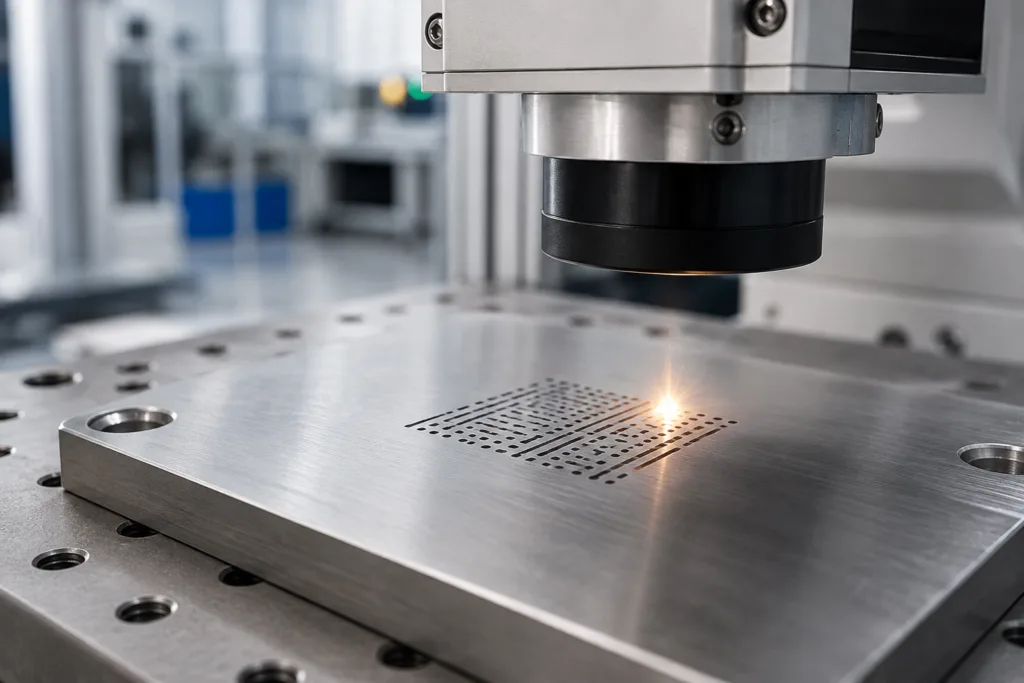
Traceability marking with laser
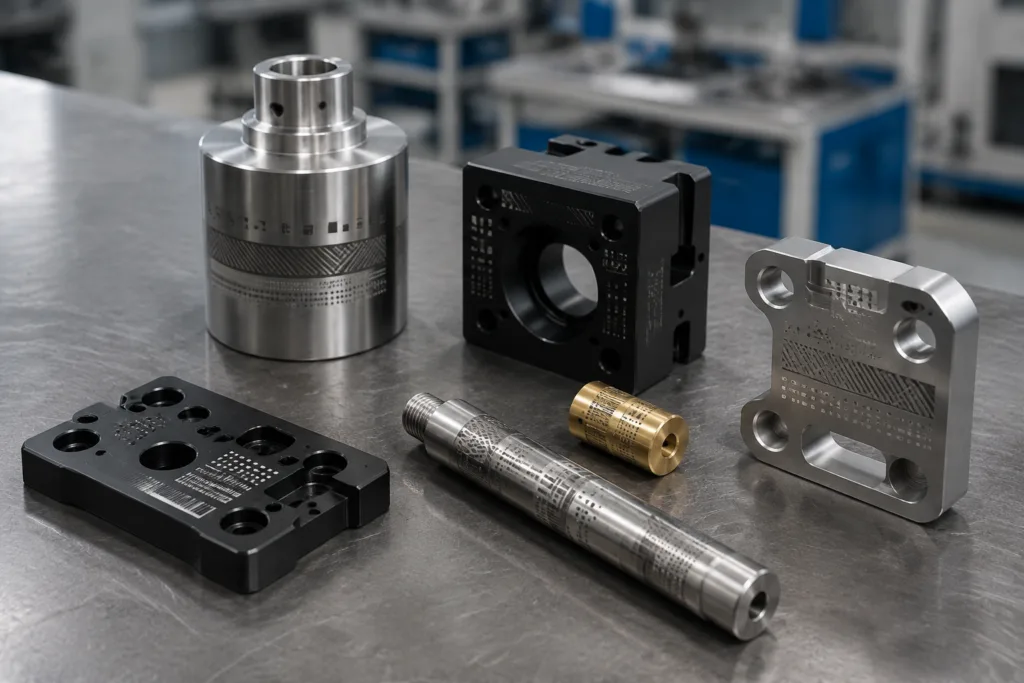
Laser marking is particularly suitable for products that need to be identified throughout production, delivery, use and service.
Each component can be given a unique identity linked to batch numbers, manufacturing data, inspection results or other product information.
Data Matrix codes are frequently used when a unique identity or a large amount of information needs to be represented within a small area.
For a robust solution, several factors need to be considered, including:
- code size and cell size
- contrast against the material background
- marking field and optics
- component position and geometry
- surface variations between components and batches
- reader position and illumination
- code quality verification
- integration with databases, PLCs, MES or other production systems
A technically sharp and visually clear mark does not automatically constitute a reliable traceability solution. Marking, data flow, reading and verification need to be designed as one integrated process.
Standalone, mobile or integrated laser marking
Standalone marking station
An enclosed workstation is suitable when an operator manually loads components or places them in a fixture.
The station can be configured with features such as a motorised Z-axis, XY table, rotary unit, camera and different optical marking fields. This type of system provides considerable flexibility when handling product variation and batch production.
Mobile laser marking
A mobile system allows the marking head to be moved to the component rather than moving the component to the machine.
This is useful for large, heavy or installed components that are difficult or impossible to place inside a conventional marking station.
Because the laser head is used outside a traditionally enclosed workstation, the safety solution must be carefully adapted to the system design and operating environment.
Integrated marking in production lines
For high-volume production, the marking laser can be integrated directly into a production cell, robotic cell or conveyor system.
The system can, for example, receive variable data, verify that the correct component is in position, perform the marking operation and subsequently verify the result.
Marking products while they are moving is commonly referred to as on-the-fly marking.
Which laser technology is suitable for marking?
| Property | Fiber laser | MOPA fiber laser | UV laser | CO₂ laser |
| Typical materials | Metals and many engineering plastics | Metals and demanding plastic applications | Plastics, glass, ceramics and sensitive materials | Wood, paper, cardboard, glass and certain plastics |
| Common results | Contrast marking and engraving | Contrast, specific colour and surface effects, and controlled material interaction | Very fine marking with limited thermal impact | Marking, engraving and removal of certain surface coatings |
| Level of detail | Very High | Very High | Very High | High |
| Control of thermal impact | Good | Very good | Very good | Material-dependent |
| Marking speed | High | High | Application-dependent | High on suitable materials |
| Particularly suitable for | Industrial metal marking and traceability | Demanding applications where pulse characteristics and material interaction need to be optimised | Small codes, electronics and heat-sensitive materials | Packaging and organic materials |
There is no single laser technology suitable for every material and marking requirement. The choice must be based on the material composition, desired contrast, marking depth, level of detail and required production cycle time.
For this reason, test marking on the actual component is always recommended before configuring the system.
What affects the marking result?
A stable and readable marking result depends on several factors:
- exact material composition and surface treatment
- laser wavelength and pulse characteristics
- laser power and pulse energy
- frequency and pulse width
- scanning speed and hatch spacing
- focal position and choice of optics
- marking field size
- component flatness and geometry
- fixturing and repeatable positioning
- required marking depth and contrast
- permitted cycle time
- whether the marking needs to be human-readable or machine-readable
- extraction and management of fumes, gases and particles
A larger marking field is not always better. Increasing the marking field changes factors such as focusing, spot size and available power density. For small codes and very fine details, a smaller optical marking field or programmable positioning of the component or marking head may therefore provide better results.
How to choose the right laser marking system
Material and surface
What is the component made of, and does it have a coating, paint or other surface treatment?
Marking content
Does the system need to create text, graphics, serial numbers, machine-readable codes, contrast marking or deep engraving?
Quality requirements
What level of contrast, resolution, durability and code quality is required?
Component size and geometry
Is the component flat, cylindrical, large, heavy or variable in shape and size?
Marking field
How large an area needs to be marked, and how small are the finest details?
Production volume and cycle time
How many components need to be marked, and what cycle time and availability must the process achieve?
Handling and automation
Should the system be standalone, mobile, robot-integrated or installed directly in a production line?
Data and integration
Should marking information be retrieved from a PLC, database, MES, ERP system or operator?
Safety and extraction
How will laser radiation and any fumes, gases or particles generated by the process be managed?
Service and future development
What training, spare-part availability and technical support will be required throughout the system’s service life?

Safety in laser marking
Industrial marking lasers can pose risks to the eyes and skin. The process can also generate fumes, gases and particles depending on the material and surface coating being processed.
The machine’s laser classification, enclosure and safety functions therefore need to be combined with risk assessment, appropriate extraction, documented procedures and trained personnel.
An enclosed and interlocked workstation can normally be designed as a Class 1 laser product during normal operation, while open and mobile systems may require additional protective measures.
The final safety solution must always be adapted to the laser system design, laser source, application and operating environment.
Laser marking solutions adapted to your production
LMI provides laser marking systems for a wide range of industrial requirements – from compact workstations and mobile marking lasers to larger multi-axis systems and solutions for integration into automated production lines.
Our range includes solutions from manufacturers such as TYKMA Electrox and Abmark.
LMI can help you evaluate the material, marking result, laser technology, optics, marking field, fixturing, automation and safety requirements. By starting with the actual component and production process, the system can be configured to achieve the required quality, cycle time and production flow.
Frequently asked questions about laser marking
Laser marking is a non-contact process in which a focused laser beam interacts with a material surface to create permanent text, graphics or machine-readable codes. The result depends on the material, laser technology and selected process parameters.
Metals, many engineering plastics, anodised and painted surfaces and a wide range of organic and non-metallic materials can be marked using the appropriate laser technology. The exact material composition and surface should always be tested, as even small differences can affect the marking result.
Laser marking is an umbrella term for several laser processes that create information or contrast on a surface. During laser engraving, material is removed so that the mark has a measurable depth.
Laser etching is often used as a term for shallow laser processing of a material surface, although terminology varies between industries. Unlike conventional chemical etching, laser energy is used to modify the material surface.
Fiber lasers and MOPA fiber lasers are common choices for marking metals. The optimum laser technology, power, optics and pulse characteristics depend on the material, surface, required contrast, marking depth and cycle time.
Both are fiber lasers, but a MOPA fiber laser provides greater control over laser pulse characteristics, particularly pulse width. This makes it possible to fine-tune the interaction with the material and can provide advantages for certain plastics, sensitive surfaces and applications requiring specific contrast or colour effects.
Yes. Many plastics can be laser marked, but the result varies depending on the polymer, pigments, fillers and other additives. Fiber laser, MOPA fiber laser or UV laser may be suitable depending on the material and required marking result.
Yes. Serial numbers, Data Matrix codes, QR codes and other unique information can be generated automatically and linked to production, quality or business systems. For machine-readable codes, code quality and reliable reading also need to be ensured.
Yes, this is strongly recommended. Materials that appear identical can contain different alloys, pigments, additives or surface treatments and may therefore react differently to laser light. Test marking makes it possible to select the appropriate laser source, optics and process parameters before the system is specified.

Contact LMI about laser marking
Are you planning to invest in a laser marking machine, or would you like to investigate how laser marking could improve traceability and increase efficiency in your production?
LMI can help you analyse the material, surface treatment, marking content, component geometry, production volume, cycle time and automation requirements to identify a technically and economically suitable solution.
Contact Urban Gärds for advice on laser marking and laser marking systems.
Urban Gärds
Contact person for laser marking
Urban can help you evaluate your material, marking requirements and production needs to identify the appropriate laser technology and marking system for your application.