


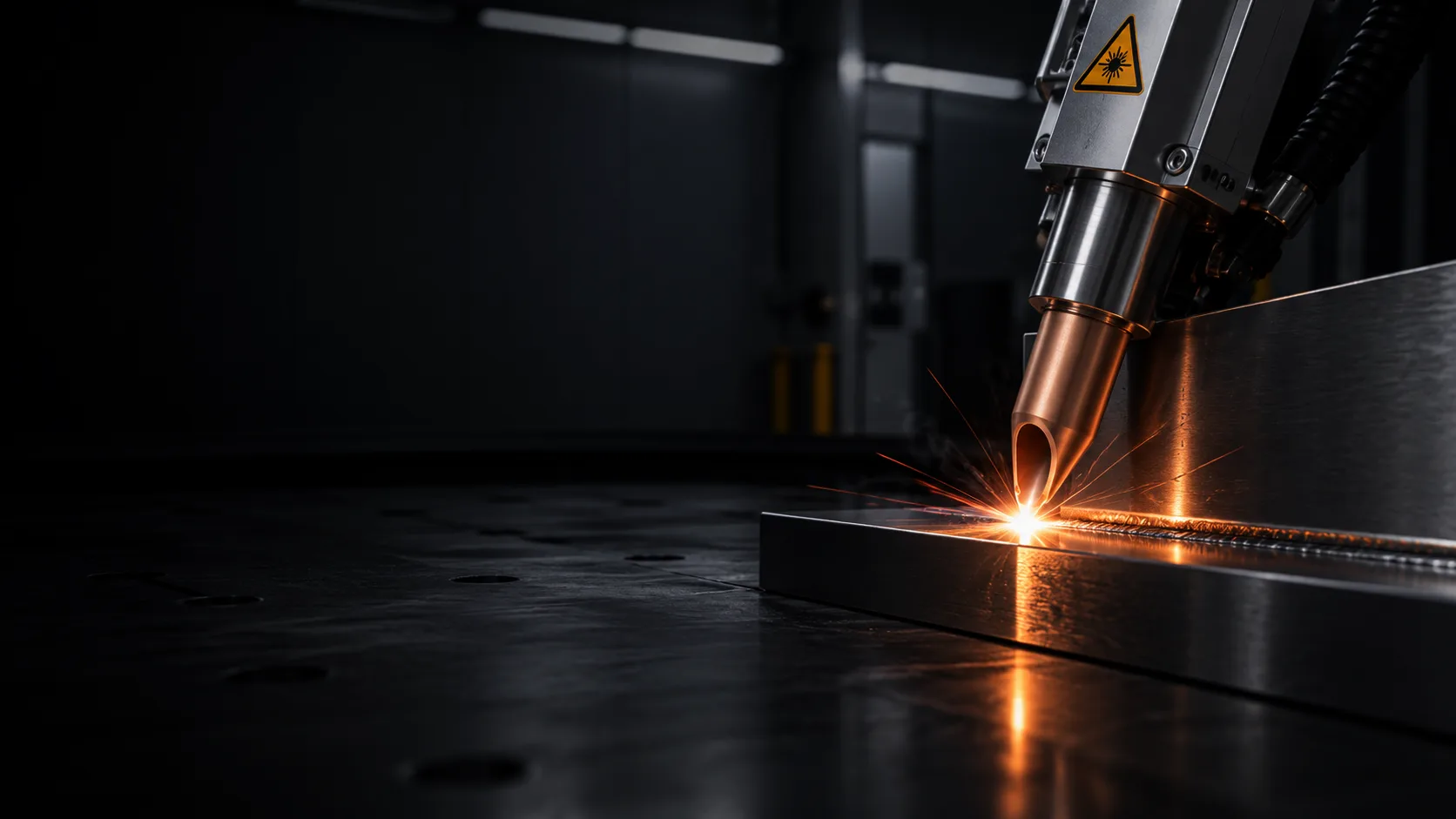
Laser Welding
Laser welding is a fast and precise method for joining metallic materials, in which a concentrated laser beam is used to melt the material and create a weld joint. The high energy density makes it possible to achieve high welding speeds, narrow weld seams and limited heat input to the surrounding material. Here we explain how laser welding works, which materials and applications the technology is suitable for, the differences between various welding principles, and what is important to consider when selecting a laser welding system.
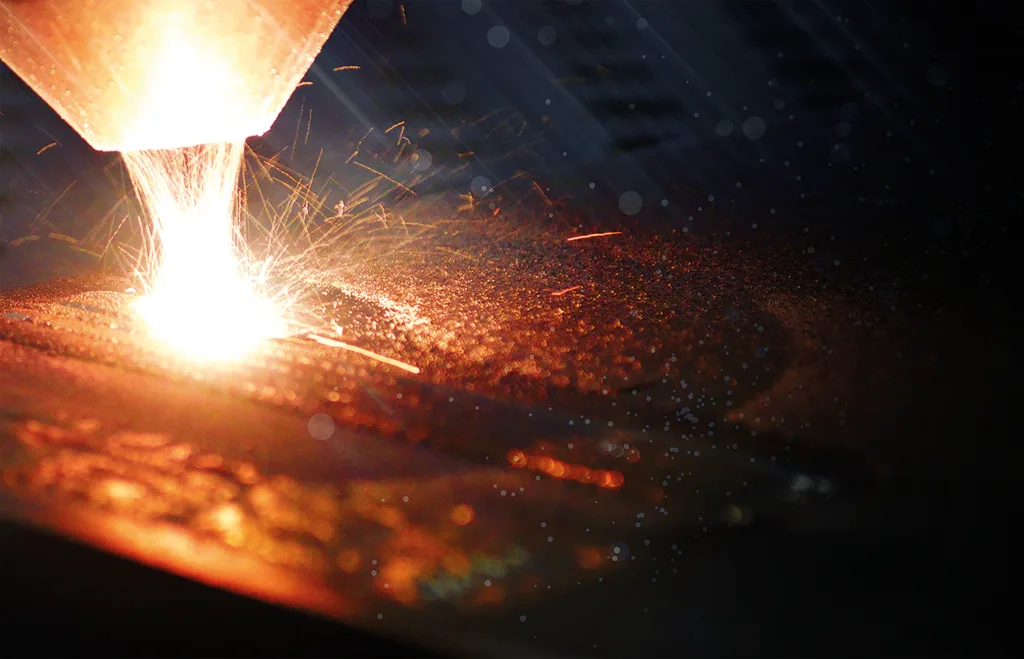
What is laser welding?
Laser welding is a fusion welding process in which a focused laser beam delivers energy to a very limited area. The material melts locally and forms a molten pool that solidifies into a weld seam as the laser beam moves along the joint.
The concentrated energy input allows the process to produce a narrow weld seam and a relatively small heat-affected zone, HAZ (Heat Affected Zone). This can reduce distortion and the need for post-processing compared with welding processes where heat is distributed over a larger area.
Laser welding can be performed without filler material, known as autogenous welding, or with filler material such as welding wire. The process can be performed manually using a handheld laser welder, automated using linear or multi-axis motion, or integrated into robot- and cobot-based production systems.
How does laser welding work?
The process can be described in five basic steps:
- Laser light is generated in the laser source and directed to the welding optics.
- The optics focus the laser beam onto a defined area of the workpiece.
- The laser energy is absorbed by the material and converted into heat.
- The material melts locally and forms a molten pool. At sufficiently high power density, a so-called keyhole can also form.
- As the laser beam moves along the joint, the molten material solidifies behind the beam and forms the weld seam.
The process is influenced by factors including laser power, welding speed, focal position, beam diameter, material, joint geometry and the possible use of shielding gas and filler material. It is the combination of these parameters – rather than any single setting – that determines weld penetration, geometry and quality.
Conduction welding and deep penetration welding
Laser welding can be performed according to two main process principles: conduction welding and deep penetration welding, often referred to as keyhole welding.
Conduction welding – conduction mode
In conduction welding, the power density is sufficient to melt the surface of the material but not to cause significant vaporisation.
Heat is conducted from the surface into the material through thermal conduction. The result is normally a relatively wide and shallow weld seam.
Conduction welding is primarily used when:
- the material is thin
- deep penetration is not required
- surface finish and weld geometry are important
- highly controlled heat input is desired
Deep penetration welding – keyhole mode
When the power density is increased sufficiently, the material begins to vaporise. The vapour pressure creates a narrow cavity in the molten material – a so-called keyhole.
The laser light can penetrate deeper into the material and is efficiently absorbed within the cavity. This makes it possible to create significantly deeper and narrower weld seams than with pure conduction welding.
Keyhole welding is used when deep penetration, high welding speed and narrow weld seams are important.
At the same time, the process requires careful control. An unstable keyhole can contribute to porosity, spatter and variations in penetration depth.
Benefits of industrial laser welding
Laser welding offers several characteristics that make the technology attractive for modern industrial production.
High welding speed
The concentrated energy allows welding to be performed at significantly higher speeds than conventional arc welding processes in many applications.
Limited heat input
The energy is concentrated within a relatively small area. This can result in a narrow heat-affected zone and reduced thermal distortion of the component.
High precision
The laser beam can be focused and positioned with high accuracy, making the process suitable for small components, narrow joints and complex geometries.
Deep and narrow weld seams
In keyhole welding, a high ratio between penetration depth and weld width can be achieved.
Possibility of welding without filler material
With good joint fit-up, many applications can be welded autogenously, eliminating the need for filler material.
Excellent potential for automation
The laser beam can be integrated with robots, cobots, linear axes and other automation systems. The process is therefore well suited to repeatable series production.
Reduced need for post-processing The narrow weld seam and limited heat input can reduce the need for straightening, grinding and other post-processing operations.
What is laser welding used for?
Laser welding is used in many industrial sectors where high precision, productivity and repeatable quality are required.
Common applications include:
- automotive and transport industries
- sheet metal constructions
- machinery and engineering industries
- batteries and electrical components
- electronics and precision engineering
- medical devices
- stainless steel and aluminium components
- enclosures and containers
- tubes and profiles
- tools and precision components
- automated series production
Laser welding can be used for both very small precision components and larger industrial structures.er.
Which materials can be laser welded?
Many metallic materials can be laser welded, including:
- structural steel
- stainless steel
- high-strength steels
- aluminium and aluminium alloys
- nickel and nickel alloys
- titanium and titanium alloys
- copper and certain copper alloys
The material’s absorption, thermal conductivity, melting temperature and metallurgical properties influence how easily a stable welding process can be achieved.
Stainless steels and many steel grades are generally well suited to laser welding.
Aluminium requires greater consideration of factors including high thermal conductivity, surface properties and the risk of porosity and cracking in certain alloys.
Copper is particularly challenging for traditional infrared fiber lasers because the material both reflects a large proportion of the incident laser light and conducts heat away very efficiently. The choice of laser source, wavelength, beam quality and process parameters is therefore particularly important. Material combinations and different alloys should always be test welded to verify the process, strength and weld quality.
Joint design and fit-up
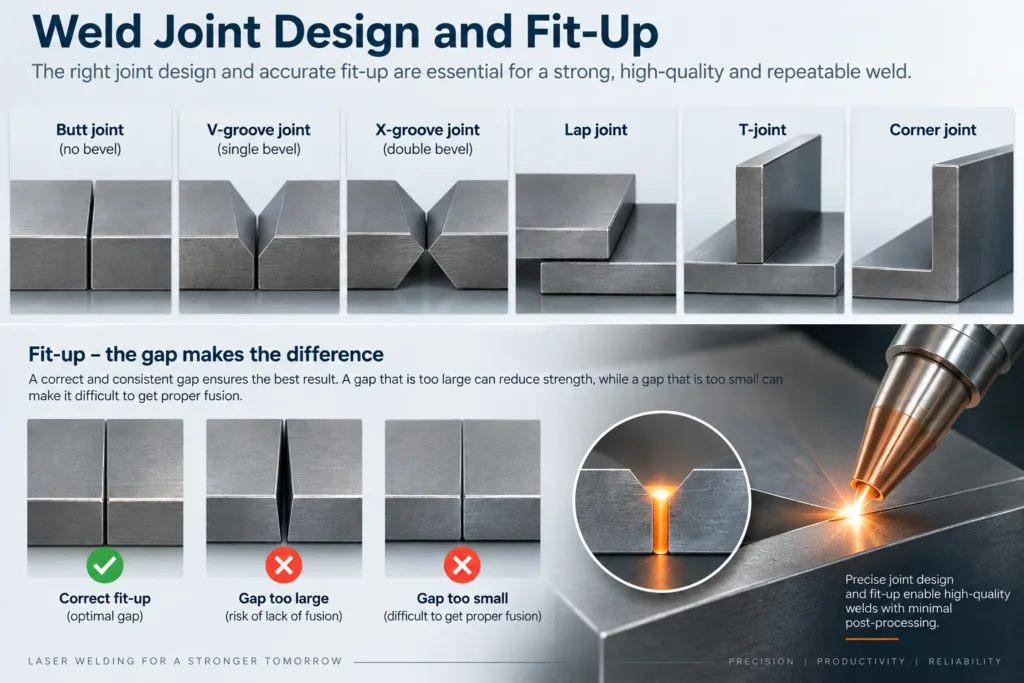
Laser welding often places higher demands on joint fit-up and positioning than traditional arc welding processes.
Because the laser beam and weld seam can be very narrow, the laser beam must hit the joint with high precision.
Common joint types include:
- butt joints
- lap joints
- T-joints
- corner joints
- edge joints
In autogenous laser welding, the gap between the components is particularly important because no filler material is available to compensate for larger variations.
Filler material can be used to bridge gaps, influence the chemical composition of the weld metal or improve the weldability of certain material combinations. Good fixturing and repeatable component positioning are therefore often essential for a stable automated laser welding process.
Filler material in laser welding
Laser welding can be performed both with and without filler material.
Autogenous laser welding
In autogenous welding, only the base materials are melted together. The method provides a simple and fast process but places high demands on joint fit-up and material compatibility.
Laser welding with filler wire
Filler wire can be used to:
- bridge small gaps
- compensate for variations in joint geometry
- influence the chemical composition of the weld metal
- improve weldability
- create the desired weld geometry
The wire feed must be synchronised with the laser beam and movement along the joint to achieve a stable process.
Shielding gas in laser welding
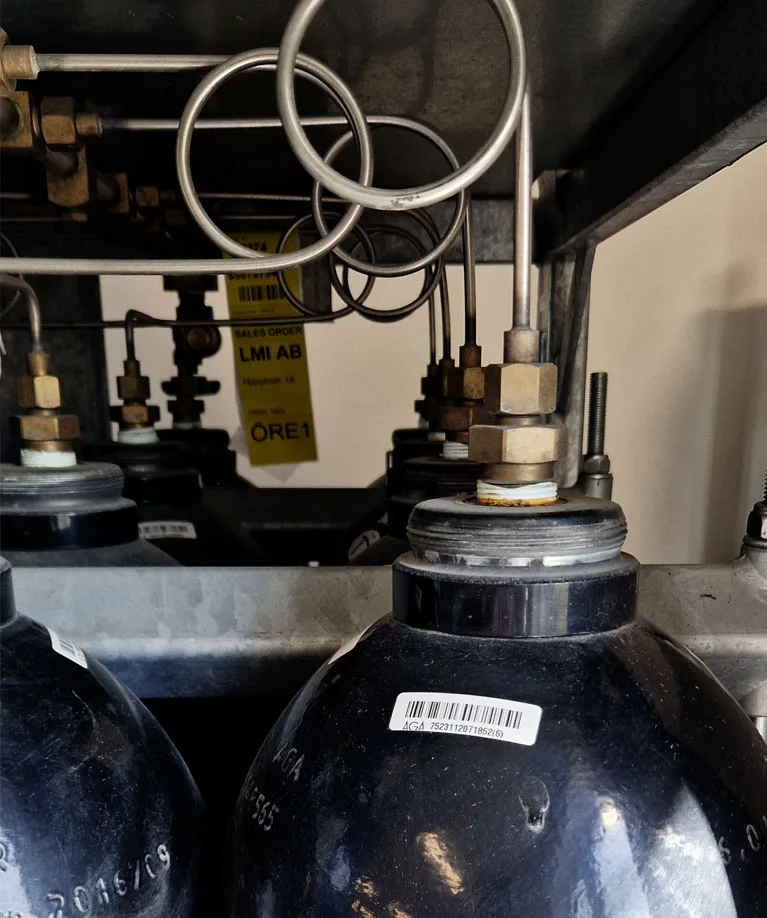
Shielding gas is used in many laser welding processes to protect the molten pool and heated material from the surrounding atmosphere.
Common shielding gases include argon, helium or gas mixtures adapted to the material and process.
The shielding gas can influence:
- oxidation
- weld surface quality
- porosity
- process stability
- weld geometry
The type of gas, flow rate, nozzle position and direction must therefore be adapted to the specific process. For certain materials, root shielding may also be required to protect the underside of the weld from oxidation.
What affects the welding result?
A stable and repeatable welding result depends on the interaction between a large number of parameters.
Important factors include:
- laser power
- welding speed
- beam diameter and power density
- focal position
- beam quality
- material and alloy
- material thickness
- joint geometry
- gap and joint fit-up
- fixturing
- component position
- shielding gas
- filler material and wire feed
- coatings, oxides and contaminants
- desired penetration depth
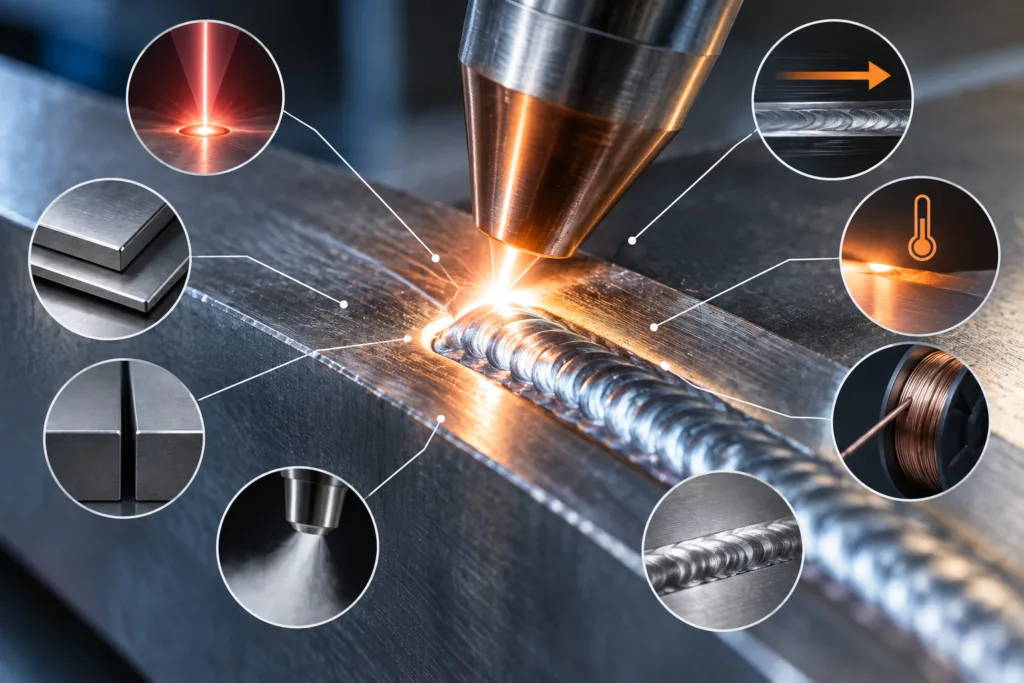
Higher laser power does not automatically result in a better weld. Laser power, speed, focus and other process parameters must be balanced to create the desired weld geometry and a stable process.
Common defects in laser welding
As with other welding processes, laser welding can produce defects if the material, joint preparation or process parameters are not correctly adapted.
Examples include:
- porosity
- cracks
- lack of fusion
- insufficient penetration
- excessive penetration
- burn-through
- undercut
- spatter
- irregular weld geometry
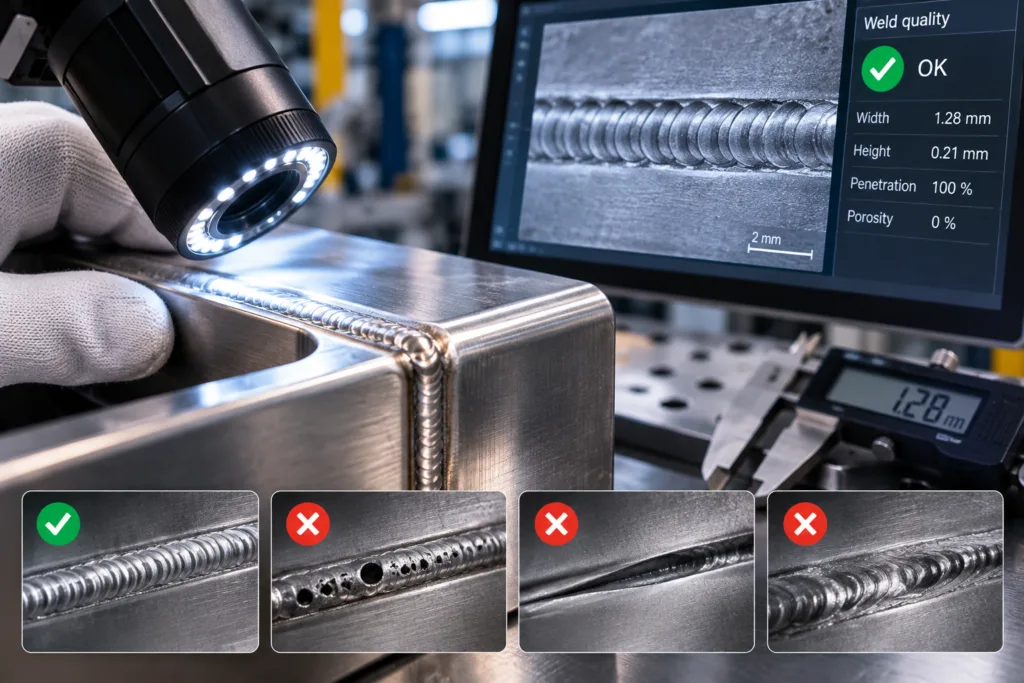
Porosity can, for example, result from instability in the keyhole process, gases in the material or contamination on the component surface. Careful process development, clean components, stable fixturing and correct parameters are therefore important for achieving repeatable weld quality.
Handheld or automated laser welding?
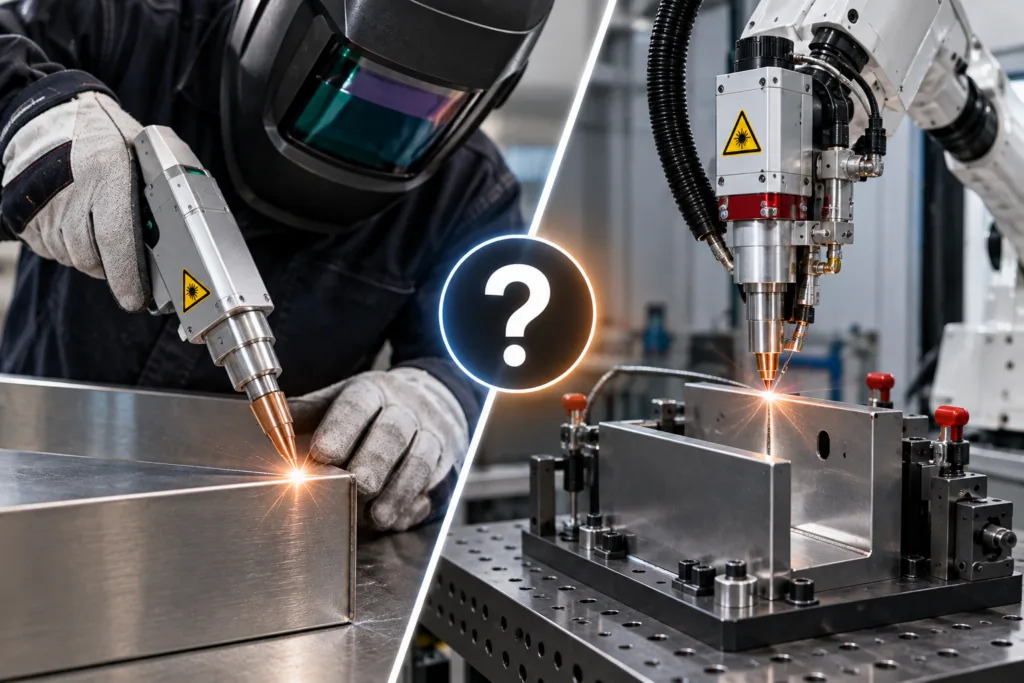
Laser welding can be used both as a manual and an automated process.
Handheld laser welding
In handheld laser welding, the operator guides the welding optics along the joint.
The technology is suitable for applications including:
- small and medium-sized production runs
- varying components
- sheet metal constructions
- workshop production
- applications where high flexibility is important
Handheld systems can provide significantly higher welding speeds than traditional TIG welding in suitable applications.
However, the process requires appropriate training, risk assessment and a carefully designed laser safety solution.
Cobot- and robot-based laser welding
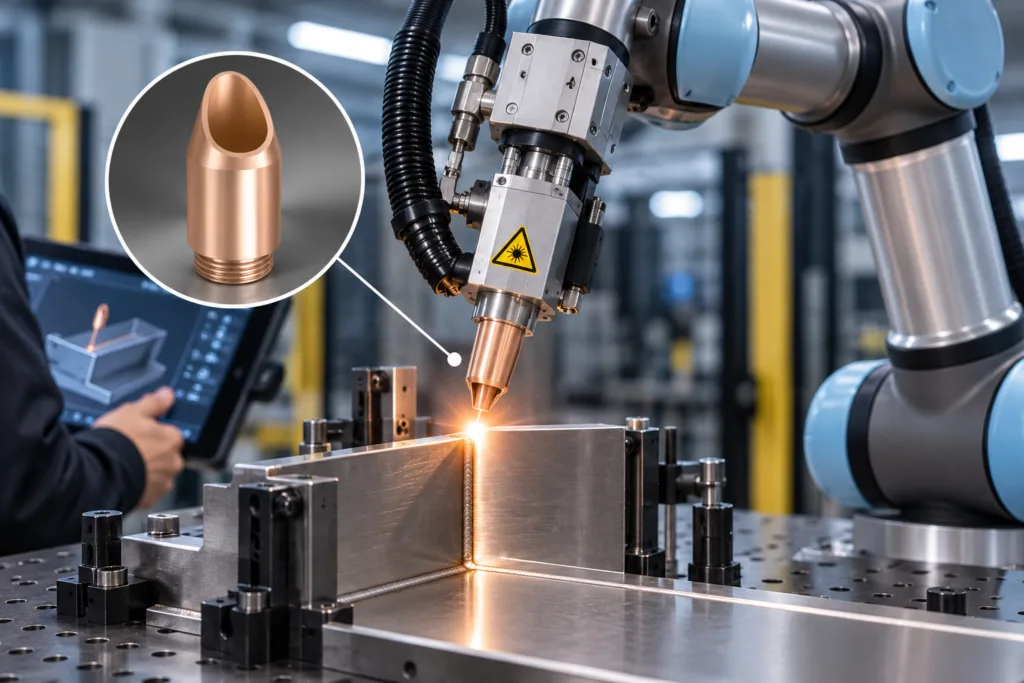
In automated laser welding, the welding optics or component is controlled using, for example, an industrial robot, cobot or multi-axis motion system.
This enables:
- high repeatability
- stable welding speed
- precise positioning
- short cycle times
- automated series production
- integration with other production equipment
Robotic laser welding is particularly attractive when the same or similar components are produced in larger volumes.traktiv när samma eller liknande komponenter produceras i större volymer.
Remote welding – laser welding at a distance
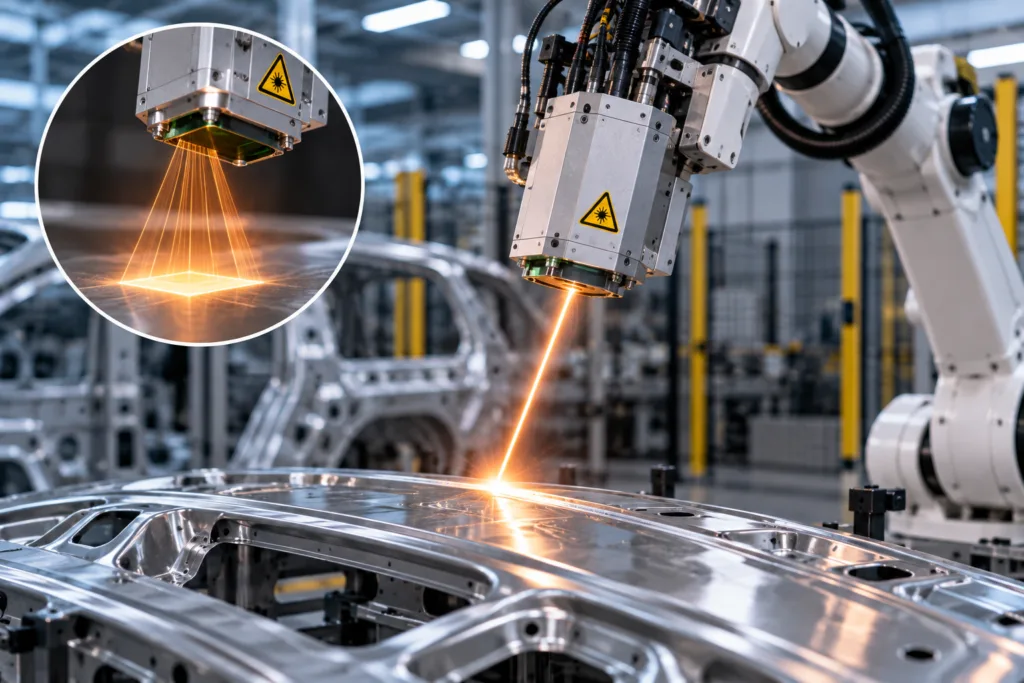
Remote welding is an automated laser welding process in which the laser beam is directed across the workpiece using fast galvanometer mirrors in a scanner head. Unlike conventional robotic laser welding, the welding optics therefore do not need to mechanically follow each individual weld seam.
The laser beam is focused from a relatively long working distance and can be moved very quickly between different weld points and weld seams within the working area of the scanner optics. Repositioning the laser beam itself can take only a fraction of the time required to mechanically move a robot or welding optics.
This makes remote welding particularly attractive for the production of components with many short welds or weld points, where the time between individual welding operations would otherwise account for a significant proportion of the total cycle time.
Benefits of remote welding
Remote welding can provide:
- very short positioning times between welds
- high productivity and short cycle times
- the ability to perform many welds within a large working area
- high precision and repeatability
- flexible programming of welding patterns and geometries
- reduced need for mechanical movement
- excellent potential for integration into automated series production
The technology is used in the automotive industry, battery manufacturing and other high-volume production environments where a large number of welds need to be performed quickly and repeatably.
Remote welding with robot and scanner optics
A remote welding system can also combine an industrial robot with scanner optics. The robot movement then provides a large overall working area, while the scanner head performs the very fast and precise movements of the laser beam.
By combining the mechanical movement of the robot with the optical movement of the scanner, the system can process large and complex components while taking advantage of the high speed of remote welding. The technology places high demands on component positioning, joint fit-up, programming, focal position and process control. Since the working distance is large and the laser beam can be directed over an extensive area, laser safety must also be an integral part of the system design.
Laser welding compared with TIG, MIG and MAG
Laser welding does not automatically replace conventional welding methods. The best process depends on the component, material, quality requirements and production environment..
| Property | Laser welding | TIG welding | MAG welding |
| Welding speed | Very high in suitable applications | Relatively low | High |
| Heat input | Low and concentrated | Relatively high | Relatively high |
| Heat-affected zone | Typically narrow | Wider | Wider |
| Distortion | Typically low | Higher risk | Higher risk |
| Precision | Very high | High | Good |
| Joint fit-up | Often demanding | More tolerant | More tolerant |
| Filler material | Not always required | Commonly used | Commonly used |
| Automation | Very well suited | Possible | Very well suited |
| Investment level | Higher | Lower | Lower |
| Productivity in series production | Very high | Lower | High |
TIG, for example, is a highly flexible process that provides good control and may be more suitable for low production volumes, complex manual work or applications where joint fit-up varies.
MIG/MAG are robust and cost-effective processes for many structures and material thicknesses.
Laser welding becomes particularly attractive when high welding speed, low heat input, low distortion, high precision or automation have a major impact on the total production cost.
Quality control in laser welding
Quality control requirements depend on the function of the component and the requirements applicable to the specific product.
Methods may include:
- visual inspection
- dimensional inspection
- dye penetrant testing
- X-ray inspection
- ultrasonic testing
- metallographic examination
- tensile or strength testing
- leak testing
In automated systems, process monitoring can also be used to record various process signals during welding. The appropriate inspection method depends on the material, joint type, weld geometry and the types of defects that need to be detected.
How to choose the right laser welding system
Material and thickness
Which materials need to be welded and what material thicknesses are involved?
Joint and geometry
Which joint types need to be welded, and how accurately can component fit-up and positioning be controlled?
Penetration depth
Is surface welding, partial penetration or full penetration required?
Welding speed and production volume
What cycle time must the process achieve, and how many components need to be produced?
Filler material
Can the process be performed autogenously, or is filler wire required?
Automation
Should welding be performed using a handheld system, cobot, industrial robot or a custom-built multi-axis system?
Quality requirements
What requirements apply to strength, leak tightness, weld geometry, appearance and repeatability?
Process control
Is automatic seam tracking, a camera system, sensors or monitoring of the welding process required?
Safety
How should laser radiation, reflections, welding fumes and other risks be managed?
Service and support
What training, service and technical support will be required throughout the system’s service life?
Safety in laser welding
Laser welding uses very high-power laser radiation and therefore requires a carefully designed safety solution.
Industrial welding lasers are normally Class 4 before being incorporated into a safe machine or cell. Direct and reflected laser radiation can pose serious risks to both the eyes and skin.
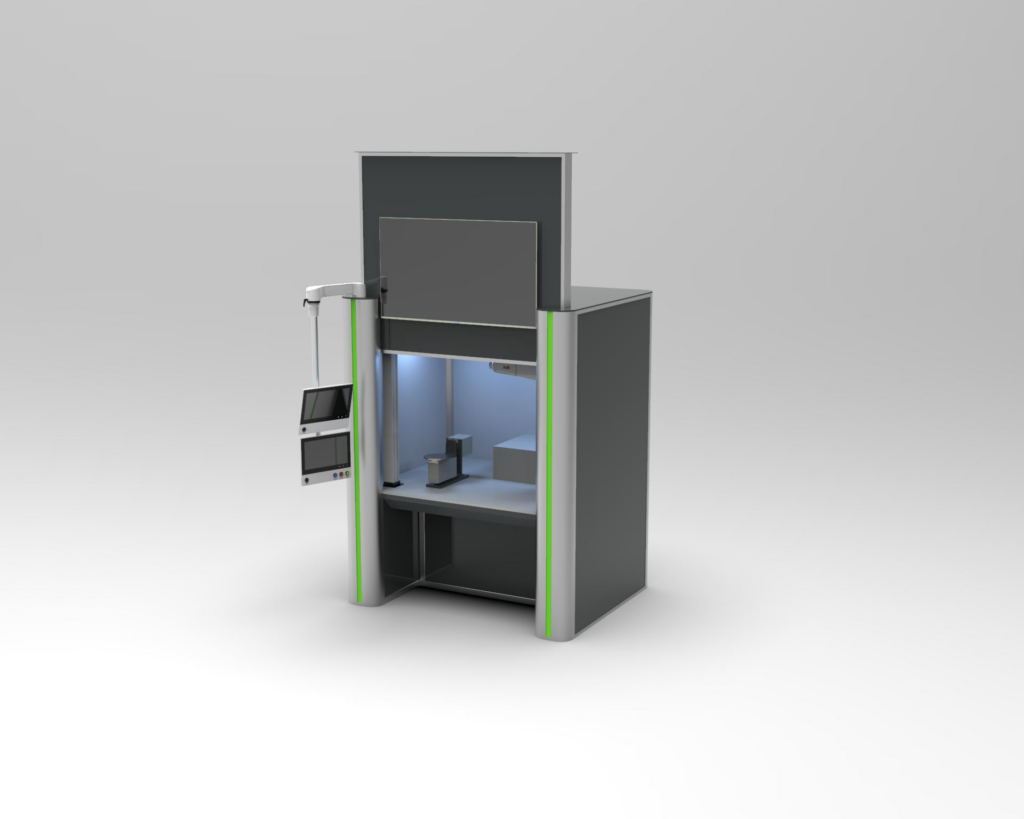
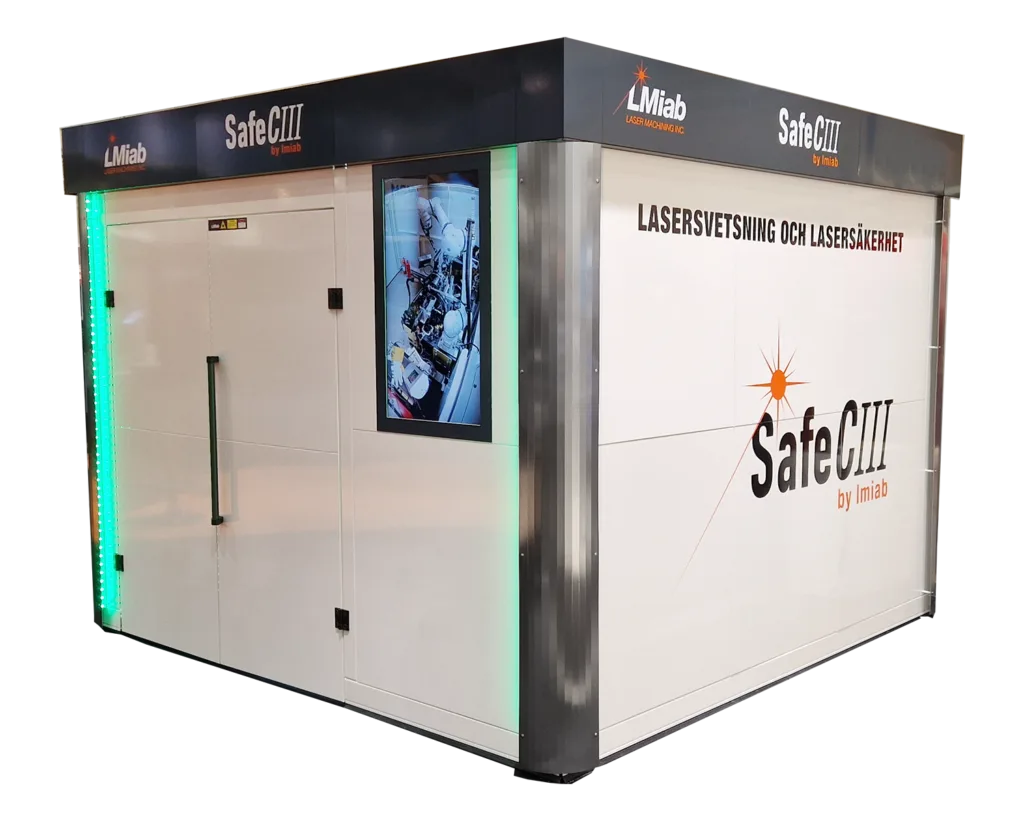
An automated laser welding cell can be designed to operate as a Class 1 laser product during normal operation through enclosures, interlocks and other safety functions.
Handheld laser welding requires particular attention because the laser beam is used manually and the risk from reflected radiation must be managed throughout the entire working area.
The safety solution may include:
- laser safety enclosures or restricted areas
- interlocked doors
- laser-rated protective barriers
- personal protective equipment where required
- extraction of welding fumes and particles
- documented operating procedures
- trained personnel
- risk assessment of the specific application
Safety must always be designed according to the laser power and wavelength, material, process and the environment in which the equipment is used.
Laser welding adapted to your production
LMI offers laser welding solutions for different types of industrial production – from handheld laser welders to cobot- and robot-based systems and customised automated solutions.
We help you evaluate materials, joint geometry, weld quality, laser power, optics, filler material, fixturing, automation and safety.
Through test welding and process development, the solution can be adapted to the actual component and the requirements for quality, cycle time and production flow.
See our laser welding machines and systems
Vanliga frågor & svar om lasersvetsning
Laser welding is a fusion welding process in which a concentrated laser beam is used to locally melt and join materials. The high energy density makes it possible to create narrow weld seams with high welding speeds and limited heat input.
Many metals can be laser welded, including steel, stainless steel, aluminium, nickel and titanium alloys, as well as certain copper alloys. Weldability depends on the properties of the material, the alloy and the specific joint design.
In keyhole welding, the laser power density is sufficiently high to vaporise part of the material and create a narrow cavity in the molten pool. The laser energy can thereby penetrate deep into the material and create a deep and narrow weld seam.
Not always. Many applications can be welded autogenously without filler material. Welding wire can be used, for example, when joint gaps need to be bridged or when the composition of the weld metal needs to be modified.
Shielding gas is used in many applications to protect the molten pool and heated material from oxidation and to contribute to a stable welding process. The choice of gas and gas flow depends on the material and application.
In many suitable applications, laser welding can be performed significantly faster than TIG welding. The actual productivity gain, however, depends on the material, joint geometry, component handling and the design of the entire production process.
Generally, yes. The concentrated energy input and high welding speed often result in lower total heat input and therefore less thermal distortion than many conventional welding processes.
Yes. Laser welding is very well suited to automation and can be integrated with industrial robots, cobots, multi-axis systems and automated production lines.Ja. Lasersvetsning lämpar sig mycket väl för automation och kan integreras med industrirobotar, cobotar, fleraxliga system och automatiserade produktionslinjer.
Yes. A cobot can be used to position and move the welding optics along programmed welding paths. This can be particularly attractive when flexibility is required in combination with better repeatability than manual welding can provide.
Yes, this is recommended. Test welding makes it possible to evaluate material weldability, joint design, laser power, speed, focus, filler material and other process parameters before the system is specified.

Contact LMI about laser welding
Are you planning to invest in laser welding, or would you like to investigate whether the technology could make an existing welding process more efficient?
LMI can help you analyse materials, component geometry, joint design, quality requirements, production volume and automation requirements to develop a technically and economically suitable solution.
Contact Tim Smith for advice on laser welding and laser welding systems.
Tim Smith
CEO & laser welding expert