


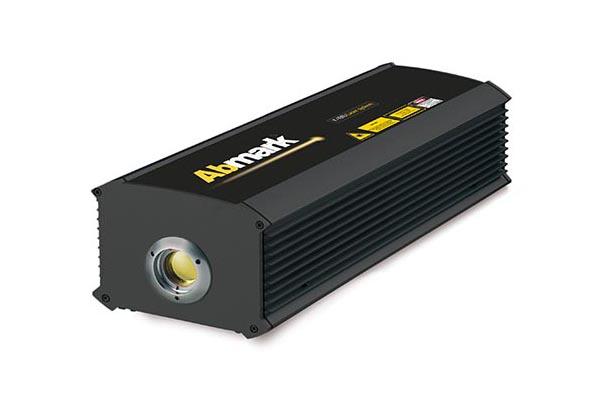
Abmark C Series – Industrial CO₂ Laser for Marking and Coding
Abmark C Series is a range of compact industrial CO₂ lasers for permanent marking, coding and processing of organic and non-metallic materials. The systems are particularly suitable for materials such as wood, glass, textiles, paper, carton and composite materials and can be integrated directly into production lines or customised machine systems.
CO₂ Laser for Industrial Marking
Abmark C Series, also known as AB-C Series, is designed for industrial applications where the wavelength of a CO₂ laser provides better absorption and processing characteristics than technologies such as fibre lasers.
CO₂ lasers are particularly effective for many organic and non-metallic materials and are therefore used in applications ranging from product marking and packaging to the wood, textile and composite industries.
AB-C Series is designed as a compact and modular laser platform that can be adapted to different production environments. Abmark describes the series as compact, cost-effective and specifically designed for online integration.
For Materials Where Fibre Laser Is Not the Right Choice
No single laser technology is optimal for every material.
Fibre lasers are a natural choice for many metals, but for wood, paper, carton, textiles, glass and many other non-metallic materials, CO₂ laser technology is often significantly more suitable.
This is due to how the material absorbs the wavelength of the laser.
With the right combination of laser source, optics and parameters, a CO₂ laser can create clear and permanent markings without the need for inks, labels or other marking materials.
LMI helps you determine which laser technology will provide the best result for your specific material.
Laser Marking on Wood
Wood is a typical material for CO₂ laser processing.
The laser energy affects the surface of the wood and can create anything from subtle markings to dark, clearly visible engraving depending on the type of wood and selected parameters.
The technology can be used for applications including:
- Logos
- Serial numbers
- Text
- Product information
- Decorative patterns
- QR codes
- Data Matrix codes
- Traceability information
Because the process is digital, the marking can be changed from one product to another without replacing printing tools or templates.
Permanent Marking on Glass
CO₂ laser technology is also well established for permanent marking of glass. Abmark describes CO₂ lasers as the most widely used technology for glass marking applications.
The laser locally modifies the glass surface to create a permanent visible mark.
This can be useful for product identification, logos, serial numbers and decorative markings.
The result is influenced by the composition, thickness and geometry of the glass, making sample marking particularly valuable for this type of application.
Textiles, Leather and Synthetic Materials
AB-C Series can also be used for processing textiles, leather and various synthetic materials.
Depending on the material, the laser can be used for marking, engraving or cutting. CO2 lasers are typically used for materials such as leather and denim.
Because the process is non-contact, the material is not subjected to the mechanical forces associated with conventional cutting or marking tools.
This makes CO₂ laser technology a flexible option when the same system needs to handle different graphical designs and product variants.
Paper, Carton and Packaging
CO₂ lasers can be used for coding and marking paper, carton and various packaging materials.CO₂-laser kan användas för kodning och märkning av papper, kartong och olika typer av förpackningsmaterial.
Abmark notes that paper and carton often require a suitable coating to produce a clearly visible laser mark.
For suitable material combinations, the laser can be used for:
- Product codes
- Batch numbers
- Date
- Serial numbers
- Barcodes
- QR codes
- Data Matrix codes
- Logos and graphics
The digital process makes it possible to work with both fixed and variable information.
Composite and Other Non-Metallic Materials
AB-C Series is not limited to traditional organic materials.
Abmark also identifies composite and synthetic materials among the application areas for C Series.
Composite materials can, however, vary significantly in composition and in how they react to laser radiation.
For these applications, it is therefore important to verify the process using the actual material.
LMI can carry out sample marking to evaluate contrast, level of detail and potential thermal effects.
More Than Just Laser Marking
An important feature of Abmark C Series is that the system is not limited to marking.
Abmark also specifies cutting, scoring and perforating as possible applications.
This means that the same basic laser technology can be used for several types of material processing depending on the material, laser power and optical configuration.
Examples include perforating thin materials, cutting films or textiles and scoring materials for subsequent processes.
The suitability of each process must always be assessed according to the material properties, thickness and required processing time.
Multiple Power and Optical Configurations
AB-C Series is available with several power levels and optical configurations.
This allows the system to be adapted depending on whether the application primarily involves high-speed product marking, coding or more energy-intensive material processing.
Higher laser power does not automatically provide a better marking result.
The appropriate power depends on factors such as material, process, required contrast, line speed and the size of the area being processed.
LMI helps you select the right power and optics based on the actual application.
Designed for Integration into Production Lines
One of the key features of AB-C Series is its suitability for online integration.
The laser can be integrated into an existing production machine or production line where components automatically pass through the marking position. Abmark specifically describes the C Series as being designed for this type of integration.
This makes the system particularly attractive for production environments where marking needs to become an integrated part of the manufacturing process rather than a separate manual operation.
Laser marking can then be combined with product detection, conveyor systems and higher-level control systems.
Marking Moving Products
When integrated into a production line, marking may need to be carried out while products are moving through the process.
Beroende på applikation och systemkonfiguration kan lasermärkningen synkroniseras med produktflödet.
This is particularly useful for coding and product identification applications where large volumes of products need to be marked automatically.
Product speed, the amount of marking information and material properties determine the laser power and system configuration required.
Special Version for Limited Installation Space
For integrations where available space is limited, Abmark also offers AB-CS, featuring a split-head configuration.
Abmark describes this configuration as being designed specifically for applications where installation space is restricted.
This can be a significant advantage when retrofitting a laser into existing production machinery where there is insufficient space for a conventional integrated laser unit.
It provides greater freedom when positioning the laser components around the existing machine design.
Typical Applications
Abmark C Series can be used for a wide range of industrial applications, including:
- Product marking
- Industrial coding
- Serial numbers and batch numbers
- Date and production codes
- QR codes and Data Matrix codes
- Barcodes
- Logos and graphics
- Laser Marking on Wood
- Märkning av glas
- Textile marking and processing
- Leather marking
- Paper and carton
- Packaging materials
- Composite materials
- Synthetic materials
- Cutting thin materials
- Scoring
- Perforating
- Integrated marking in production lines
Permanent Marking without Inks or Labels
One of the advantages of laser marking is that the information is created directly through interaction with the material.
This means that the process normally requires no inks, labels or other marking materials that need to be continuously replenished.
For industrial production, this can reduce both material handling and the need for consumables.
The laser process is also digital, making it easy to switch between different product texts, serial numbers, codes and graphical elements.
Advantages of Abmark C Series
- Industrial CO₂ laser
- Designed for marking and coding
- Suitable for many organic and non-metallic materials
- Marking of wood, glass, textiles and composite materials
- Suitable for paper and carton with appropriate material properties
- Multiple power levels
- Multiple optical configurations
- Compact and modular design
- Designed for Integration into Production Lines
- Special configuration for installations where space is limited
- Suitable for marking and engraving
- Cutting, scoring and perforating capabilities
- Digital handling of variable information
- No mechanical contact with the component
- Normally no need for inks or labels
CO₂ Laser or Fibre Laser?
The choice between CO₂ and fibre laser technology is primarily determined by the material.
Fibre lasers are generally the natural choice for marking and engraving metals such as steel, stainless steel and aluminium.
CO₂ lasers, on the other hand, are particularly suitable for many organic and non-metallic materials such as wood, paper, carton, textiles and certain plastics. CO₂ is also a well-established technology for glass marking.
There are materials where both technologies can produce results, but the appearance of the marking and the efficiency of the process can differ significantly.
Laser technology should therefore be selected according to the material and the result that actually needs to be achieved – not simply according to laser power.
Abmark C Series or D Series?
C Series and D Series complement each other but use fundamentally different laser technologies.
Abmark C Series uses CO₂ laser technology and is primarily suited to organic and non-metallic materials.
Abmark D Series uses DPSS technology and is intended for applications where different wavelengths and processing characteristics are required.
Which system is right therefore depends on the material, required marking result and production process.
LMI can help compare the technologies and select the laser best suited to the application.
Integration and Laser Safety
When a CO₂ laser is integrated into production machinery, laser safety needs to be considered as part of the complete system design.
Guards, doors, interlocks and other safety functions must be designed to prevent operators from being exposed to hazardous laser radiation during normal operation.
This applies both to the direct laser beam and to potential reflections from the process.
LMI can assist with both system integration and laser safety solutions for the complete installation.
Send Us a Material Sample
Are you unsure whether CO₂ laser technology is suitable for your material?
Send us a material sample or product and we will help you evaluate the application.
We can carry out sample marking and assess factors including contrast, level of detail, marking speed and any potential effect on the material.
For integrated applications, we can also discuss product flow, cycle time, communication and how the laser can best be incorporated into existing production equipment.
Contact LMI
Would you like to learn more about Abmark C Series or discuss CO₂ laser technology for industrial marking, coding or material processing?
Contact us and we will help you select the right laser technology, power, optics and system solution based on your material and production requirements.
Available models, laser power levels and optical configurations are subject to change. LMI will help you select the current configuration best suited to your application.