


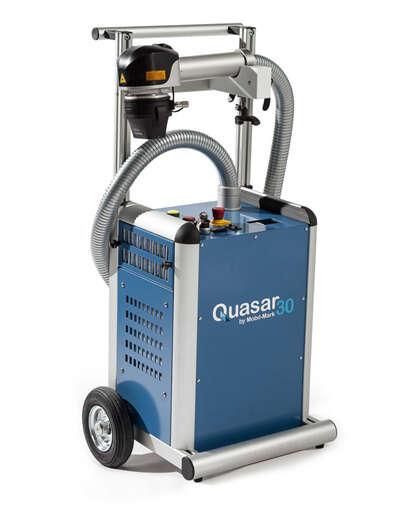
Mobil-Mark Quasar – Handheld Laser Marking for Large Components
Mobil-Mark Quasar is a mobile industrial laser system for permanent marking of large, heavy and difficult-to-move components. The handheld laser head is positioned directly against the workpiece, allowing the laser to be brought to the product instead of requiring the product to be handled inside a conventional marking workstation.
Handheld Laser Marking for Industry
Mobil-Mark Quasar is designed for applications where the component is too large, heavy or cumbersome to be easily placed inside a stationary laser marking machine.
The base unit is mobile and the laser head can be brought to the exact position on the component where marking is required.
This makes the system particularly useful in machine building, tooling, metalworking and other industrial environments where large products need permanent identification.
Instead of adapting the material flow to the laser machine, the marking equipment can be adapted to the product.
Bring the Laser to the Workpiece
One of the key advantages of Mobil-Mark is its simple principle:
The workpiece does not need to come to the laser – the laser comes to the workpiece.
This can provide major practical advantages when the component weighs hundreds of kilograms, is several metres long or is already installed in a machine or structure.
Marking can be carried out directly on site without first having to transport, lift or load the component into a large laser-safe workstation.
This can reduce both material handling and the time required for the marking process.
Handheld Laser Head with Safety Enclosure
The handheld laser head is equipped with a safety enclosure that is positioned directly against the surface of the object being marked.
The sealing unit around the laser head can be adapted to the geometry of the workpiece so that the laser area is enclosed against the component during marking.
Mobil-Mark uses this principle to create a safe Class 1 laser solution when correctly configured and used.
This makes it possible to use a powerful industrial laser system without requiring a large conventional laser enclosure around the entire component.
The shape and surface of the component are, however, important to the safety solution, and the correct sealing unit must be selected for each application.
LMI can help evaluate the component and develop the appropriate safety and sealing solution.
20, 30 or 60 W MOPA Fibre Laser
According to LMI’s current configuration, Mobil-Mark Quasar can be equipped with a 20, 30 or 60 W MOPA fibre laser.
MOPA technology provides excellent flexibility for industrial marking by allowing the laser parameters to be adapted to the material and required marking result.
Fibre laser technology is particularly well suited to metals and many engineering plastics.
The different power levels make it possible to adapt the system according to required marking speed, engraving depth and production volume.
The most suitable power level depends on the actual application – higher power is not automatically the best choice for every marking task.
Marking Metals and Plastics
Mobil-Mark Quasar can be used for permanent marking of a wide range of industrial materials.
Typical materials include:
- Stainless steel
- Steel
- Aluminium
- Anodised aluminium
- Titanium
- Brass and other metals
- Engineering plastics
- Painted surfaces
- Powder-coated components
- Rubber and other suitable materials
Mobil-Mark also demonstrates applications on materials such as ceramics, glass, wood and others across its broader product range.
The exact result depends on the laser configuration, material, surface treatment and selected process parameters.
Ideal for Large and Heavy Components
Mobil-Mark is particularly effective when the marking itself is small but the workpiece is large.
A serial number, QR code or Data Matrix code may only be a few centimetres in size while the component itself may weigh several tonnes.
Building a large laser cell simply to mark a small area can therefore be both expensive and impractical.
With Mobil-Mark, the laser head is instead positioned exactly where the marking is required.
This makes the system attractive for applications such as:
- Large machine components
- Welded structures
- Tools and moulds
- Shafts and rollers
- Automotive components
- Machine frames
- Sheet metal and steel structures
- Production equipment
- Components that are already installed
Marking Tools and Moulds
Large tools, moulds and fixtures are a natural application for handheld laser marking.
These components can be both heavy and difficult to move between different production stations.
Mobil-Mark makes it possible to add permanent information directly to the tool, including:
- Tool numbers
- Part numbers
- Serial numbers
- QR and Data Matrix codes
- Maintenance information
- Calibration information
- Revision numbers
- Logos and other identification
The marking can be changed digitally from one object to another without the need for new stamps, templates or labels.
Traceability Directly on the Component
Industrial traceability is one of the most important applications for laser marking.
Mobil-Mark can be used for permanent marking of information such as:
- Serial numbers
- Part numbers
- Data Matrix codes
- QR codes
- UID information
- Production dates
- Batch numbers
- Inspection information
- Maintenance and service information
Because the information is marked directly onto the component surface, there is no label that can detach or need replacement.
For machine-readable codes, the marking can also be verified as part of the production process.
Adaptable Sealing Units
Different components have different surfaces, radii and geometries.
Mobil-Mark’s safety principle is therefore based on the sealing unit at the laser head being adaptable to the workpiece.
This allows the system to be used on flat surfaces as well as many curved and more complex geometries.
For recurring production parts, a customised sealing unit can provide both safe and repeatable positioning of the laser head.
This is an important difference compared with simpler handheld laser systems where the operator works with an open laser beam.
Robot Integration
Mobil-Mark does not have to be used manually.
The system can also be integrated with a robot or other automated component handling system.
The laser head can then be positioned and moved automatically to predefined marking locations.
This makes it possible to combine Mobil-Mark’s flexible safety concept with automated series production.
Such a solution can be particularly attractive when the components are large but the marking positions are repetitive and well defined.
Integration into the Production Flow
Mobil-Mark can also be integrated into production stations and existing production flows.
The manufacturer’s systems are designed with open interfaces to communicate with external production and data systems.
This means that marking data can be linked to production orders, part numbers, serial numbers or other information from higher-level systems.
The marking process can therefore become an integrated part of the company’s traceability solution.
Air-cooled design
Quasar uses an air-cooled fibre laser and therefore does not require a separate water-cooling system.
This is particularly valuable for a mobile solution.
Fewer external installations make the equipment easier to move between different work areas and reduce overall system complexity.
Fibre laser technology also generally requires relatively little maintenance.
No Contact-Based Consumables
Traditional product marking often uses labels, paints, inks, etching or mechanical marking tools.
Laser marking instead creates the mark through controlled interaction with the component surface.
This means that the marking process itself normally requires no paints, inks or labels.
This can reduce both ongoing material costs and the handling of consumables.
Typical Applications
Mobil-Mark Quasar is particularly suitable for:
- Handheld marking of large components
- Marking installed components
- Machine and tool manufacturing
- Tools and moulds
- Jigs and fixtures
- Shafts and rollers
- Large cast components
- Welded structures
- Automotive components
- Production equipment
- Serial numbers and part numbers
- Data Matrix codes and QR codes
- UID and traceability marking
- Maintenance and service information
- Re-marking existing products
- Marking directly within the production environment
Advantages of Mobil-Mark Quasar
- Mobile industrial laser marking
- Handheld laser head
- The laser is brought to the workpiece
- Designed for large and difficult-to-move components
- Adaptable safety and sealing unit
- Class 1 laser operation when correctly configured and used
- 20, 30 or 60 W MOPA Fibre Laser
- Suitable for a wide range of industrial materials
- Air-cooled design
- Low maintenance requirements
- Robot Integration
- Can be integrated into production flows
- Digital handling of variable marking data
- Permanent marking without labels or inks
- Industrial design made in Germany
Mobil-Mark or a Stationary Laser Marking Machine?
A stationary laser marking machine is normally the natural choice when the component can easily be placed inside a workstation.
This provides defined fixturing and a clear, repeatable production flow.
Mobil-Mark becomes particularly attractive when it is easier to move the laser than the workpiece.
For large, heavy or already installed components, this can eliminate the need for extensive material handling.
It can also make permanent laser marking possible on products that are practically impossible to place inside a conventional workstation.
Mobil-Mark or TYKMA Lase-N-Go?
LMI also offers TYKMA Electrox Lase-N-Go, which is based on the same fundamental idea: a mobile laser head is brought to the component.
The systems, however, have different designs, power options and safety concepts.
Mobil-Mark Quasar offers 20, 30 or 60 W MOPA fibre laser according to the current LMI configuration and features a flexible system with adaptable sealing units as well as options for robot and production integration.
Lase-N-Go is TYKMA Electrox’s mobile 20 W MOPA system with its own nozzle-based Class 1 concept.
The most suitable solution therefore depends on component geometry, material, marking requirements, required power and how the system will be used in production.
LMI can help compare the systems based on the actual application.
When Is Handheld Laser Marking the Right Solution?
Handheld laser marking is particularly attractive when the size and weight of the workpiece make conventional component handling complicated.
The larger and heavier the component is in relation to the marking itself, the greater the potential benefit.
The system is also attractive when marking needs to be carried out at several different locations within a factory or directly on equipment that is already installed.
In these situations, a mobile marking system can provide significantly greater flexibility than a fixed workstation.
Send Us a Photo, Drawing or Component
For handheld laser marking, component geometry is important because the safety and sealing unit must be able to connect correctly to the surface.
Send us a photo, drawing or component and we will help you evaluate the application.
We can assess the material, accessibility, surface, component geometry, marking requirements and suitable sealing solution.
If necessary, we can also carry out sample marking to verify contrast, level of detail and marking time.
Contact LMI
Would you like to learn more about Mobil-Mark Quasar or discuss handheld laser marking for large and difficult-to-move components?
Contact us and we will help you determine whether a mobile or stationary laser marking system is the right solution for your production.
*Mobil-Mark technical documentation specifies several optical configurations, for example approximately 70 × 35, 80 × 40, 100 × 80 and 120 × 100 mm with corresponding safety enclosures. Larger optical fields may require a separate laser safety enclosure.