


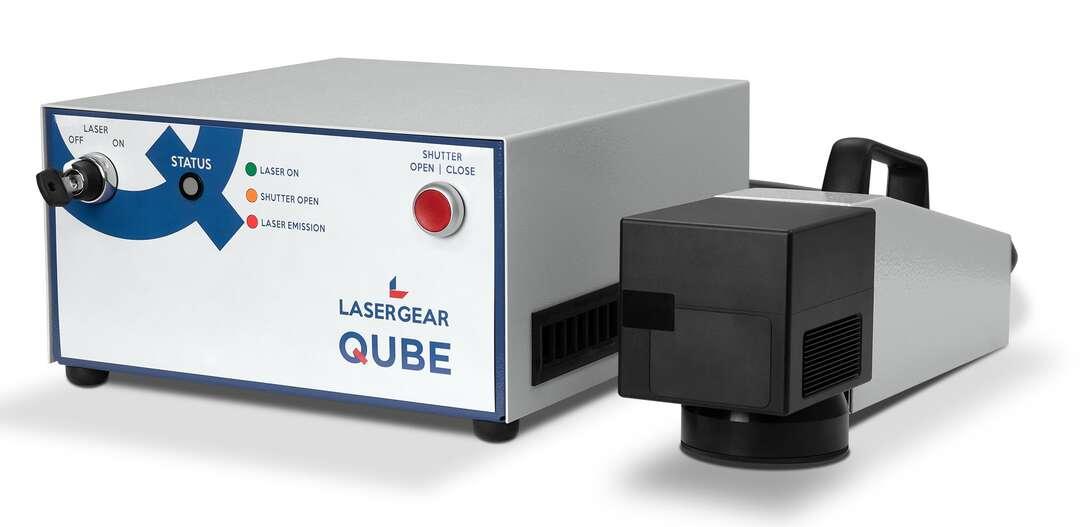
LaserGear QUBE – Compact Fibre Laser for Integration and Open Laser Marking
TYKMA Electrox LaserGear QUBE is a compact Class 4 laser marking system for integration into machines, laser-safe enclosures and production equipment. The separate laser head provides excellent installation flexibility, while MOPA fibre laser technology is well suited to permanent marking and engraving of metals and many engineering plastics.
Compact Laser Marking with Maximum Flexibility
LaserGear QUBE is designed for applications where a complete standalone laser marking workstation is not the ideal solution.
Instead, the user gets the laser system itself in a compact format that can be adapted to the application.
QUBE can, for example:
- Be installed at a workbench
- Be integrated into an existing machine
- Be incorporated into a customised laser-safe enclosure
- Be integrated into an automated production cell
- Form the basis of a customised marking solution
This makes QUBE particularly attractive for companies requiring greater freedom in component handling, fixturing and automation than a conventional enclosed workstation can provide.
Separate Laser Head for Flexible Installation
One of the key features of LaserGear QUBE is its design with a separate laser head and controller.
The laser head is compact and can be positioned where the marking process takes place, while the controller can be installed in another suitable location.
TYKMA specifies an approximately 2 metre fibre cable between the units.
This gives the machine designer greater flexibility when integrating the system into a machine or production cell.
MOPA Fibre Laser for Industrial Marking
LaserGear QUBE uses MOPA fibre laser technology.
MOPA technology provides greater control over laser pulse characteristics than simpler fibre laser systems, making it flexible for different materials and marking results.
The system is suitable for permanent marking, etching and engraving of a wide range of industrial components.
Typical markings include:
- Serial numbers
- Part numbers
- Text
- Logos
- Data Matrix codes
- QR codes
- Barcodes
- UID information
- Production data
- Traceability information
The marking is created directly on the component surface and normally requires no labels, inks or other marking consumables.
20 or 60 W MOPA Fibre Laser
TYKMA’s product documentation specifies LaserGear QUBE with 20 or 60 W MOPA fibre laser.
The different power levels allow the system to be adapted to the application.
20 W can be more than sufficient for many standard marking tasks, while 60 W can provide advantages where higher processing speeds or greater material removal are required.
Higher laser power, however, is not automatically better.
Material, marking size, required result and cycle time all need to be considered when configuring the system.
LMI will help you select the appropriate laser power and optics for your specific application.
Marking Metals and Engineering Plastics
MOPA fibre laser technology is particularly well suited to industrial metals and many engineering plastics.
Typical materials include:
- Stainless steel
- Steel
- Aluminium
- Anodised aluminium
- Titanium
- Brass
- Copper and other metals
- Carbide
- Many engineering plastics
- Painted components
- Coated and surface-treated materials
The result that can be achieved depends on the composition of the material, surface treatment and selected laser parameters.
For new or unusual materials, we recommend sample marking.
Permanent Traceability
LaserGear QUBE is highly suitable for industrial traceability applications.
The system can create permanent product information such as:
- Serial numbers
- Part numbers
- Batch numbers
- Production dates
- Data Matrix codes
- QR codes
- UID codes
- Logos
- Inspection and quality control information
The information can change from one component to another, making the system suitable for production environments where every product requires a unique identity.
Focus Finder Simplifies Setup
QUBE is equipped with red positioning and focusing lasers.
Two red laser points are used to help the operator establish the correct working distance between the laser head and the component.
This simplifies installation and adjustment, particularly when QUBE is used with flexible fixtures or in open marking applications.
Correct focus is important for achieving stable and repeatable marking results.
Standard Marking Field 100 × 100 mm
QUBE’s standard optics provide a marking field of approximately 100 × 100 mm.
This is sufficient for many common industrial marking applications, including product information, serial numbers, logos and machine-readable codes.
The choice of optics affects the marking field, working distance and laser energy density.
LMI can help select the appropriate optics based on marking size, detail requirements and component geometry.
Integration into Production Machinery
LaserGear QUBE can be integrated directly into automated production equipment.
The system features I/O interfaces for automated control, allowing the machine’s control system to manage the marking sequence.
A typical automated process could be:
- The component is positioned.
- The machine verifies that the component is in place.
- The correct marking data is selected.
- The laser receives a start signal.
- The marking process is performed.
- The system confirms that the process is complete.
- The component proceeds to the next production stage.
QUBE can therefore become an integrated part of a larger production machine.
USB connection to PC
LaserGear QUBE connects via USB to a Windows PC for programming and control.
The marking software can be used to create and manage:
- Text
- Serial numbers
- Barcodes
- Data Matrix codes
- QR codes
- Logos
- Graphics
- Variable product information
This makes it easy to create both fixed and automatically changing markings.
Open Marking at a Workbench
QUBE does not necessarily have to be integrated into an automated machine.
The system can also be installed at a workbench for applications where open access to large or unusually shaped components is required.
This can be particularly useful for:
- Large components
- Prototypes
- Tools
- Fixtures
- Long products
- Products with unusual geometries
- Components that do not fit inside a conventional marking workstation
Because QUBE is a Class 4 laser system, appropriate laser safety measures must always be implemented for open marking applications.
Platform for Customised Marking Solutions
QUBE is particularly well suited as the laser platform for a customised machine.
LMI can combine the laser system with, for example:
- Custom fixtures
- Linear axes
- Rotary devices
- Component detection
- Vision systems
- Automated component handling
- Laser-safe enclosures
- PLC control
This makes it possible to build the marking solution around the customer’s product rather than trying to adapt the product to a standard machine.
Compact Design
According to TYKMA’s QUBE 20/60 documentation, the laser head measures approximately 102 × 356 × 114 mm and weighs around 4.5 kg, while the controller measures approximately 343 × 343 × 203 mm and weighs around 16 kg.
The compact format makes the system relatively easy to integrate even where installation space is limited.
The separate design also allows the laser head and controller to be positioned in different locations within the machine.
Luftkyld och underhållsvänlig
QUBE is air-cooled and therefore requires no separate water-cooling system.
This simplifies integration and reduces the number of external systems that need to be installed and maintained.
Fibre laser technology also generally offers low maintenance requirements and a long expected service life.
For industrial production, this provides a robust solution with relatively few ongoing service requirements.
Typical Applications
LaserGear QUBE is particularly suitable for:
- Integration into Production Machinery
- Automated laser workstations
- Special-purpose machines
- Customised marking systems
- Open laser marking
- Marking large components
- Metal marking
- Marking engineering plastics
- Serial numbers and part numbers
- Data Matrix codes
- QR codes
- UID marking
- Industrial traceability
- Tools and fixtures
- Machine components
- Automotive components
- Electronics and industrial products
Advantages of LaserGear QUBE
- Compact Class 4 laser marking system
- MOPA Fibre Laser
- 20 or 60 W according to current QUBE 20/60 documentation
- Separate laser head and controller
- Approximately 2 m fibre cable
- Standard marking field approximately 100 × 100 mm
- Focus Finder with red laser points
- I/O for automated control
- USB connection to PC
- Air-cooled
- Low maintenance requirements
- Suitable for machine integration
- Can be used for open marking
- Excellent platform for customised marking solutions
- Suitable for metals and many engineering plastics
LaserGear QUBE or a Standalone Laser Marking Machine?
The choice primarily depends on how the components need to be handled.
A standalone workstation such as Minilase or Zetalase is often the best choice when an operator manually loads smaller and medium-sized products and requires a complete laser-safe machine.
QUBE is instead particularly attractive when the laser itself needs to be adapted to the production process.
This may involve integrating it into an existing machine, creating a special-purpose workstation or providing open access to large and unusually shaped components.
QUBE therefore provides greater design freedom, while a complete workstation provides a more complete solution from the outset.
LaserGear QUBE or Vereo Smart?
Both QUBE and Vereo Smart are designed for integration, but they fulfil somewhat different roles.
LaserGear QUBE is a compact and flexible laser platform that connects to an external Windows PC via USB. It is suitable for both machine integration and open Class 4 applications.
Vereo Smart places greater emphasis on advanced automation, with an integrated controller, web-based administration, network communication and PLC integration.
For a relatively straightforward integration or customised marking station, QUBE can therefore be a very attractive solution.
For a more advanced automated production line where network communication and centralised system management are important, Vereo Smart may be the more natural choice.
LMI will help you select the right platform based on the required level of automation and your production requirements.
LaserGear QUBE as the Platform for LMI HHX1
QUBE is also the technical platform used by LMI as the basis for LMI HHX1.
HHX1 is LMI’s customised portable solution for marking large and difficult-to-move components.
This also demonstrates the flexibility of the QUBE concept – the same basic laser platform can be used both for fixed machine integration and as the basis for customised marking systems.
Class 4 and Laser Safety
LaserGear QUBE is a Class 4 laser system.
This means that the laser itself should not be regarded as a complete laser-safe workstation.
When integrated into machinery, the safety solution must be designed around the complete machine and application.
This may include:
- Laser-safe enclosures
- Interlocked doors and access panels
- Safety circuits
- Controlled material openings
- Laser safety eyewear for open Class 4 operation
- Risk assessment
- Appropriate operating procedures
When QUBE is integrated into a complete machine, the objective is normally to ensure that operators cannot be exposed to hazardous laser radiation during normal production.
LMI can assist with integration, risk assessment and laser safety solutions.
Send Us Information About Your Application
An integration laser should not be selected based solely on laser power.
The component, material, cycle time, marking field, automation and laser safety all need to be considered as part of the complete solution.
Send us a drawing, component or description of your application and we will help you evaluate the solution.
We can assess:
- Material
- Required marking result
- Laser power
- Marking time and cycle time
- Optics and marking field
- Working distance
- Fixturing
- Automation
- I/O and control
- Lasersäkerhet
If required, we can also carry out sample marking before the system is configured.
Contact LMI
Would you like to learn more about TYKMA Electrox LaserGear QUBE or discuss integrating laser marking into a machine or customised production solution?
Contact us and we will help you select the appropriate laser, optics, automation and safety concept for your application.
Available laser power levels, optics and system configurations are subject to change. LMI will help you select the current configuration best suited to your application.