

Abmark AB-D Series – DPSS Laser for Sensitive Materials and Precision Marking
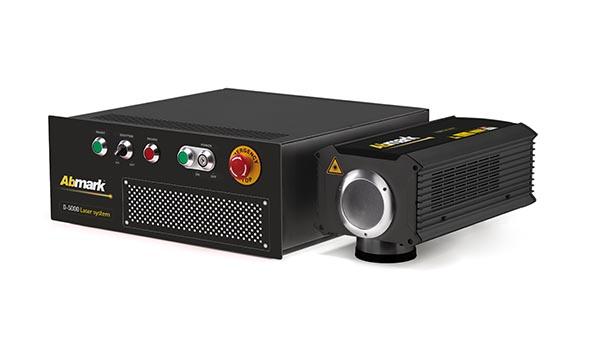
Abmark AB-D Series is a range of industrial DPSS lasers for high-precision marking and engraving using short laser pulses. With different wavelengths – 1064 nm, 532 nm green laser and 355 nm UV – the series can be adapted to materials and applications where low heat input, high detail and controlled material processing are essential. AB-D Series is particularly interesting for plastics, sensitive materials and selective removal of thin surface coatings.
DPSS Laser for Advanced Industrial Marking
AB-D Series is based on DPSS technology – Diode-Pumped Solid-State Laser.
The technology produces short laser pulses with high peak power, enabling materials to be processed with high precision.
Abmark has developed AB-D Series particularly for marking sensitive materials and for applications where surface coatings need to be removed in a controlled manner. The series complements conventional fibre lasers by providing different wavelengths and process characteristics.
This makes AB-D Series particularly interesting for applications where a traditional fibre laser does not provide the optimum result.
Three Wavelengths for Different Materials
One of the major advantages of AB-D Series is the ability to select different laser wavelengths.
The series includes solutions at:
- 1064 nm – infrared
- 532 nm – green laser
- 355 nm – UV laser
The optimum wavelength primarily depends on how the material absorbs the laser radiation.
LMI will help you select the appropriate wavelength based on the material and required marking result.
1064 nm – for Metals and Selected Plastics
AB-D Series is available with a 1064 nm wavelength.
Versions have been available with:
- 6 W
- 10 W
- 20 W
1064 nm is a common wavelength for industrial laser marking and can be used on a wide range of metals and selected plastic materials.
The pulse characteristics of a DPSS laser make the technology particularly interesting when the process requires precise control.
Typical materials can include:
- Stainless steel
- Aluminium
- Titanium
- Other metals
- Engineering plastics
- Coated components
532 nm Green Laser – When the Material Requires a Different Wavelength
AB-D Series is also available with a 532 nm green laser.
Green laser light is absorbed differently compared with 1064 nm and can therefore produce better results on materials where infrared laser radiation has poor absorption.
Both nanosecond and picosecond green laser configurations have been available within the series.
This makes the technology particularly interesting for:
- Sensitive materials
- Certain plastics
- Thin surface coatings
- Precision marking
- Applications where heat input needs to be minimised
The choice between infrared, green and UV laser should therefore be based on the actual response of the material to each wavelength.
Picosecond Laser for Minimal Heat Input
AB-D Series has also included green laser versions with extremely short pulses of less than 600 ps.
Picosecond pulses mean that the laser energy is delivered within a very short period of time.
This can reduce the heat-affected zone around the processed area and enable extremely precise processes.
The technology can be particularly interesting for:
- Sensitive components
- Thin materials
- Micro-features
- Selective ablation
- Thin surface coatings
- Applications with demanding edge-quality requirements
355 nm UV Laser – for Sensitive Plastics and Fine Details
For particularly demanding materials, AB-D Series is available with a 355 nm UV laser.
The shorter wavelength provides different absorption characteristics compared with both 1064 and 532 nm, making UV laser technology particularly interesting for sensitive materials and detailed markings.
A 355 nm version has been available with 5 W laser power and a pulse width of approximately 15 ns.
UV lasers can be particularly suitable for:
- Engineering plastics
- Sensitive polymers
- Small components
- Fine text
- Small Data Matrix codes
- Electronic components
- Thin coatings
- Precision marking
Low Heat Input on Sensitive Materials
A key characteristic of AB-D Series is the ability to process materials with limited thermal impact.
This is particularly important when the component:
- Is thin
- Can deform due to heat
- Contains sensitive electronics
- Has a thin surface coating
- Requires very fine details
- Has tight tolerances
AB-D Series is specifically intended for applications involving sensitive substrates and coating ablation.
Selective Removal of Surface Coatings
AB-D Series is particularly interesting for coating ablation, where a thin surface layer is removed while minimising the effect on the underlying material.
This can involve removing:
- Paint
- Lacquer
- Thin coatings
- Functional layers
- Insulating layers
By selecting the appropriate wavelength and laser parameters, the process can be optimised so that the coating absorbs the laser energy more efficiently than the substrate.
This enables highly controlled material processing.
Precision Marking of Plastics
Plastics are one of the material groups where AB-D Series can provide significant advantages.
Different polymers react very differently to laser radiation.
The result is affected by factors including:
- Polymer
- Pigment
- Colour
- Additives
- Fillers
- Wavelength
- Pulse width
- Laser power
The ability to choose between 1064, 532 and 355 nm provides considerably greater flexibility when finding the optimum process window.
LMI always recommends sample marking when evaluating a new plastic or material formulation.
Permanent Product Identification and Traceability
AB-D Series can be used for permanent industrial product marking.
The system can create:
- Serial numbers
- Part numbers
- Batch numbers
- Production dates
- Data Matrix codes
- QR codes
- Barcodes
- UID information
- Logos
- Product information
- Inspection information
The marking is created directly on the component and normally requires no labels or printing inks.
Small Data Matrix Codes and Fine Details
An important advantage of shorter wavelengths is the ability to focus the laser beam to a small spot.
This can be particularly valuable for very small and detailed markings.
Typical examples include:
- Small Data Matrix codes
- Microtext
- Small symbols
- Detailed graphics
- Electronic components
- Medical components
For optimum results, the wavelength, optics and laser parameters need to be specified together.
Abmarca – Software for Marking and Variable Data
AB-D Series uses Abmarca software.
The software can be used to manage:
- Text
- Serial numbers
- Logos
- Graphics
- Data Matrix codes
- QR codes
- Barcodes
- Variable product information
Marking data can also be retrieved from higher-level IT and production systems.
This makes AB-D Series suitable for automated traceability applications where the information changes from one component to the next.
Integration with Production Systems
AB-D Series can be integrated into production lines and customised machinery.
The series is designed both for integration into production lines and for use in standalone workstations.
This makes it possible to use the system in:
- Automated production lines
- Robotic cells
- Assembly machines
- Electronics production
- Inspection stations
- Special-purpose machines
- Automated traceability systems
Marking data can then be retrieved automatically from a higher-level production system.
Flexible User Interface
AB-D Series can be operated using several types of user interface, depending on the system configuration:
- PC or laptop
- Touchscreen
- Handheld terminal
This allows the operator interface to be adapted to the installation.
A PC can, for example, be used for programming and development, while a touchscreen may be more suitable for everyday production.
Integration with Abstation Mini, Midi and Maxi
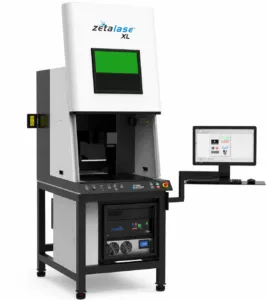
AB-D Series can be used with Abmark’s standalone workstations.
Abstation-Mini is suitable for smaller components and installations where a compact machine footprint is important.
Abstation-Midi provides a larger working area and flexible component handling.
Abstation-Maxi is intended for larger components and more advanced system solutions.
This allows the same fundamental laser technology to be incorporated into different machine concepts depending on component size and production requirements.
Rotary Marking and Motorised Functions
AB-D Series can be equipped with a rotary unit for marking cylindrical components.
This can be relevant for:
- Tubes
- Shafts
- Rings
- Cylindrical components
- Tools
- Medical products
Additional motorised functions can be selected according to the component and marking process.
AB-D Series or Fibre Laser?
This is an important consideration when selecting a marking laser.
A fibre laser is often the first choice for conventional marking and engraving of many metals.
AB-D Series becomes particularly interesting when the application requires:
- A wavelength other than standard fibre laser
- Lower heat input
- Marking of sensitive plastics
- Extremely fine details
- Selective coating ablation
- Green laser
- UV laser
- Very short laser pulses
Neither technology is therefore inherently better than the other.
The right laser is the one whose wavelength and pulse characteristics are best suited to the material and process.
Green Laser or UV Laser?
The choice between 532 nm and 355 nm also depends on the material.
532 nm green laser can provide better absorption than 1064 nm on certain materials and is an interesting alternative when infrared laser radiation produces excessive heat input or poor process response.
355 nm UV laser provides an even shorter wavelength and can be particularly interesting for sensitive polymers and extremely fine details.
However, the optimum wavelength cannot always be determined from the material’s trade name alone.
Pigments, additives and surface treatments can significantly alter the material’s response to laser radiation.
Sample marking is therefore often the most reliable way to select the appropriate laser technology.
Electronics and Sensitive Components
AB-D Series is particularly interesting for electronics and other production applications where components may be sensitive to heat.
Examples can include:
- Electronic housings
- Connectors
- Small plastic components
- Thin materials
- Precision components
- Small machine-readable codes
A short pulse width combined with the appropriate wavelength can make it possible to create a clear marking while limiting thermal impact.
Long Service Life and Low Maintenance Requirements
DPSS is a solid-state laser technology designed for stable industrial operation.
Long service life and low maintenance requirements contribute to low overall operating costs.
Laser marking also normally requires no:
- Labels
- Ink
- Paint
- Solvents
- Mechanical marking tools
This contributes to a clean and efficient industrial marking process.
Accessories and System Customisation
AB-D Series can be equipped with various accessories depending on the application.
Options can include:
- Handheld terminal
- Touchscreen
- Aiming laser
- Advanced Barcode Generator
- Split Head Option
- Encoder Kit
- Photocell Kit
- Alarm Kit
- Mounting support
- Floor stand
- U-ARM mounting bracket
- Fume extraction
- Rotary unit
The accessories required depend on the system design, component handling and level of automation.
Typical Applications
Abmark AB-D Series is particularly suitable for:
- Precision marking
- Marking sensitive materials
- Engineering plastics
- Permanent product identification
- Industrial traceability
- Data Matrix codes
- QR codes
- Serial numbers
- Microtext
- Electronic components
- Aluminium
- Titanium
- Stainless steel
- Other metals
- Coating ablation
- Removal of thin coatings
- Fine engraving
- Automated production lines
- Standalone workstations
Advantages of Abmark AB-D Series
- Industrial DPSS laser
- Short laser pulses
- High peak power
- 1064 nm infrared laser
- 532 nm green laser
- 355 nm UV laser
- Picosecond options
- Low and controllable heat input
- Suitable for sensitive materials
- Excellent for engineering plastics
- Suitable for coating ablation
- High level of detail
- Permanent marking
- Machine-readable codes
- Abmarca software
- Integration with higher-level production systems
- Can be integrated into automated production lines
- Can be combined with Mini, Midi and Maxi workstations
- Long service life
- Low maintenance requirements
Class 4 and Laser Safety
When AB-D Series is used as an integration laser, the complete installation must be designed with appropriate laser safety measures.
These may include:
- Laser-safe enclosure
- Interlocked doors and service panels
- Safety circuits
- Controlled material openings
- Risk assessment
- Appropriate service and operating procedures
For UV and other specialised wavelengths, it is particularly important that protective equipment and safety components are designed for the specific laser wavelength.
When the system is installed in a correctly designed workstation or safety enclosure, the complete solution can be designed for safe operator use.
LMI can assist with system integration, risk assessment and laser safety solutions.
Send Us a Material Sample
For AB-D Series, sample marking is particularly valuable because the choice of wavelength can have a major impact on the result.
Send us a component, drawing or material sample and we will help you evaluate the appropriate laser technology.
We can assess:
- Material
- Required marking result
- 1064, 532 or 355 nm
- Pulse width
- Laser power
- Marking field
- Optics
- Heat input
- Level of detail
- Marking time and cycle time
- Coating ablation
- Fixturing
- Automation
- Laser safety
If required, we can perform sample marking using different laser technologies to find the solution that provides the best combination of quality and processing time.
Contact LMI
Would you like to learn more about Abmark AB-D Series or discuss DPSS, green or UV laser technology for a demanding marking application?
Contact us and we will help you select the appropriate wavelength, laser power, optics and system configuration based on your material and production requirements.
Technical Specifications
| Property | Value |
|---|---|
| Manufacturer | Abmark |
| Model series | AB-D Series |
| System type | Industrial DPSS laser |
| Wavelengths | 1064 nm, 532 nm and 355 nm* |
| 1064 nm | IR DPSS |
| 532 nm | Green DPSS |
| 355 nm | UV DPSS |
| Pulse regime | Short-pulsed, depending on model* |
| Picosecond option | Available depending on model* |
| Models | AB-D UV, AB-D GREEN PS, AB-D GREEN, AB-D 06, AB-D 10, AB-D 20* |
| Typical materials | Plastics, aluminium, titanium, stainless steel and other metals |
| Coating ablation | Yes |
| Typical processes | Marking, engraving, precision processing and ablation |
| Software | Abmarca |
| Variable data | Yes |
| Production integration | Yes |
| Standalone operation | Yes |
| Workstations | Abstation Mini, Midi and Maxi |
| Rotary marking | Available |
| User interface | PC/laptop, touchscreen or handheld terminal* |
Available models, wavelengths, pulse widths, laser power levels, optics and system configurations are subject to change. LMI will help you select the current configuration best suited to your application.