


LMI HHX1 – Portable Laser Marking for Large Components
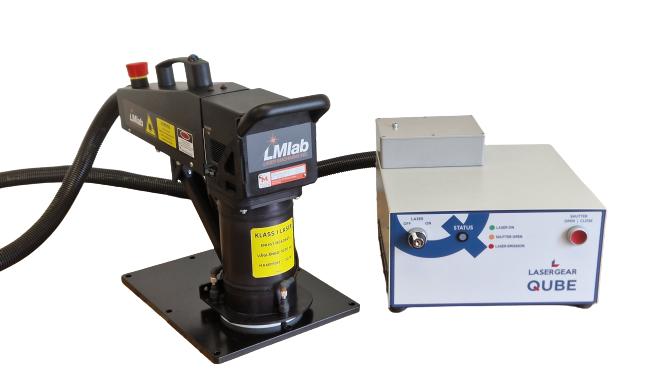
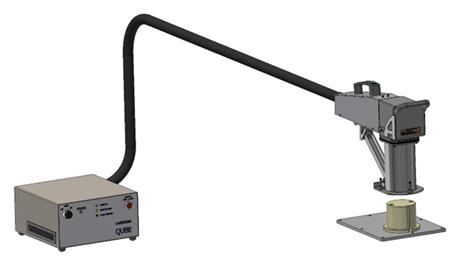
LMI HHX1 is a portable laser marking solution developed by LMI for marking large, heavy and difficult-to-move components. The system is based on the TYKMA Electrox LaserGear QUBE and makes it possible to bring the laser head to the workpiece instead of moving the product to a conventional marking workstation.
Portable Laser Marking for Industry
LMI HHX1 is designed for applications where the component is larger or more difficult to handle than the marking itself.
Instead of lifting or transporting the workpiece to a stationary laser marking machine, the laser head is brought to the location where the marking needs to be applied.
This makes HHX1 particularly suitable for large machine components, tools, fixtures, welded structures and other products that are impractical to place inside a conventional workstation.
The system is an LMI adaptation of the TYKMA Electrox LaserGear QUBE, a compact MOPA fibre laser designed for open Class 4 marking and integration.
Move the Laser – Not the Component
The basic principle behind HHX1 is simple:
The laser is brought to the workpiece instead of bringing the workpiece to the laser.
This can provide significant practical advantages when the product is heavy, long, cumbersome or already installed as part of a larger structure.
The operator positions the laser head at the required marking location, allowing permanent marking to be applied directly to the component.
This reduces the need for cranes, lifting equipment and other material handling simply to perform a marking operation.
Based on TYKMA Electrox LaserGear QUBE
HHX1 is based on LaserGear QUBE, TYKMA Electrox’s compact integration laser.
QUBE is a Class 4 system using MOPA fibre laser technology and is designed for both open marking and integration into production equipment.
The current QUBE platform is available with 20 or 60 W MOPA fibre lasers and can be used with several different optical configurations depending on the required marking field.
LMI has adapted the basic system to create a more portable solution where the laser head can be used directly at large workpieces.
MOPA Fibre Laser for Permanent Marking
MOPA fibre laser technology is highly flexible for industrial product marking.
It is particularly well suited to metals and many engineering plastics and can be used for applications including:
- Serial numbers
- Part numbers
- Data Matrix codes
- QR codes
- Barcodes
- Logos
- Text and product information
- UID and traceability marking
MOPA technology also provides the ability to adjust pulse characteristics according to the material and required result.
The exact marking result depends on the material, surface treatment, optics and selected laser parameters.
Marking Metals and Engineering Plastics
With the appropriate configuration, HHX1 can be used for many common industrial materials, including:
- Stainless steel
- Steel
- Aluminium
- Anodised aluminium
- Titanium
- Brass and other metals
- Carbide
- Many engineering plastics
- Painted and coated components
The MOPA fibre technology used in LaserGear QUBE is designed for marking metals, most markable plastics, carbide, anodised aluminium and painted or coated materials.
LMI can help you carry out sample marking and determine suitable parameters for your application.
Focus Finder for Quick Setup
LaserGear QUBE features Focus Finder, which uses two red laser points to establish the correct working distance.
When the two points coincide on the surface of the workpiece, the laser head is positioned at the correct focal distance.
This is particularly useful for a portable solution such as HHX1, where the laser head is moved between different products and marking positions.
Correct focus is essential for achieving consistent and repeatable marking quality.
Multiple Marking Fields Depending on Optics
The QUBE platform can be used with several different F-Theta lenses.
Standard optics provide a marking field of approximately 100 × 100 mm, while optional optics can provide larger marking fields of up to approximately 260 × 260 mm.
A larger marking field makes it possible to cover a greater area without repositioning the laser head, while smaller optics generally provide higher energy density and finer detail.
The correct optics therefore depend on the size of the marking, material and required resolution.
Ideal for Large and Heavy Components
HHX1 is particularly useful when a relatively small marking needs to be applied to a very large workpiece.
Typical examples include:
- Large machine components
- Welded structures
- Machine frames
- Tools and moulds
- Fixtures and jigs
- Large sheet metal components
- Automotive components
- Shafts and other machine parts
- Production equipment
- Components that are already installed
In these situations, moving the laser head can be significantly easier than moving the entire product.
Traceability Marking Directly on the Product
HHX1 can be used to create permanent identification directly on the workpiece.
This can include:
- Serial numbers
- Part numbers
- Production dates
- Batch numbers
- Data Matrix codes
- QR codes
- UID information
- Inspection data
- Maintenance information
Because the information is created directly on the material surface, labels or printed identification plates are normally not required for the marking itself.
Variable information can be managed digitally through the marking software.
Suitable for Tools, Moulds and Fixtures
Large production tools and fixtures can be particularly difficult to move solely for marking purposes.
With HHX1, identification can instead be applied wherever the object is already located.
This can be useful for tool numbers, revision information, calibration data and maintenance information.
Permanent marking directly on the tool also reduces the risk of information being lost if separate labels or identification plates become damaged.
Digital Marking Data and USB Connection
LaserGear QUBE connects to a Windows PC via USB and is controlled using TYKMA Electrox marking software.
The operator can digitally create text, graphics, serial numbers, barcodes and 2D codes.
The software can also handle automatic serialisation and date coding.
This makes HHX1 suitable both for fixed markings and for production processes where the information changes between individual components.
Integration and I/O Capabilities
Because HHX1 is based on an integration laser, the system’s I/O interfaces can also be utilised.
QUBE provides connections for functions including digital I/O, hardware interlocks and control of external equipment.
This means that the basic system can, when required, form part of a more automated solution.
For customer-specific applications, LMI can help determine how the laser can best be integrated with fixtures, safety systems or other production equipment.
Important Information About Laser Safety
HHX1 differs significantly from systems such as Mobil-Mark and TYKMA Lase-N-Go in terms of its safety concept.
LaserGear QUBE is fundamentally a Class 4 laser system intended for open operation or integration into a correctly designed laser-safe solution.
This means that installation and operation require a carefully designed laser safety concept.
Depending on the application, this may include:
- Laser Safety Glasses
- Shielding of the working area
- Interlocks
- A controlled laser safety area
- Risk assessment
- Appropriate operating procedures
LMI can help evaluate laser safety requirements and develop a solution adapted to the specific application.
HHX1 or Mobil-Mark?
Both systems make it possible to bring the laser to a large or difficult-to-move component, but their safety concepts are different.
LMI HHX1 is based on LaserGear QUBE and provides a flexible Class 4 solution where the working environment and safety area are adapted to the application.
Mobil-Mark, on the other hand, uses a handheld laser head with an adaptable safety and sealing unit against the workpiece to provide Class 1 operation when correctly configured.
HHX1 can therefore be particularly attractive when open access, straightforward laser positioning and maximum flexibility are priorities, while Mobil-Mark may be a better option when a local Class 1 concept against the component is possible and preferred.
LMI can help determine which system and safety concept is best suited to the application.
HHX1 or TYKMA Lase-N-Go?
TYKMA Electrox Lase-N-Go is another option for mobile marking.
Lase-N-Go is designed as a handheld Class 1 system where dedicated nozzles form an enclosure against the workpiece.
HHX1 använder istället den öppna QUBE-plattformen och ger därmed en annan typ av flexibilitet, men kräver Class 4-säkerhetsåtgärder.
The most suitable solution depends on component geometry, marking position, working environment, safety requirements and the way the system will be used in production.
When Is HHX1 the Right Solution?
HHX1 is particularly suitable when:
- The workpiece is too large for a conventional workstation
- The component is heavy or difficult to move
- The marking position needs to be flexible
- An open Class 4 system is practical for the application
- Hög flexibilitet är viktigare än en fast arbetsstation
- The same laser needs to be used on several different types of components
For repetitive series production of smaller products, an enclosed stationary machine can often provide a simpler production workflow.
Send Us a Photo or Drawing of the Component
For repetitive series production of smaller products, an enclosed stationary machine can often provide a simpler production workflow.
Send Us a Photo or Drawing of the Component
We can evaluate the material, marking position, optics, working distance, marking time and the laser safety solution required.
Vid behov kan vi även genomföra provmärkning för att verifiera resultatet innan systemet konfigureras.
Contact LMI
Would you like to learn more about LMI HHX1 or discuss portable laser marking of large and difficult-to-move components?
Contact us and we will help you develop the right solution based on material, component geometry, marking requirements and laser safety.
*HHX1 is an LMI-adapted solution based on LaserGear QUBE. Available laser power, optics and system configuration should be confirmed by LMI for the specific system.
Available laser power options, optics and other specifications are subject to change. LMI will help you select the current configuration best suited to your application.