


Laser Safety
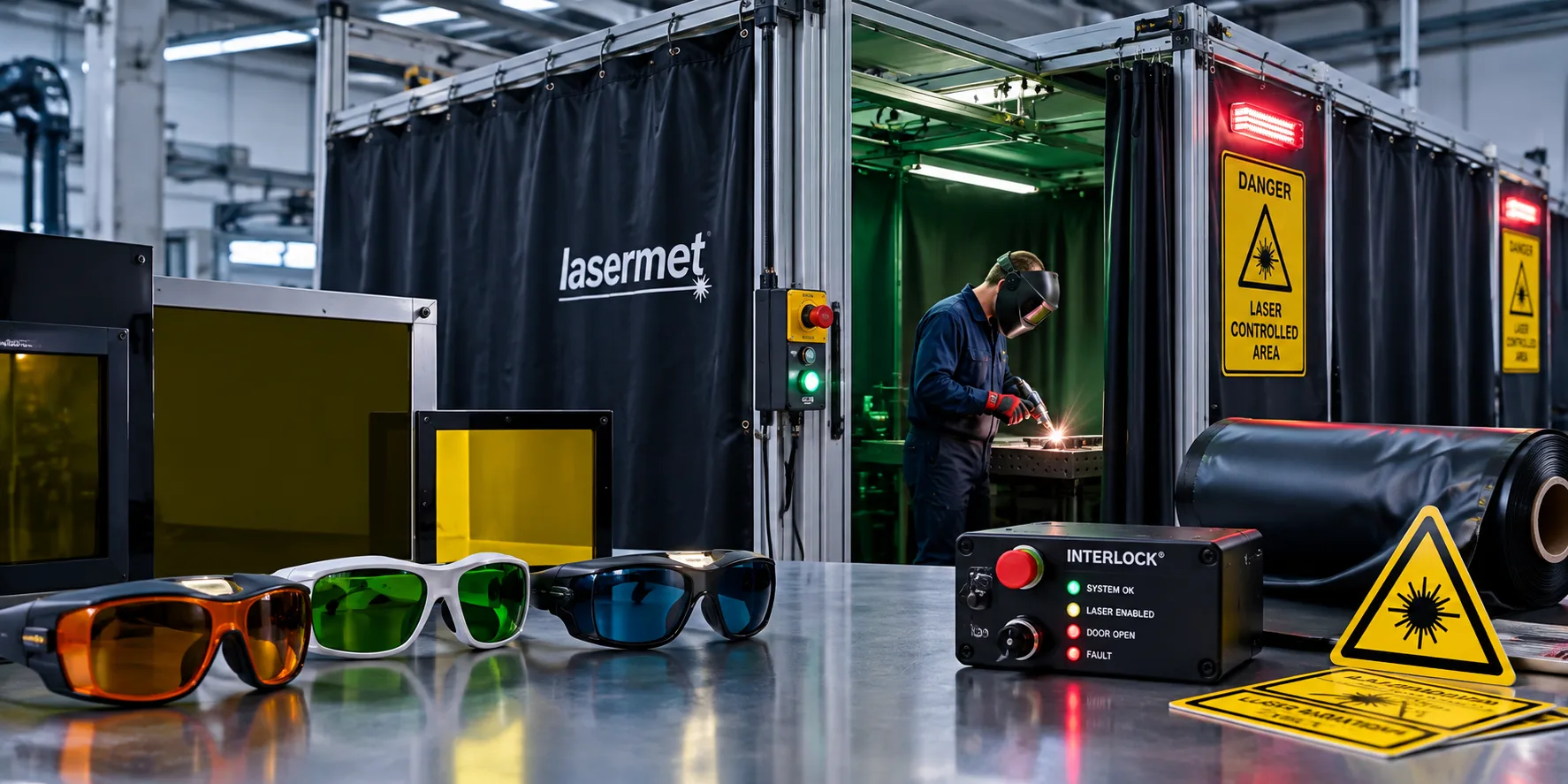
Laser safety involves much more than simply using the correct protective eyewear. A safe laser installation depends on the laser source, machine design, enclosure, interlock system, protective windows, personal protective equipment, work procedures and training working together as one complete safety system.
The protective measures required depend on factors such as laser class, wavelength, power, pulse regime, process and how people may be exposed to laser radiation during normal operation, setup, service and maintenance.
LMI AB works with industrial laser technology and laser safety and offers both safety products, guidance and training in this field.
Why Is Laser Radiation Dangerous?
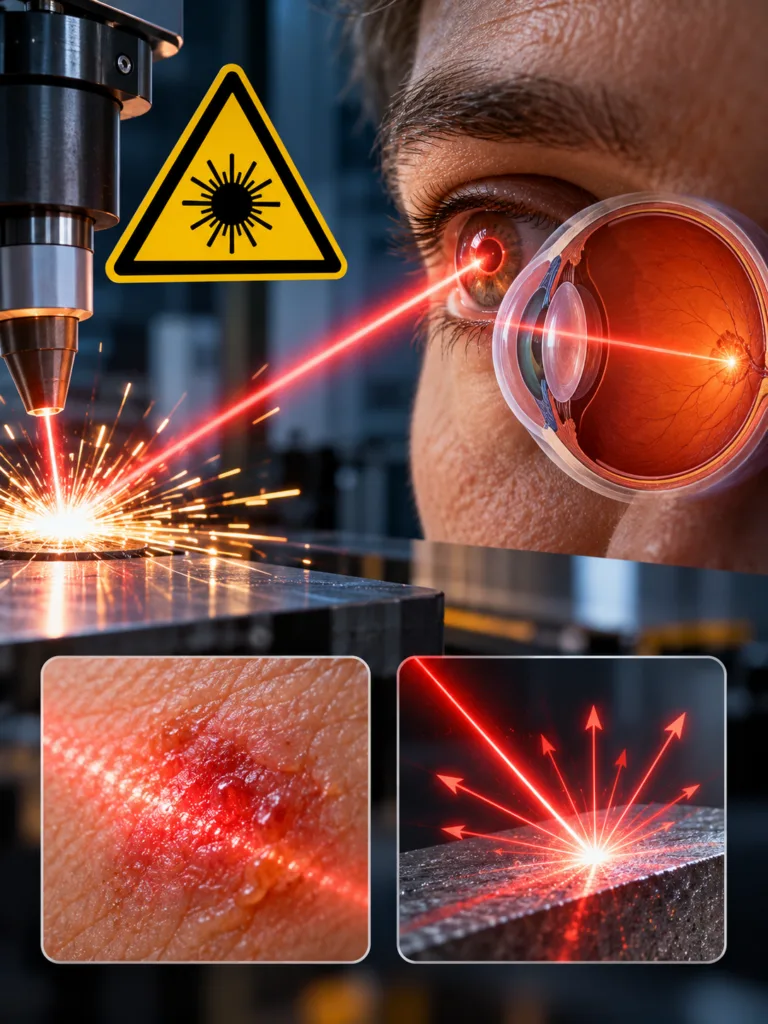
Laser light differs from ordinary light in that the radiation can be highly directional and concentrated. A large amount of energy can therefore be transferred to a very small area.
The eye is particularly sensitive. At certain wavelengths, the optical system of the eye can also focus incoming laser radiation onto the retina, significantly increasing the power density.
At other wavelengths, the radiation is absorbed mainly by the cornea or lens of the eye.
At higher laser powers, the skin can also be injured. Powerful industrial lasers may additionally create risks such as:
- fire
- hot particles and molten material
- smoke and gases from the process
- secondary optical radiation
- direct and reflected laser radiation
- exposure during service and maintenance.
Risk assessment must therefore consider both direct exposure and relevant indirect hazards.
Laser Class and Machine Class Are Not Always the Same
One of the most important concepts in industrial laser safety is the difference between the hazard class of the laser source and the classification of the complete machine during normal operation.
A laser cutting machine may, for example, contain a 20, 40 or 60 kW fiber laser – an extremely powerful Class 4 laser source – while the complete machine may still be safe to operate as a Class 1 laser product because of a correctly designed enclosure, safety switches and interlocks.
This means that the operator is not exposed to hazardous laser radiation as long as the machine is used as intended and the safety systems remain intact.
During service, adjustment or opening of the enclosure, however, the situation can change completely.
Laser Classes – What Do They Mean in Practice?
Laser products are classified according to EN/IEC 60825-1 into Classes 1, 1M, 2, 2M, 3R, 3B and 4. The classification describes the level of risk associated with accessible laser radiation.
| Laser class | General meaning | Typical implication for the user |
| 1 | Safe under intended conditions of use | Normally no personal laser protection required |
| 1M | Safe for the unaided eye but potentially hazardous with optical instruments | Avoid beam-collecting optics |
| 2 | Visible laser; short accidental exposure is normally limited by the natural aversion response | Never deliberately stare into the beam |
| 2M | As Class 2, but greater risk with optical instruments | Avoid beam-collecting optics |
| 3R | Direct radiation may be hazardous | Controlled use and risk assessment required |
| 3B | Direct radiation is hazardous | Controlled laser area, LSO and laser protection where required |
| 4 | Direct and even diffuse reflected radiation may be hazardous; fire risk | Extensive technical and organisational safeguards required |
Personal protective equipment is not determined by laser class alone. The actual exposure and workplace risk assessment must determine which protective measures are required.

Class 1 – Safe During Normal Operation
A Class 1 laser product is safe under reasonably foreseeable conditions of use.
This is particularly important in industry because a Class 1 machine may contain a much more powerful laser source.
A fully enclosed:
- laser cutting machine
- laser welding cell
- laser marking machine
- robotic cell
may therefore be classified as Class 1 even though the internal laser source is Class 4.
What Does Class 1 Mean for the Operator?
During normal operation of a correctly designed and intact Class 1 machine, laser safety glasses, laser safety helmets or special laser-protective clothing are normally not required solely because of the laser radiation.
The operator should, however:
- follow the machine instructions
- never bypass interlocks or safety switches
- ensure doors and access panels are correctly closed
- report damage to enclosures or safety systems
- use any other personal protective equipment required by the process.
Safety footwear, hearing protection or other workplace PPE may therefore still be necessary.
Important During Service
During service, a Class 1 machine may temporarily lose its Class 1 protection.
If an enclosure is opened or a safety system must be bypassed, the underlying Class 3B or Class 4 radiation may become accessible. Such work requires special procedures and competent personnel.
Class 1M – Safe Under Normal Viewing Conditions
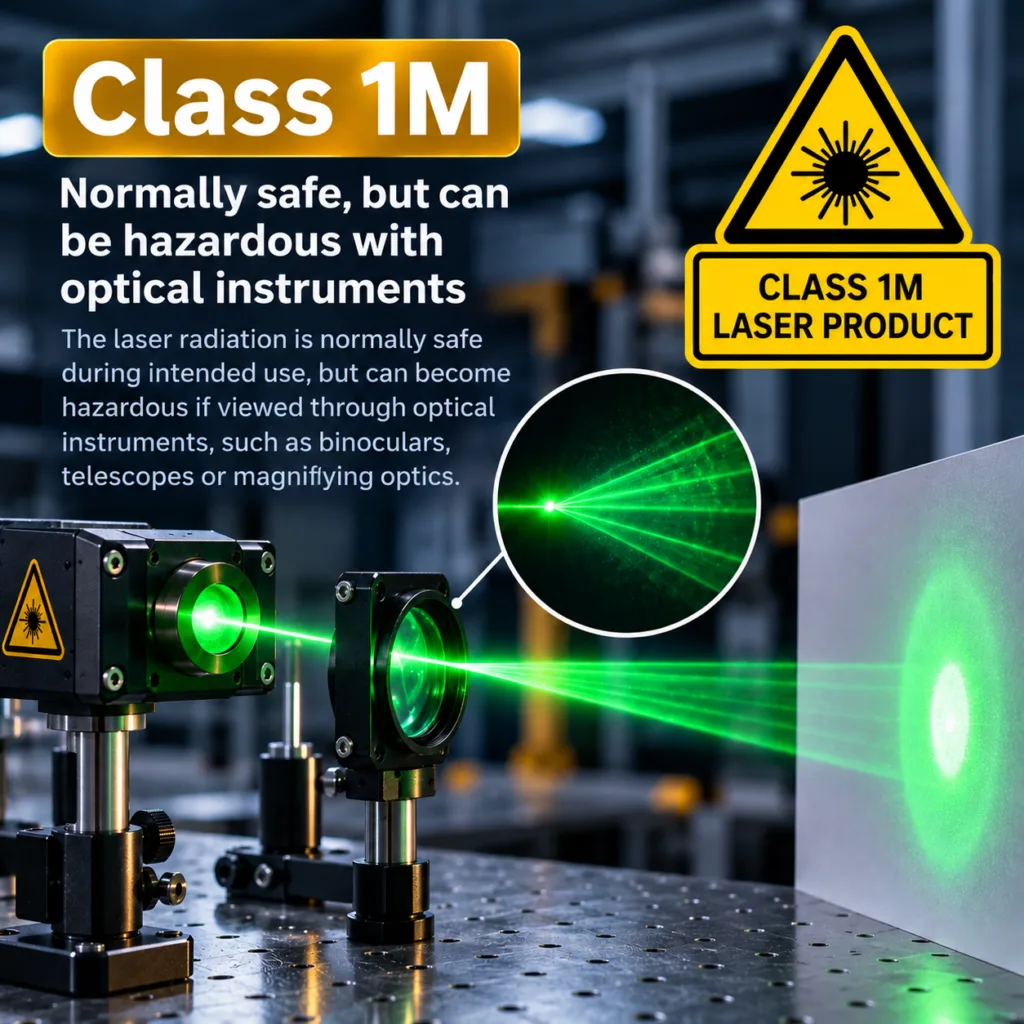
Class 1M means that the radiation is normally safe for the unaided eye but may become hazardous if viewed through optical instruments.
Examples include:
- binoculars
- telescopes
- microscopes
- magnifying optics.
What Does Class 1M Mean for the Operator?
Laser safety glasses are normally not required during intended use.
Optical aids that can collect or focus the laser radiation should not be used to view the beam unless they are specifically included in the safe design of the equipment.etrakta strålen om detta inte uttryckligen ingår i utrustningens säkra användning.
Class 2 – Visible Laser Radiation
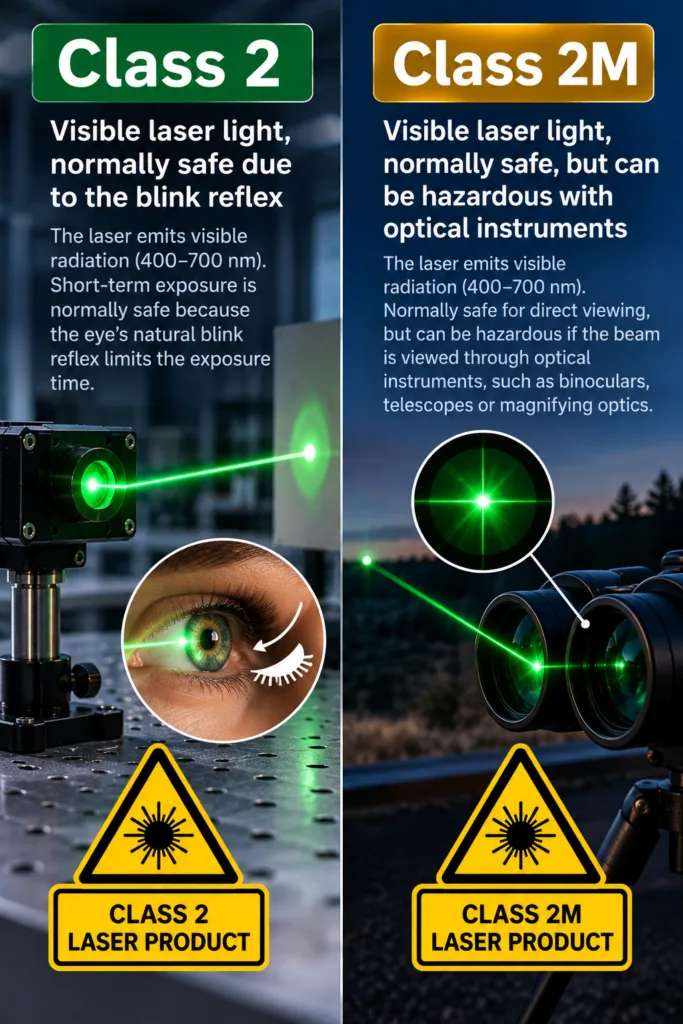
Class 2 covers visible laser radiation where short accidental exposure is normally limited by the natural aversion response of the eye.
This does not mean that it is safe to stare deliberately into the beam.
What Does Class 2 Mean for the Operator?
Laser safety glasses are normally not required for intended use.
The operator should:
- never deliberately stare into the beam
- never direct the beam towards other people
- avoid unnecessary reflections
- follow the equipment instructions.
Class 2M – Visible Laser with Additional Risk from Optical Instruments
Class 2M follows the same principle as Class 2, but the radiation may become significantly more hazardous if viewed through optical instruments.
What Does Class 2M Mean for the Operator?
Laser safety glasses are normally not required during intended use. However, binoculars, telescopes, magnifying optics or other optical devices that could collect laser radiation should not be used to view the beam.
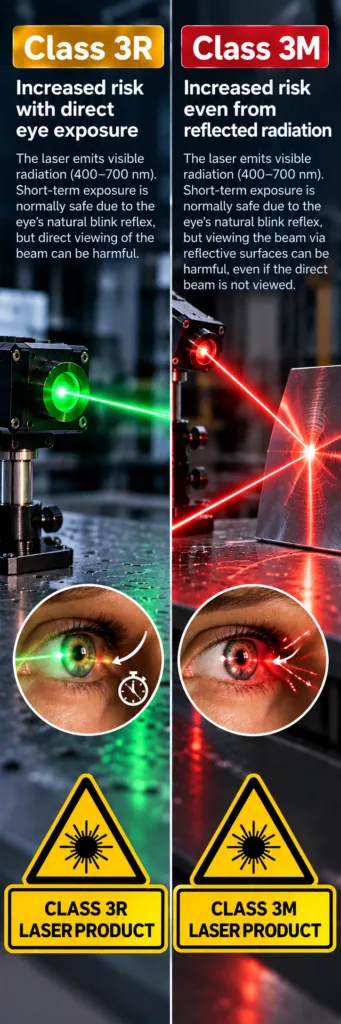
Class 3R – Limited but Real Risk
Class 3R represents a higher risk level. Direct exposure to the eye can be hazardous, although the risk is lower than for Class 3B.
What Does Class 3R Mean for the Operator?
The workplace and the use of the equipment should be risk assessed.
Direct eye exposure must be avoided and the beam should not be directed towards people.
Laser safety glasses are not automatically required solely because the equipment is Class 3R, but they may be necessary if the risk assessment shows that exposure could occur.
If protective eyewear is required, it must be selected for the specific:
- wavelength
- laser type
- exposure
- required protection level.
Class 3B – Direct Radiation Is Hazardous
Class 3B laser radiation can cause eye injury through direct exposure and may, depending on the characteristics of the laser, also present a risk to the skin.
Diffuse reflection is normally not the dominant risk in the same way as for Class 4.
This class requires significantly greater control of the workplace.
What Does Class 3B Mean for the Organisation?
The employer needs to ensure, among other things, that:
- a controlled hazard area is defined
- unauthorised access is restricted
- appropriate warning signs are installed
- the beam path is enclosed or screened where possible
- safe working procedures are established
- personnel have the necessary knowledge and training
- required personal protective equipment is available.
For Class 3B and Class 4, Swedish workplace regulations also require the employer to appoint a person responsible for overseeing laser safety.
This role is commonly referred to as:
LSO – Laser Safety Officer
What Does Class 3B Mean for the Operator?
If there is a risk that the eye may be exposed to laser radiation, suitable laser safety glasses must be used.
Depending on the actual process, the following may also be required:
- skin-covering clothing
- protective gloves
- face or head protection
- other process-related personal protective equipment.
The exact equipment required must be determined through the risk assessment. A laser safety helmet is therefore not automatically required for all Class 3B applications.
Class 4 – The Highest Risk Class
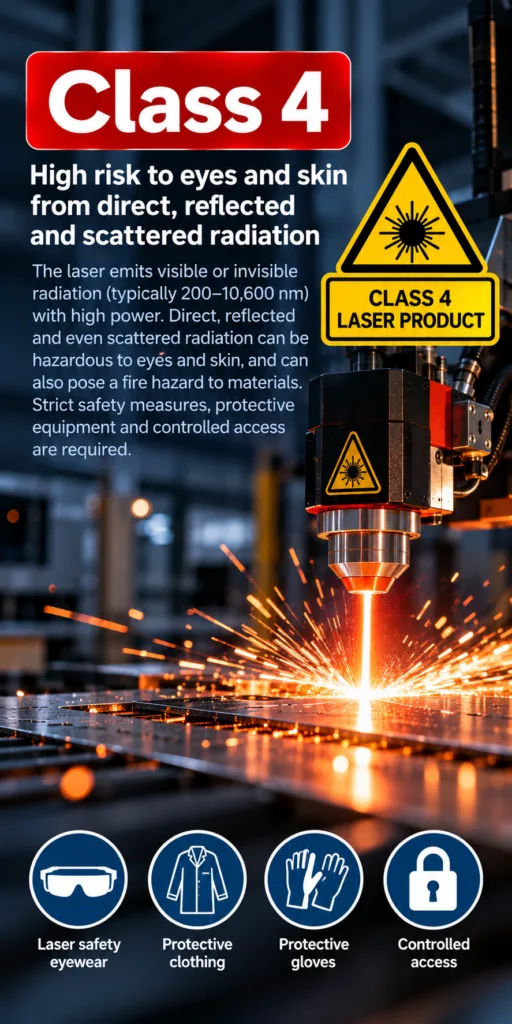
Class 4 covers lasers presenting the highest level of risk.
With Class 4:
- direct laser radiation can be hazardous
- specular reflections can be hazardous
- diffuse reflected radiation can be hazardous
- skin injury can occur
- materials can ignite.
This means that fire risk must also be considered.
Many industrial fiber lasers used for cutting, welding and cleaning are inherently Class 4.
Class 4 Does Not Automatically Mean the Operator Is Exposed
Again, it is important to distinguish between the laser source and the complete machine.
A Class 4 laser source can be completely enclosed inside a Class 1 machine.
In such an installation, the operator normally does not need personal laser protective equipment during standard production.
When Class 4 Radiation Is Accessible
If the radiation is accessible – for example during:
- open laser processing
- handheld laser welding
- development work
- installation
- adjustment
- service
– significantly more extensive safety measures are required.
These may include:
- laser-blocking enclosure
- laser safety curtains
- interlocks
- safety switches
- controlled hazard area
- laser safety windows
- warning systems
- laser safety glasses
- face or head protection
- protective clothing and gloves
- special work procedures.
The exact level of protection must be determined by risk assessment.
LSO – Laser Safety Officer
At workplaces where Class 3B or Class 4 lasers are used, the employer must appoint a person to oversee laser safety.
This function is commonly referred to as LSO – Laser Safety Officer.
The LSO can be an important part of the organisation’s systematic laser safety work and needs to understand areas including:
- laser classification
- biological hazards
- hazard zones
- reflections
- personal protective equipment
- enclosure and screening
- interlocks
- warning signs
- working procedures
- service and maintenance situations
- relevant regulations.
LMI AB provides training in laser safety and LSO – Laser Safety Officer.
Technical Safeguards Should Come First
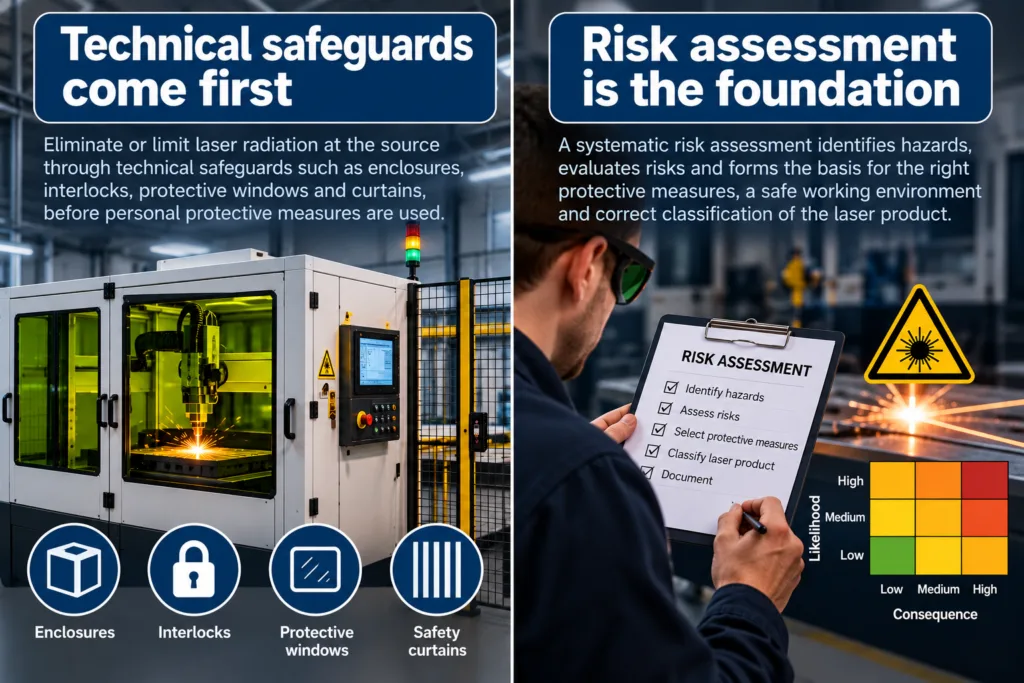
A fundamental principle of laser safety is that risks should primarily be eliminated or reduced through design and technical safeguards.
It is generally safer to prevent hazardous laser radiation from leaving a machine or laser area than to rely solely on personal protective equipment.
Examples of technical safeguards include:
- complete enclosures
- barriers
- laser-blocking curtains
- interlocks
- shutters
- beam stops
- safety switches
- laser-safe observation windows.
Personal protective equipment then provides additional protection where the risks cannot be reduced sufficiently by other means.
Risk Assessment Is the Foundation
Laser class or laser power alone is not enough to determine the required safety solution.
The risk assessment should consider factors including:
- wavelength
- output power
- pulse energy
- pulse duration
- beam profile
- direct radiation
- specular reflections
- diffuse reflections
- optical components
- working distance
- material
- process
- working method
- possible faults or abnormal conditions
- service and maintenance
- people who may be present in or near the hazard area.
Laser processing may also create indirect hazards such as fire, smoke and gas formation.
Handheld Laser Welding Requires Special Attention
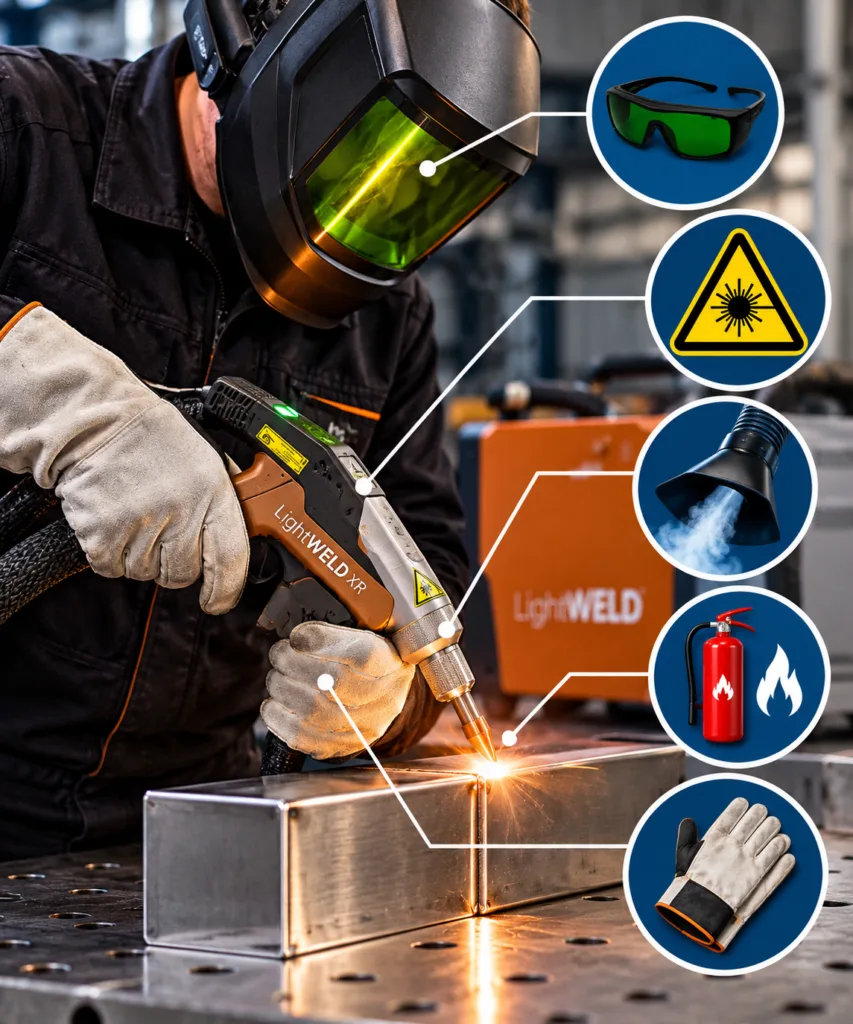
Handheld laser welding differs from a fully enclosed machine because the operator manually controls the laser head.
This means that the direction of the beam changes during operation and both direct radiation and reflections must be considered very carefully.
A workplace for handheld laser welding may, for example, require:
- full or partial laser-blocking enclosure
- laser safety curtains
- interlocked doors
- laser-safe observation windows
- warning systems
- controlled access
- correctly selected laser safety glasses
- laser-safe face or head protection
- skin-covering flame-resistant clothing
- appropriate gloves
- extraction for welding fumes
- fire protection
- trained personnel and clear work procedures.
The exact personal protective equipment required depends on the equipment, wavelength, power, process and risk assessment.
A conventional welding helmet should not automatically be considered laser protection unless it is specifically rated for the relevant laser exposure.n inte är specificerad för den aktuella laserexponeringen..
Laser Safety During Service and Maintenance
Service deserves particular attention.
A machine that normally operates as Class 1 may need to be opened for:
- troubleshooting
- optical alignment
- fiber replacement
- laser head service
- process adjustment
- inspection of the laser beam.
When the enclosure is opened, completely different hazards may arise compared with normal production.
Service work must therefore be carried out according to dedicated procedures and by personnel with the correct competence and authorisation.
This is another clear example of why laser classification cannot be considered separately from the actual working situation.
Laser Safety Products
LMI AB offers a broad range of products for safe laser workplaces and industrial laser installations.
The products required depend on the actual laser process and risk assessment.
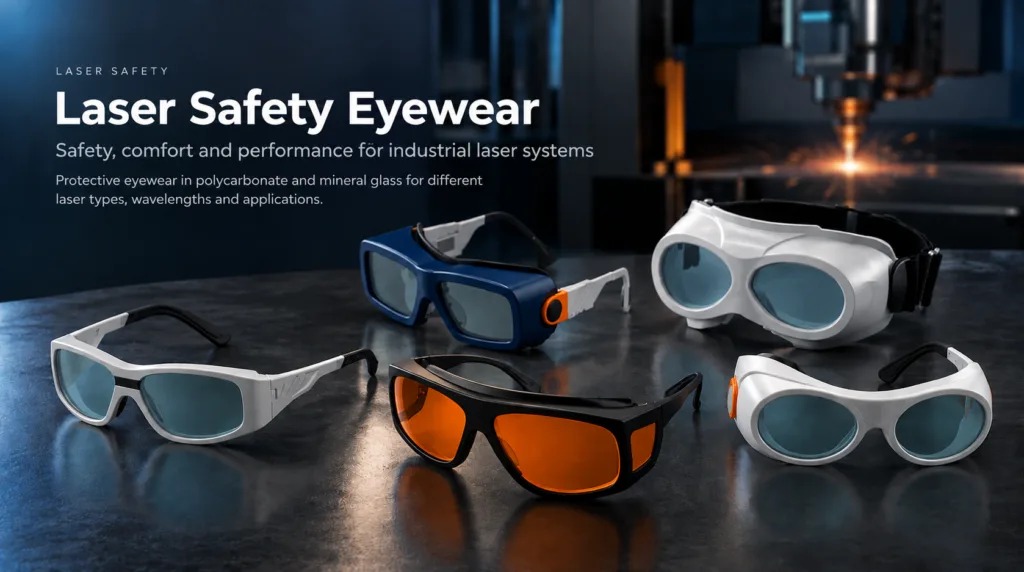
Laser Safety Glasses
Laser safety glasses must be selected for the specific laser’s:
- wavelength
- power and exposure
- required attenuation
- application.
One pair of laser safety glasses is therefore not universally suitable for all lasers.
LMI AB supplies:
- laser safety glasses with polycarbonate filters
- laser safety glasses with glass filters
The correct choice depends on factors such as required protection level, wavelength, visible light transmission, comfort and working conditions.
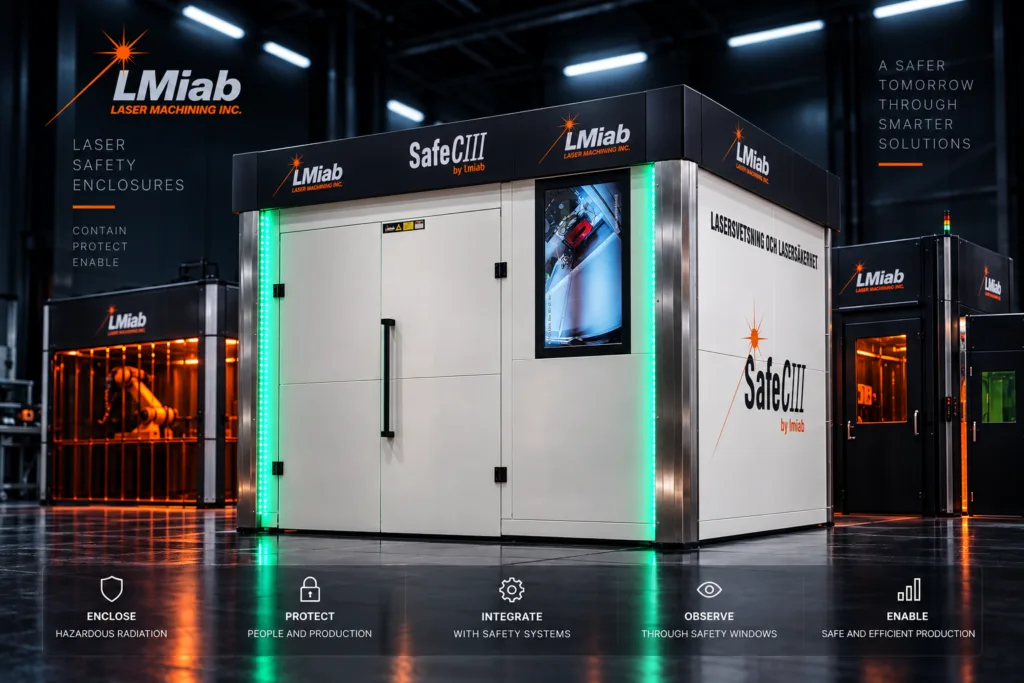
Laser Safety Enclosures
A correctly designed enclosure prevents laser radiation from leaving the defined laser area.
Enclosures are therefore one of the most important technical safety measures in industrial laser processing.
LMI AB supplies several solutions from Lasermet:
Dolphin Pod Lite
Lightweight and flexible enclosure for applications including handheld laser processes.
Dolphin Laser Safety Curtain Pod
Modular enclosure based on laser-blocking curtain material.
XXXL Dolphin Laser Safety Cell
Larger modular safety cell for applications requiring more working space.
Laser Castle
Modular enclosure system for industrial laser installations.
Laser Castle Lite
Compact modular enclosure system for smaller laser installations and robot cells.
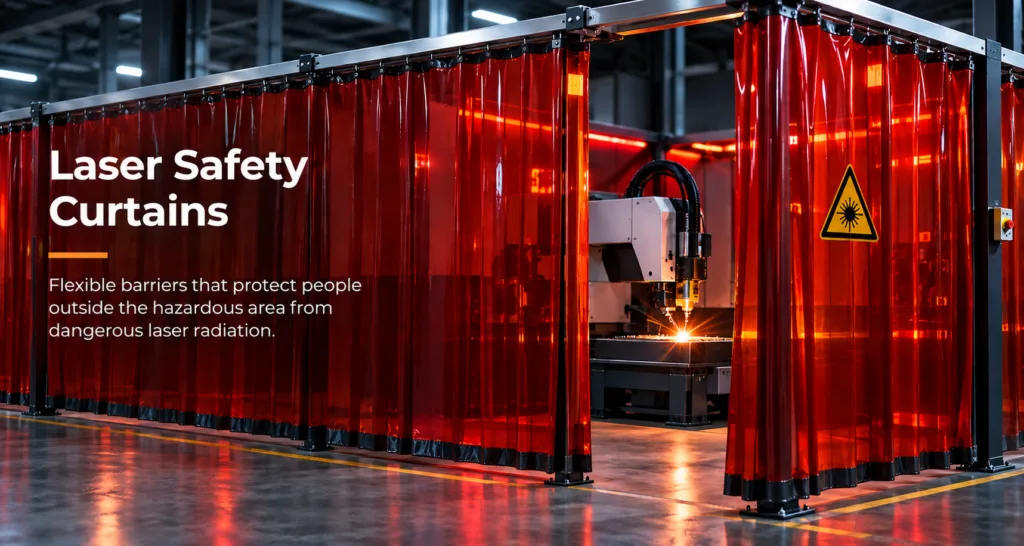
Laser Safety Curtains
Laser-blocking curtains can be used to define and protect laser areas where a fixed wall or complete enclosure is not the most suitable solution.
Typical applications include:
- handheld laser welding
- temporary laser work areas
- laboratories
- robot cells
- service areas.
LMI AB supplies Dolphin Laser Blocking Curtains from Lasermet.
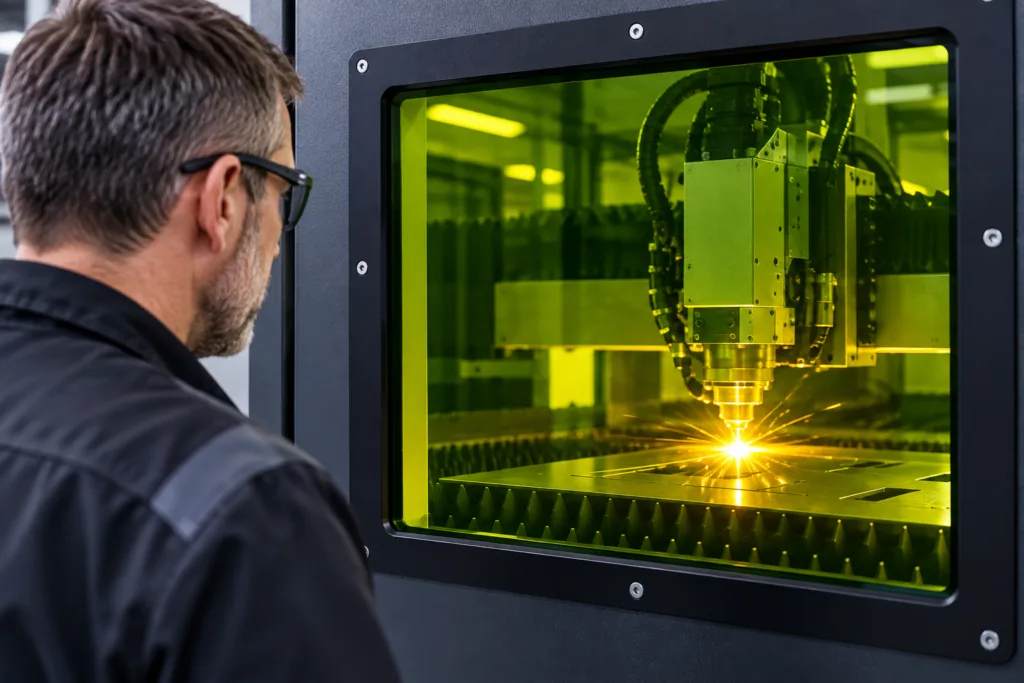
Laser Safety Windows
A laser safety window allows the process to be observed without opening the enclosure.
The filter must be selected for the specific laser wavelength and required protection level.
Colour or transparency alone does not indicate whether a window provides adequate laser protection.
LMI AB supplies Laser Filter Windows for different laser applications.
Interlock Systems
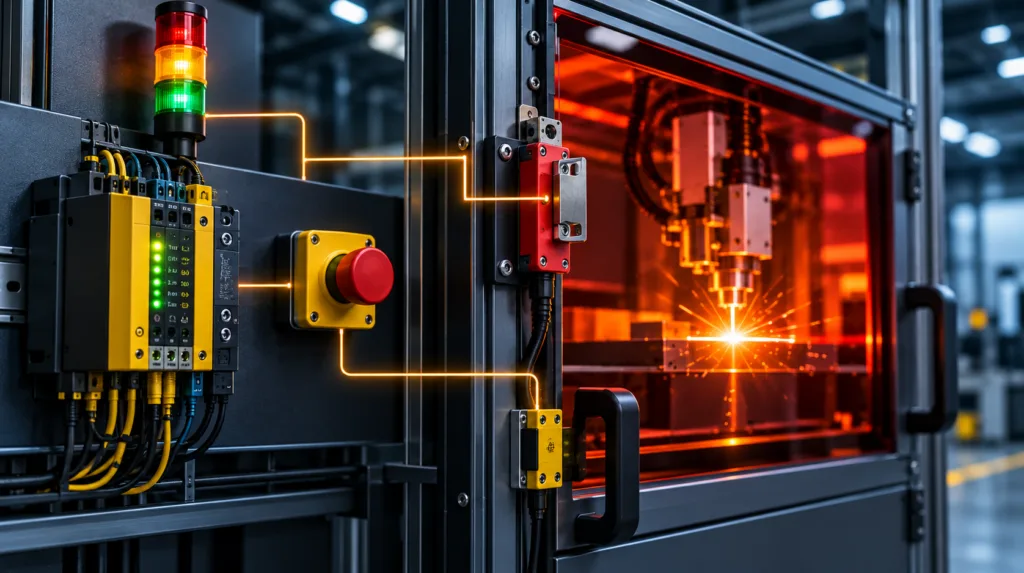
Interlocks connect laser operation with the safety functions surrounding the workplace.
An interlock system can, for example, monitor:
- doors
- access panels
- emergency stops
- shutters
- warning lights
- illuminated warning signs
- other access points.
If a safety door is opened, the system can prevent or stop hazardous laser emission.
LMI AB supplies systems including:
- Lasermet ICS-6 ELISe
- Lasermet ICS-9 Laser Safety Interlock Controller
- Lasermet ICS Solo
- Lasermet ICS-LLDC
Laser Safety Signs and Warning Systems
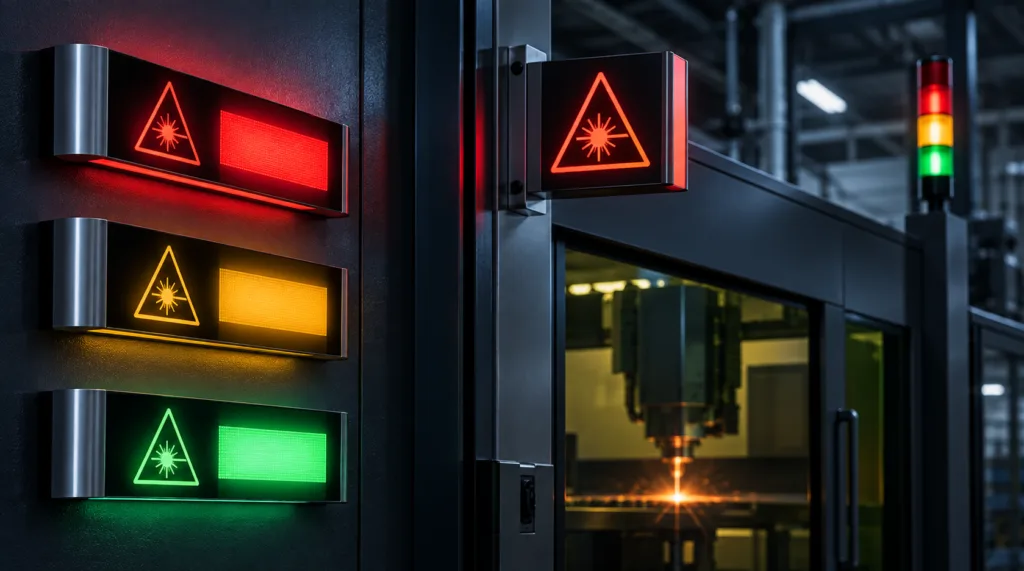
Clear warning information is an important part of a safe laser installation.
Signs can indicate:
- laser class
- type of laser
- hazard area
- access restrictions
- when the laser is active.
Illuminated warning signs can also be connected to the interlock system so that the current status of the workplace is shown automatically.
Laser Safety Blinds
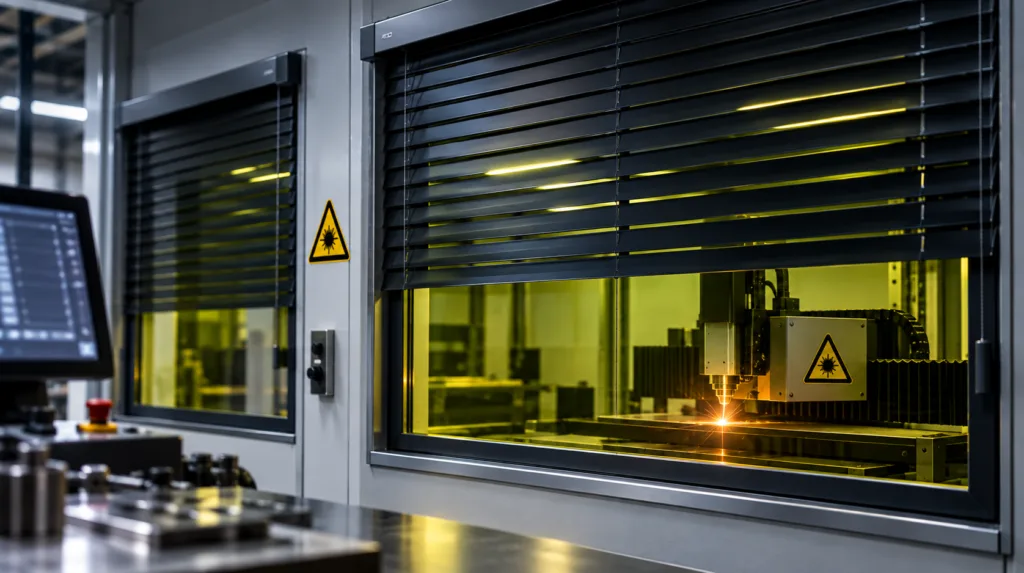
Laser safety blinds are used where windows or other openings need to be blocked during laser operation.
They are particularly useful in rooms where normal use of the windows should be retained when the laser equipment is not operating.
Laser Warning Labels
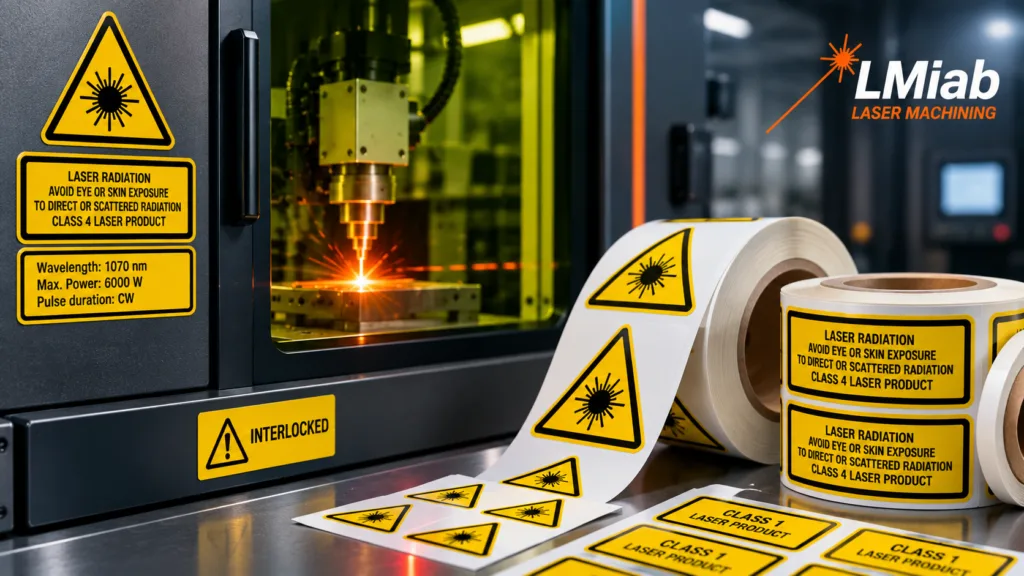
Laser equipment requires clear and correct identification.
LMI AB can provide customised:
- warning labels
- laser class labels
- machine labels
- other safety labels
through in-house development in cooperation with Swedeprint.
This makes it possible to tailor labelling to the individual machine and installation.
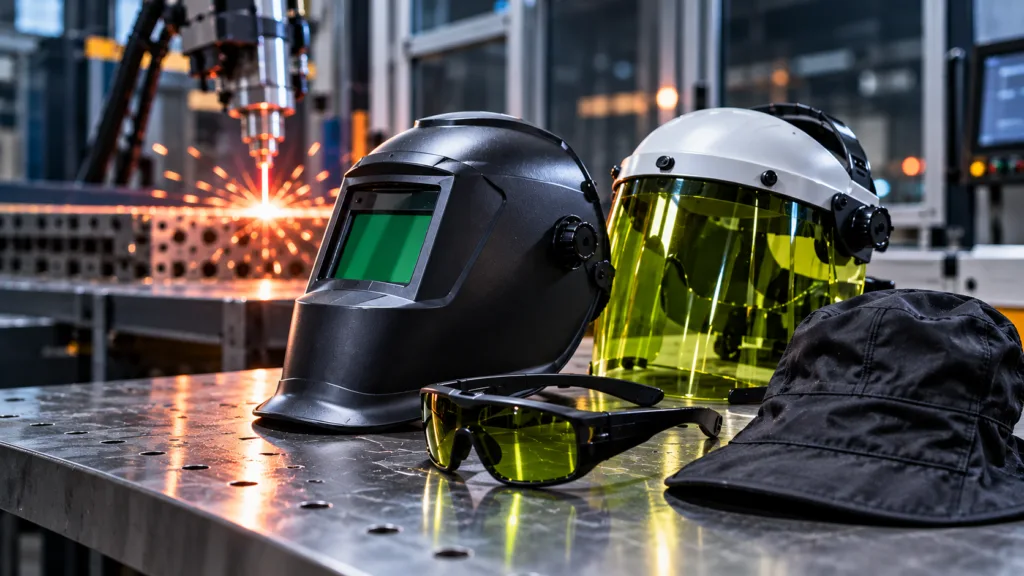
Welding Helmets and Face Protection for Laser Welding
Handheld laser welding in particular may require protection of the eyes, face and skin.
It is important to distinguish between conventional welding PPE and equipment specifically designed for laser exposure.
Suitable face or head protection must be rated for the relevant laser and process.
LMI AB can help identify suitable personal protective equipment for laser welding.
Laser Safety Is a System Issue
No single safety product automatically makes a laser installation safe.
A safe workplace may, for example, consist of:
Class 4 laser source → enclosure → interlocked doors → laser-safe observation window → warning system → defined work procedures → trained personnel
Another installation may require a completely different solution.
The safety concept must therefore be based on the real process and the risk assessment.
Standards for Industrial Laser Safety
Several standards are central to the field.
EN/IEC 60825-1
Covers the classification and safety requirements for laser products and forms the basis for laser Classes 1 to 4.
ISO 11553-1
ISO 11553-1:2020 – Safety of machinery – Laser processing machines – Part 1: Laser safety requirements
This standard covers safety requirements for laser processing machines.
ISO 11553-2
ISO 11553-2:2026 – Safety requirements for hand-held or hand-operated laser processing machines
This standard specifically addresses handheld and hand-operated laser processing machines. The exact standards that apply must always be assessed for the specific product and installation.

Laser Safety in Swedish Workplaces
Swedish workplace rules concerning artificial optical radiation are included in AFS 2023:10, Risks in the Work Environment, where Chapter 12 covers artificial optical radiation.
The employer is responsible for assessing risks and implementing the necessary measures.
For Class 3B and 4 lasers, specific requirements apply, including:
- a designated person responsible for laser safety
- definition of the hazard area
- access restrictions
- labelling and warning signs
- protection against hazardous exposure
- information and competence.
In practice, this is where the LSO – Laser Safety Officer plays a central role.
Laser Safety Training
Technical safeguards are essential, but they only work if the people using the equipment understand how the system must be operated.
Operators, service personnel, supervisors and LSOs may therefore require different levels of training.
LMI AB provides training in areas including:
- basic laser safety
- hazards associated with industrial laser systems
- laser classes
- personal protective equipment
- safe operation
- LSO – Laser Safety Officer
Do You Need Help with Laser Safety?
Do you need safety equipment for a new laser installation, want to improve safety around an existing machine, or need help identifying the correct protection?
LMI AB can help with everything from individual safety components to more complete solutions involving:
- laser safety glasses
- enclosures
- curtains
- safety windows
- interlock systems
- warning systems
- signs and labels
- personal protective equipment
- training.
Contact LMI AB and we will help you find a suitable safety solution for your laser installation.
Frequently Asked Questions About Laser Safety
Normally not during standard operation of a correctly designed and intact Class 1 machine. However, if the machine is opened for service or safety functions are disabled, the underlying hazardous laser radiation may become accessible.
The laser source and accessible free beam are typically associated with Class 4 hazards, but a correctly designed and fully enclosed complete machine may be classified as Class 1 during normal operation.
At Swedish workplaces where Class 3B or Class 4 lasers are used, the employer must appoint a person to oversee laser safety. This role is commonly referred to as LSO – Laser Safety Officer.
No. Personal protective equipment does not replace technical safeguards such as enclosures, barriers and interlocks. The required measures must be determined by risk assessment.
Not automatically. The protection must be rated for the actual laser radiation and process. Conventional welding protection and laser protection are not the same thing.Inte automatiskt. Skyddet måste vara specificerat för den aktuella laserstrålningen och processen. Traditionellt svetsskydd och laserskydd är inte samma sak.
This should never be assumed. Laser safety windows must be designed for the relevant wavelength and required protection level.
Selection depends on factors including wavelength, output power or pulse parameters, possible exposure and required protection level. Protective eyewear must be selected for the actual laser and risk assessment, not simply according to filter colour.
An interlock system connects laser operation with safety functions such as doors, access panels, shutters and emergency stops. If a safety function is interrupted, the system can prevent hazardous laser radiation from being emitted.

Contact LMI AB about Laser Safety
Are you planning a new laser installation or would you like to review the laser safety of an existing production environment?
LMI AB helps you assess the risks and identify appropriate protective measures based on the laser type, wavelength, power, process and working environment. This may include protective enclosures, interlock systems, laser safety windows, curtains, warning systems and personal protective equipment.
Contact Urban Gärds for advice on laser safety and laser safety products.
Urban Gärds
Contact Person for Laser Safety